
A2 June 2019 Q7
7. Aisha is deciding whether or not to play a game.
The game involves rolling three fair six-sided dice, which have faces numbered from 1 to 6
If the total score on the three dice is 16 or more then she wins a prize. If the total score is 15 or less then she loses and will have to pay the person running the game £3
The utility function of the game to Aisha is \(\mathrm{u}(m) = 1 - \mathrm{e}^{-\frac{m}{500}}\) where \(m\) is the amount of money that Aisha has available. Given that Aisha has exactly £3 and that the prize is now £\(x\)
Aisha decides to use the expected utilities to determine whether she should play the game or not.
| Scheme | Marks | AO |
|---|---|---|
(i)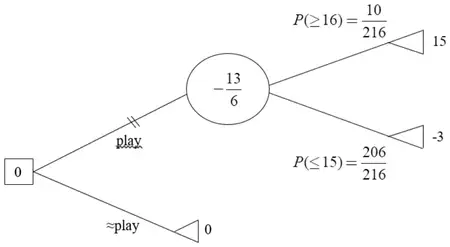 | 1M1 1B1 1A1 2M1 2A1 | 3.3 1.1b 1.1b 3.4 1.1b |
| (ii) Optimum EMV is (£)0 and Aisha should not play the game | 1B1ft | 3.2a |
| (6) |
Notes
(a)(i) 1M1: tree diagram with at least three end pay-offs, one (rectangular) decision node and one (circular) chance node
1B1: Correct probability for rolling 16 or more (accept equivalent fractions)
1A1: Correct structure of tree diagram with each arc labelled correctly. The following must be seen for this mark:
- Probabilities on branches leading from chance node. Probabilities may not be correct but must sum to 1
- ‘Play’ and ‘Not Play’ (o.e.) labelled correctly. (If one branch is labelled correctly then condone lack of label on the other branch).
- Pay offs: 15, –3, 0 placed at tree ends (do not condone ‘3’ for ‘–3’)
2M1: Correct chance node. ft from their probabilities: \(15p - 3(1 - p)\) where \(p\) is their probability for rolling 16 or more. If given as a decimal allow for correct (or truncated) to 2dp
2A1: CAO (must be exact) for chance and decision node including double line through inferior option
Note must see 0 at the decision node for this mark.
(ii) 1B1ft: correct optimal EMV (clearly indicated) and analysis in context.
So: If their EMV for playing game < 0 then ‘Optimum EMV = 0, together with corresponding conclusion: ‘Aisha should not play’ o.e. would earn B1.
Whereas, if their EMV for playing game > 0 then ‘Optimum EMV = their EMV of playing game’ together with corresponding conclusion: ‘Aisha should play’ o.e. would earn B1. (Corrected from the printed mark scheme, which has ‘should play’ and ‘should not play’ the wrong way round in these two sentences.)
BUT If their EMV for playing game does not ft from their probabilities then B0.
| Scheme | Marks | AO |
|---|---|---|
| Expected utility is \(\dfrac{10}{216}\left(1 - \mathrm{e}^{-\frac{(x+3)}{500}}\right)\) | 1M1 1A1 | 3.4 2.2a |
| (2) |
Notes
1M1: \(p\left(1 - \mathrm{e}^{-\frac{(x+3)}{500}}\right)\) with their \(p\) from (a)
Note: isw after a correct expression for M mark. May see:
\(p\left(1 - \mathrm{e}^{-\frac{(x+3)}{500}}\right) + (1 - p)\left(1 - \mathrm{e}^{-\frac{(-3+3)}{500}}\right)\) o.e.
1A1: CAO for expected utility. Must be of the correct form as is specified in the question. So: \(\dfrac{10}{216}\left(1 - \mathrm{e}^{-\frac{(x+3)}{500}}\right)\) but allow fractions equivalent to \(\dfrac{10}{216}\)
| Scheme | Marks | AO |
|---|---|---|
| If Aisha doesn’t play she will have \(3 \Rightarrow 1 - \mathrm{e}^{-\frac{3}{500}}\) | 1B1 | 3.1a |
| For the prize to be worthwhile \(\dfrac{10}{216}\left(1 - \mathrm{e}^{-\frac{(x+3)}{500}}\right) > 1 - \mathrm{e}^{-\frac{3}{500}}\) | 1M1 | 1.1b |
| Correct order of operations and use of logs to find \(x\) | 2dM1 | 1.1b |
| \(x > 66.178\ldots\) so (minimum prize amount should be) £66.18 | 1A1 | 3.2a |
| (4) | ||
| (12 marks) |
Notes
1B1: CAO. May be in decimal form: 0.00598…. May be embedded in inequality/equation.
Note: Look out for missing minus sign in the power if stated exactly.
Note: Do not award this mark if seen in only part (b).
1M1: Sets up an inequality or equation with their expected utility of playing the game (from part b).
2dM1: Solving for \(x\) (dependent on previous M mark). Requires correct order of operations and log work.
For example,
May see: \(\mathrm{e}^{-\frac{(x+3)}{500}} \ \square\ 1 - \text{‘}p\text{’}\left(1 - \mathrm{e}^{-\frac{(3)}{500}}\right)\) o.e. [Isolates exponential term]
Or \(\mathrm{e}^{-\frac{(x+3)}{500}} \ \square\ 0.870\ldots\)
Followed by: \(\dfrac{(x+3)}{500} \ \square\ -\ln\left(1 - \text{‘}p\text{’}\left(1 - \mathrm{e}^{-\frac{(3)}{500}}\right)\right)\) o.e. [Applies logs correctly]
Or \(\dfrac{(x+3)}{500} \ \square\ 0.138\ldots\)
Where \(\square\) is any inequality or equals sign.
Note: May not get to \(x = \ldots\)
Note: Can be implied by correct answer
1A1: CAO with units
Note: For this mark, condone ‘£66.18’ or ‘\(x =\) £66.18’ or ‘\(x \geqslant\) £66.18’, but not ‘\(x >\) £66.18’.