
Higher November 2016 Unit 2 Q18
18. A 9-pointed star, with centre \(O\), is shown below.
Each side of the star is of length \(x\) cm.
The distance from the centre to every inner vertex of the star is 7 cm.
The distance from the centre to every outer vertex of the star is 10 cm.
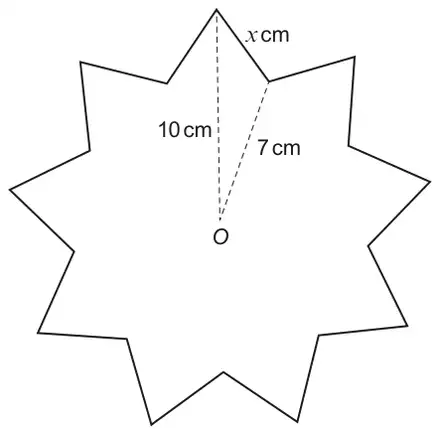
Diagram not drawn to scale
From the formula list: In any triangle \(ABC\): Cosine rule \(a^2 = b^2 + c^2 - 2bc\cos A\); Area of triangle \(= \dfrac{1}{2}ab\sin C\)
(a) Calculate the perimeter of the star. [5]
(b) Calculate the area of the star. [3]
| Scheme | Marks | Comments |
|---|---|---|
| Sight of (360/18=) 20° | B1 | May be seen in 18(a) or 18(b). |
| \(x^2 = 10^2 + 7^2 - 2 \times 10 \times 7 \times \cos 20^\circ\) | M1 | FT 'their 20°' |
| \(x\) = 4.17(6...) or \(x\) = 4.2 or \(x\) = 4.18 | A2 | A1 for \(x^2\) = 17.4(43…) |
| Perimeter = 75(.17… cm) | B1 | FT 18\(x\) provided B1 and M1 awarded |
| Scheme | Marks | Comments |
|---|---|---|
| ½ × 10 × 7 × sin20° | M1 | FT their angle from (a) |
| = 11.97(07…cm²) OR 12(cm²) | A1 | |
| (Area of star) = 215(.47… cm²) | A1 | FT 18 × 'their 11.97…' |
Alternative method (Area of a kite)
Calculating shorter diagonal of the kite by using either:
2×7×sin20°
or (cosine rule) √(7² + 7² – 2×7×7×cos40°)
= 4.78(828…cm)
| Scheme | Marks | Comments |
|---|---|---|
| Area of the kite: ½ ×10×4.78(828…) | M1, | FT ‘their 4.78…’, provided there is evidence the shorter diagonal has been calculated correctly, e.g. using the 2 methods above. |
| =23.94(141….) | A1 | |
| (Area of star)= 215(.47…. cm2) | A1 |
Corrected by Westie's Workshop
- The board's mark scheme printed “= 4.78(828…cm²)”. Changed to “= 4.78(828…cm)” because the shorter diagonal is a length, so its unit is cm, not cm².
Original: see the board's mark scheme PDF (link above).