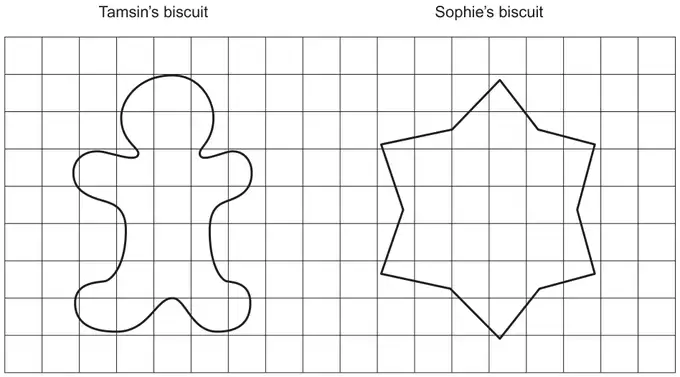
Tamsin and Sophie make biscuits. They plan to cover the top surface of each biscuit with the same thickness of chocolate.
The biscuits are shown on the centimetre squared grid below.
Tamsin thinks that Sophie’s biscuit will need more chocolate to cover it. Estimate the area of each biscuit. Decide whether or not Tamsin is correct. Show all your working. [3]
(b) Tamsin and Sophie have carried out a survey to find which biscuits are the most popular. The four most popular biscuits are chocolate cookies, custard creams, jammy dodgers and digestives. Design a tally chart that Tamsin and Sophie could have used to collect their data and show their results. [3]
(c) Tomas makes rectangular biscuits. The top of each biscuit has a surface area of 30 cm2. Tomas covers the surface area of the top of each biscuit with chocolate. The chocolate costs 3 pence per 10 cm2. Calculate the cost of covering 200 of these biscuits with chocolate. [3]
Mark scheme (a)
Scheme
Marks
Comments
Evidence of counting area in either biscuit
M1
Look at diagram
Area of Tamsin’s biscuit in range 17 – 25 (cm2) AND Area of Sophie’s biscuit in range 22 – 27 (cm2) AND conclusion given (yes). The conclusion must be consistent with their area values within the ranges given
A2
Award A1 for either area in the range.
One correct area implies M1
Allow ‘no’ if areas are within the ranges given and Tamsin’s area is greater than or equal to Sophie’s
A2 cannot be awarded unless a conclusion is given.
Mark scheme (b)
Scheme
Marks
Comments
Table set up with rows or columns:
• with all 4 biscuits listed correctly.
B1
Accept other biscuits also listed and/or use of “other”. Accept abbreviations.
• Labelled with tallies
B1
Accept tallies drawn
• Labelled with frequency or equivalent as a heading
B1
Accept total or number of people for frequency
Mark scheme (c)
Scheme
Marks
Comments
3 × 3 × 200 or 30 ÷ 10 × 200 × 3
M2
Award M1 for sight of 3 × 3 or 9 (cost of 1 biscuit) or 3 × 200 or 600 (pence per 10 cm2 across 200 biscuits) or 30 × 200 or 6000 (total surface area)
1800(p) or (£)18(.00)
A1
CAO Allow A1 for £18.00p Award A0 for £1800 or 18p or 18.00p
Watch for a method of 3 × 30 × 200 or 3 × 30 = 90 and then 90 × 200 = (£)180 or 18000(p). This would gain M1 only
The answer must come from a correct method not from a place value error e.g. 18000p = £18
We'd like to use Google Analytics cookies to count visits and see which pages help most. They're optional, and the site works exactly the same either way. Privacy policy