
M1 June 2018 Q7
7.
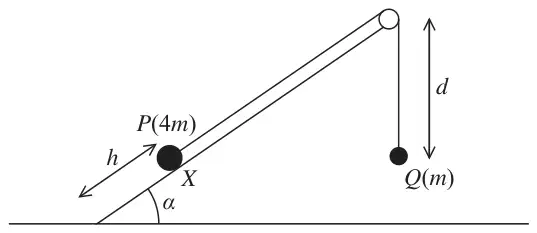
A particle \(P\) of mass \(4m\) is held at rest at the point \(X\) on the surface of a rough inclined plane which is fixed to horizontal ground. The point \(X\) is a distance \(h\) from the bottom of the inclined plane. The plane is inclined to the horizontal at an angle \(\alpha\) where \(\tan\alpha = \dfrac{3}{4}\). The coefficient of friction between \(P\) and the plane is \(\dfrac{1}{4}\). The particle \(P\) is attached to one end of a light inextensible string. The string passes over a small smooth pulley which is fixed at the top of the plane. The other end of the string is attached to a particle \(Q\) of mass \(m\) which hangs freely at a distance \(d\), where \(d > h\), below the pulley, as shown in Figure 4.
The string lies in a vertical plane through a line of greatest slope of the inclined plane. The system is released from rest with the string taut and \(P\) moves down the plane.
For the motion of the particles before \(P\) hits the ground,
When \(P\) hits the ground, it immediately comes to rest. Given that \(Q\) comes to instantaneous rest before reaching the pulley,
| Scheme | Marks |
|---|---|
| Inextensible string | B1 |
| (1) |
Notes
B1 for inextensible (and taut) string; B0 if any extras given or if an incorrect consequence of the inextensiblity of the string is given.
| Scheme | Marks |
|---|---|
| \(4mg\sin\alpha - T - F = 4ma\) | M1 A2 |
| \(T - mg = ma\) | M1 A1 |
| (5) |
Notes
MARK PARTS (b) and (c) together
N.B. Omission of \(m\) is a Method error i.e. M0 for that equation
First M1 for equation of motion for \(P\) with usual rules (omission of 4 on RHS is M0)
First A1 and second A1 for a correct equation, A1A0 if one error
Second M1 for equation of motion for \(Q\) with usual rules
Third A1 for a correct equation
Use of e.g cos(4/5) instead of \(\cos\alpha\) is an A error unless they recover correctly.
N.B. Allow consistent use of \(-a\)
| Scheme | Marks |
|---|---|
| \(F = \tfrac{1}{4}R\) | B1 |
| \(R = 4mg\cos\alpha\) | B1 |
| \(\cos\alpha = \tfrac{4}{5}\) or \(\sin\alpha = \tfrac{3}{5}\) | B1 |
| Eliminating \(R\), \(F\) and \(T\) | M1 |
| \(a = \tfrac{3}{25}g = 1.2\) or 1.18 (m s\(^{-2}\)) | A1 |
| (5) |
Notes
MARK PARTS (b) and (c) together
First B1 for \(F = \tfrac{1}{4}R\) seen or implied
Second B1 for \(R = 4mg\cos\alpha\) seen or implied
Third B1 for \(\cos\alpha = \tfrac{4}{5}\) or \(\sin\alpha = \tfrac{3}{5}\) seen or implied or an appropriate correct angle is used to give a correct trig ratio
First M1 for eliminating \(R\), \(F\) and \(T\) and finding an \(a\) value
First A1 \(a = \tfrac{3}{25}g = 1.2\) or 1.18 (m s\(^{-2}\)) (must be positive)
| Scheme | Marks |
|---|---|
| \(v^2 = 2 \times \tfrac{3}{25}gh = \tfrac{6}{25}gh\) | M1 |
| \(0^2 = \tfrac{6}{25}gh - 2gs\) | |
| \(s = \tfrac{3}{25}h\) | M1 A1 |
| \(d > \tfrac{3}{25}h + h = \tfrac{28}{25}h\) GIVEN ANSWER | DM1 A1 |
| (5) | |
| (16 marks) |
Notes
First M1 for finding \(v\) or \(v^2\) for \(P\) using their \(a\) (M0 if \(g\) is used)
Second M1 for a complete method to find \(s\), independent but must have found \(v\) or \(v^2\) (M0 if \(g\) not used)
First A1 for \(s = \tfrac{3}{25}h\) oe
Third DM1, dependent on previous two M’s, for adding \(h\) onto their \(s\) oe
Second A1 for GIVEN ANSWER