
M1 June 2017 Q8
8.
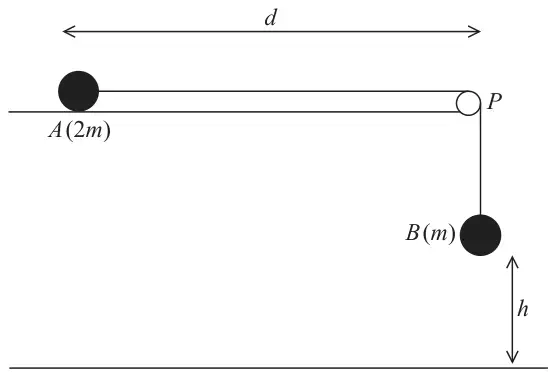
Two particles, \(A\) and \(B\), have masses \(2m\) and \(m\) respectively. The particles are attached to the ends of a light inextensible string. Particle \(A\) is held at rest on a fixed rough horizontal table at a distance \(d\) from a small smooth light pulley which is fixed at the edge of the table at the point \(P\). The coefficient of friction between \(A\) and the table is \(\mu\), where \(\mu < \dfrac{1}{2}\). The string is parallel to the table from \(A\) to \(P\) and passes over the pulley. Particle \(B\) hangs freely at rest vertically below \(P\) with the string taut and at a height \(h\), \((h < d)\), above a horizontal floor, as shown in Figure 3. Particle \(A\) is released from rest with the string taut and slides along the table.
After \(B\) hits the floor, \(A\) continues to slide along the table. Given that \(\mu = \dfrac{1}{3}\) and that \(A\) comes to rest at \(P\),
| Scheme | Marks |
|---|---|
| For \(A\): \(\ T - F = 2ma\) | M1 A1 |
| For \(B\): \(\ mg - T = ma\) | M1 A1 |
| (4) |
Notes
(i) First M1 for equation of motion for \(A\) with usual rules
First A1 for a correct equation (allow \(-T\) instead of \(T\))
(ii) Second M1 for equation of motion for \(B\) with usual rules
Second A1 for a correct equation (allow consistent \(-T\) instead of \(T\))
| Scheme | Marks |
|---|---|
| \(R = 2mg\) | B1 |
| \(mg(1 - 2\mu) = 3ma\) | M1 |
| \(\dfrac{g}{3}(1 - 2\mu) = a\) | A1 |
| (3) |
Notes
B1 for \(R = 2mg\)
M1 for using \(F = \mu R\) and eliminating to give equation in \(a\) and \(\mu\) only.
A1 for PRINTED ANSWER (Must be identical to printed answer)
| Scheme | Marks |
|---|---|
| \(v^2 = \dfrac{2gh}{3}(1 - 2\mu)\) | M1 |
| \(v = \sqrt{\dfrac{2gh}{3}(1 - 2\mu)}\) | A1 |
| (2) |
Notes
M1 for using \(v^2 = u^2 + 2as\) or any other complete method to find the speed of \(A\)
A1 for correct answer in any form
| Scheme | Marks |
|---|---|
| \(-\mu R = 2ma^{\prime}\) | M1 |
| \(0^2 =\) their \(u^2 - 2a^{\prime}s\) | M1 |
| \(0 = \dfrac{2gh}{3}\left(1 - \dfrac{2}{3}\right) - 2\left(\tfrac{1}{3}g\right)s\) (or \(s = (d - h)\)) | A1 (A1) |
| \(s = \tfrac{1}{3}h\) | A1 |
| \(d = \tfrac{1}{3}h + h = \tfrac{4}{3}h\) | A1 |
| (5) |
Notes
First M1 for equation of motion for \(A\) with \(T = 0\) and \(F = \mu R\) e.g. \(\mu R = 2ma^{\prime}\) (must be \(2m\))
Second M1 for using \(v^2 = u^2 + 2as\) with their \(u^2\) from (c), \(v = 0\) and a new \(a\) (does not need to be substituted)
First A1 for a correct equation in \(s\), \(g\) and \(h\) with \(\mu = 1/3\)
Second A1 for \(s = 1/3\,h\)
Third A1 for \(d = 4/3\,h\)
ALTERNATIVE using work-energy principle:
M2 for \(\mu Rs = \tfrac{1}{2}2mu^2\) (their \(u^2\) from (c)) (M1 if they use \(m\))
First A1 for \(\tfrac{1}{3}2mgs = \tfrac{1}{2}2m\dfrac{2gh}{3}\left(1 - \tfrac{2}{3}\right)\)
Second A1 for \(s = 1/3\,h\)
Third A1 for \(d = 4/3\,h\)
| Scheme | Marks |
|---|---|
| \(A\) (or \(B\)) would not move; OR \(A\) (or \(B\)) would remain in (limiting) equilibrium; OR the system would remain in (limiting) equilibrium | B1 |
| (1) | |
| (15 marks) |
Notes
B1 for any one of the alternatives listed above.