
C4 June 2014 Q5
5.
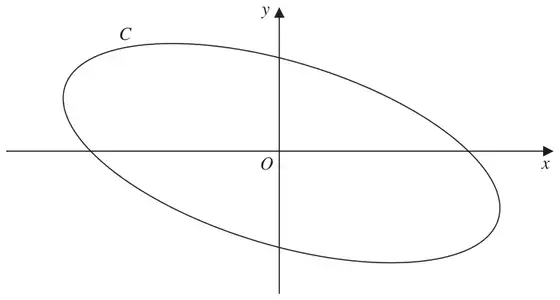
Figure 3 shows a sketch of the curve \(C\) with parametric equations \[x = 4\cos\left(t + \frac{\pi}{6}\right), \quad y = 2\sin t, \qquad 0 \leqslant t < 2\pi\]
| Scheme | Marks |
|---|---|
| \(x = 4\cos\left(t + \dfrac{\pi}{6}\right), \quad y = 2\sin t\) | |
| Main Scheme \(x = 4\left(\cos t\cos\left(\dfrac{\pi}{6}\right) - \sin t\sin\left(\dfrac{\pi}{6}\right)\right)\) \(\cos\left(t + \dfrac{\pi}{6}\right) \to \cos t\cos\left(\dfrac{\pi}{6}\right) \pm \sin t\sin\left(\dfrac{\pi}{6}\right)\) | M1 oe |
| So, \(\{x + y\} = 4\left(\cos t\cos\left(\dfrac{\pi}{6}\right) - \sin t\sin\left(\dfrac{\pi}{6}\right)\right) + 2\sin t\) Adds their expanded \(x\) (which is in terms of \(t\)) to \(2\sin t\) | dM1 |
| \(= 4\left(\left(\dfrac{\sqrt{3}}{2}\right)\cos t - \left(\dfrac{1}{2}\right)\sin t\right) + 2\sin t\) | |
| \(= 2\sqrt{3}\cos t\ *\) Correct proof | A1 * |
| (3) |
Notes
Alternative Method 1
| Scheme | Marks |
|---|---|
| \(x = 4\left(\cos t\cos\left(\dfrac{\pi}{6}\right) - \sin t\sin\left(\dfrac{\pi}{6}\right)\right)\) \(\cos\left(t + \dfrac{\pi}{6}\right) \to \cos t\cos\left(\dfrac{\pi}{6}\right) \pm \sin t\sin\left(\dfrac{\pi}{6}\right)\) | M1 oe |
| \(= 4\left(\left(\dfrac{\sqrt{3}}{2}\right)\cos t - \left(\dfrac{1}{2}\right)\sin t\right) = 2\sqrt{3}\cos t - 2\sin t\) | |
| So, \(x = 2\sqrt{3}\cos t - y\) Forms an equation in \(x\), \(y\) and \(t\). | dM1 |
| \(x + y = 2\sqrt{3}\cos t\ *\) Correct proof | A1 * |
| (3) |
Question 5 Notes
M1: \(\cos\left(t + \dfrac{\pi}{6}\right) \to \cos t\cos\left(\dfrac{\pi}{6}\right) \pm \sin t\sin\left(\dfrac{\pi}{6}\right)\) or \(\cos\left(t + \dfrac{\pi}{6}\right) \to \left(\dfrac{\sqrt{3}}{2}\right)\cos t \pm \left(\dfrac{1}{2}\right)\sin t\)
Note: If a candidate states \(\cos(A + B) = \cos A\cos B \pm \sin A\sin B\), but there is an error in its application then give M1.
Awarding the dM1 mark which is dependent on the first method mark
Main dM1: Adds their expanded \(x\) (which is in terms of \(t\)) to \(2\sin t\)
Note: Writing \(x + y = \ldots\) is not needed in the Main Scheme method.
Alt 1 dM1: Forms an equation in \(x\), \(y\) and \(t\).
A1*: Evidence of \(\cos\left(\dfrac{\pi}{6}\right)\) and \(\sin\left(\dfrac{\pi}{6}\right)\) evaluated and the proof is correct with no errors.
Note: \(\{x + y\} = 4\cos\left(t + \dfrac{\pi}{6}\right) + 2\sin t\), by itself is M0M0A0.
| Scheme | Marks |
|---|---|
| Main Scheme \(\left(\dfrac{x + y}{2\sqrt{3}}\right)^2 + \left(\dfrac{y}{2}\right)^2 = 1\) Applies \(\cos^2 t + \sin^2 t = 1\) to achieve an equation containing only \(x\)’s and \(y\)’s. | M1 |
| \(\Rightarrow \dfrac{(x + y)^2}{12} + \dfrac{y^2}{4} = 1\) | |
| \(\Rightarrow (x + y)^2 + 3y^2 = 12\) \((x + y)^2 + 3y^2 = 12\) \(\{a = 3,\ b = 12\}\) | A1 |
| (2) | |
| (5 marks) |
Notes
Alternative Method 1
| Scheme | Marks |
|---|---|
| \((x + y)^2 = 12\cos^2 t = 12(1 - \sin^2 t) = 12 - 12\sin^2 t\) | |
| So, \((x + y)^2 = 12 - 3y^2\) Applies \(\cos^2 t + \sin^2 t = 1\) to achieve an equation containing only \(x\)’s and \(y\)’s. | M1 |
| \(\Rightarrow (x + y)^2 + 3y^2 = 12\) \((x + y)^2 + 3y^2 = 12\) | A1 |
| (2) |
Alternative Method 2
| Scheme | Marks |
|---|---|
| \((x + y)^2 = 12\cos^2 t\) As \(12\cos^2 t + 12\sin^2 t = 12\) then \((x + y)^2 + 3y^2 = 12\) | M1, A1 |
| (2) |
M1: Applies \(\cos^2 t + \sin^2 t = 1\) to achieve an equation containing only \(x\)’s and \(y\)’s.
A1: leading \((x + y)^2 + 3y^2 = 12\)
SC: Award Special Case B1B0 for a candidate who writes down either
- \((x + y)^2 + 3y^2 = 12\) from no working
- \(a = 3,\ b = 12\), but does not provide a correct proof.
Note: Alternative method 2 is fine for M1 A1
Note: Writing \((x + y)^2 = 12\cos^2 t\) followed by \(12\cos^2 t + a(4\sin^2 t) = b \Rightarrow a = 3,\ b = 12\) is SC: B1B0
Note: Writing \((x + y)^2 = 12\cos^2 t\) followed by \(12\cos^2 t + a(4\sin^2 t) = b\)
- states \(a = 3,\ b = 12\)
- and refers to either \(\cos^2 t + \sin^2 t = 1\) or \(12\cos^2 t + 12\sin^2 t = 12\)
- and there is no incorrect working
would get M1A1