
C4 June 2013 (R) Q7
7.
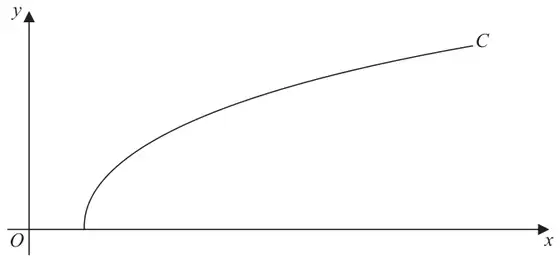
Figure 2 shows a sketch of the curve \(C\) with parametric equations \[x = 27\sec^3 t, \quad y = 3\tan t, \qquad 0 \leqslant t \leqslant \frac{\pi}{3}\]
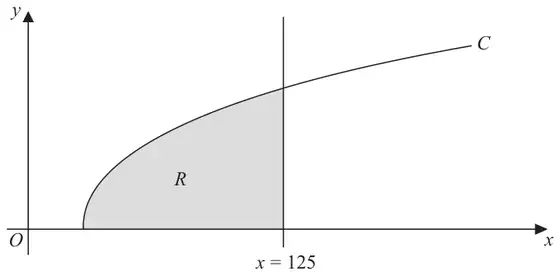
The finite region \(R\) which is bounded by the curve \(C\), the \(x\)-axis and the line \(x = 125\) is shown shaded in Figure 3. This region is rotated through \(2\pi\) radians about the \(x\)-axis to form a solid of revolution.
| Scheme | Marks |
|---|---|
| \(x = 27\sec^3 t, \quad y = 3\tan t, \quad 0 \leqslant t \leqslant \dfrac{\pi}{3}\) | |
| \(\dfrac{\mathrm{d}x}{\mathrm{d}t} = 81\sec^2 t\sec t\tan t, \quad \dfrac{\mathrm{d}y}{\mathrm{d}t} = 3\sec^2 t\) At least one of \(\dfrac{\mathrm{d}x}{\mathrm{d}t}\) or \(\dfrac{\mathrm{d}y}{\mathrm{d}t}\) correct. Both \(\dfrac{\mathrm{d}x}{\mathrm{d}t}\) and \(\dfrac{\mathrm{d}y}{\mathrm{d}t}\) are correct. | B1 B1 |
| \(\dfrac{\mathrm{d}y}{\mathrm{d}x} = \dfrac{3\sec^2 t}{81\sec^3 t\tan t}\ \left\{= \dfrac{1}{27\sec t\tan t} = \dfrac{\cos t}{27\tan t} = \dfrac{\cos^2 t}{27\sin t}\right\}\) Applies their \(\dfrac{\mathrm{d}y}{\mathrm{d}t}\) divided by their \(\dfrac{\mathrm{d}x}{\mathrm{d}t}\) | M1; |
| At \(t = \dfrac{\pi}{6}\), \(\dfrac{\mathrm{d}y}{\mathrm{d}x} = \dfrac{3\sec^2\left(\frac{\pi}{6}\right)}{81\sec^3\left(\frac{\pi}{6}\right)\tan\left(\frac{\pi}{6}\right)} = \dfrac{4}{72}\ \left\{= \dfrac{3}{54} = \dfrac{1}{18}\right\}\) \(\dfrac{4}{72}\) | A1 cao cso |
| (4) |
Notes
B1: At least one of \(\dfrac{\mathrm{d}x}{\mathrm{d}t}\) or \(\dfrac{\mathrm{d}y}{\mathrm{d}t}\) correct. Note: that this mark can be implied from their working.
B1: Both \(\dfrac{\mathrm{d}x}{\mathrm{d}t}\) and \(\dfrac{\mathrm{d}y}{\mathrm{d}t}\) are correct. Note: that this mark can be implied from their working.
M1: Applies their \(\dfrac{\mathrm{d}y}{\mathrm{d}t}\) divided by their \(\dfrac{\mathrm{d}x}{\mathrm{d}t}\), where both \(\dfrac{\mathrm{d}y}{\mathrm{d}t}\) and \(\dfrac{\mathrm{d}x}{\mathrm{d}t}\) are trigonometric functions of \(t\).
A1: \(\dfrac{4}{72}\) or any equivalent correct rational answer not involving surds.
Allow \(0.0\dot{5}\) with the recurring symbol.
Note: Please check that their \(\dfrac{\mathrm{d}x}{\mathrm{d}t}\) is differentiated correctly.
Eg. Note that \(x = 27\sec^3 t = 27(\cos t)^{-3} \Rightarrow \dfrac{\mathrm{d}x}{\mathrm{d}t} = -81(\cos t)^{-2}(-\sin t)\) is correct.
Alternative response using the Cartesian equation in part (a) – Way 2
| Scheme | Marks |
|---|---|
| \(\left\{y = \left(x^{\frac{2}{3}} - 9\right)^{\frac{1}{2}} \Rightarrow\right\}\ \dfrac{\mathrm{d}y}{\mathrm{d}x} = \dfrac{1}{2}\left(x^{\frac{2}{3}} - 9\right)^{-\frac{1}{2}}\left(\dfrac{2}{3}x^{-\frac{1}{3}}\right)\) \(\dfrac{\mathrm{d}y}{\mathrm{d}x} = \pm Kx^{-\frac{1}{3}}\left(x^{\frac{2}{3}} - 9\right)^{-\frac{1}{2}}\) \(\dfrac{\mathrm{d}y}{\mathrm{d}x} = \dfrac{1}{2}\left(x^{\frac{2}{3}} - 9\right)^{-\frac{1}{2}}\left(\dfrac{2}{3}x^{-\frac{1}{3}}\right)\) oe | M1 A1 |
| At \(t = \dfrac{\pi}{6}\), \(x = 27\sec^3\left(\dfrac{\pi}{6}\right) = 24\sqrt{3}\) \(\Rightarrow \dfrac{\mathrm{d}y}{\mathrm{d}x} = \dfrac{1}{2}\left(\left(24\sqrt{3}\right)^{\frac{2}{3}} - 9\right)^{-\frac{1}{2}}\left(\dfrac{2}{3}\left(24\sqrt{3}\right)^{-\frac{1}{3}}\right)\) Uses \(t = \dfrac{\pi}{6}\) to find \(x\) and substitutes their \(x\) into an expression for \(\dfrac{\mathrm{d}y}{\mathrm{d}x}\). | dM1 |
| So, \(\Rightarrow \dfrac{\mathrm{d}y}{\mathrm{d}x} = \dfrac{1}{2}\left(\dfrac{1}{\sqrt{3}}\right)\left(\dfrac{1}{3\sqrt{3}}\right) = \dfrac{1}{18}\) \(\dfrac{1}{18}\) | A1 cao cso |
Note: Way 2 is marked as M1 A1 dM1 A1
Note: For way 2 the second M1 mark is dependent on the first M1 being gained.
| Scheme | Marks |
|---|---|
| \(\left\{1 + \tan^2 t = \sec^2 t\right\} \Rightarrow 1 + \left(\dfrac{y}{3}\right)^2 = \left(\sqrt[3]{\left(\dfrac{x}{27}\right)}\right)^2 = \left(\dfrac{x}{27}\right)^{\frac{2}{3}}\) | M1 |
| \(\Rightarrow 1 + \dfrac{y^2}{9} = \dfrac{x^{\frac{2}{3}}}{9} \Rightarrow 9 + y^2 = x^{\frac{2}{3}} \Rightarrow y = \left(x^{\frac{2}{3}} - 9\right)^{\frac{1}{2}}\ *\) | A1 * cso |
| \(a = 27\) and \(b = 216\) or \(27 \leqslant x \leqslant 216\) \(a = 27\) and \(b = 216\) | B1 |
| (3) |
Notes
M1: Either:
- Applying a correct trigonometric identity (usually \(1 + \tan^2 t = \sec^2 t\)) to give a Cartesian equation in \(x\) and \(y\) only.
- Starting from the RHS and goes on to achieve \(\sqrt{9\tan^2 t}\) by using a correct trigonometric identity.
- Starts from the LHS and goes on to achieve \(\sqrt{9\sec^2 t - 9}\) by using a correct trigonometric identity.
A1*: For a correct proof of \(y = \left(x^{\frac{2}{3}} - 9\right)^{\frac{1}{2}}\).
Note this result is printed on the Question Paper, so no incorrect working is allowed.
B1: Both \(a = 27\) and \(b = 216\). Note that \(27 \leqslant x \leqslant 216\) is also fine for B1.
7. (b) Way 2 – Alternative responses for M1A1 in part (b): STARTING FROM THE RHS
| Scheme | Marks |
|---|---|
| \(\{\text{RHS} =\}\ \left(x^{\frac{2}{3}} - 9\right)^{\frac{1}{2}} = \sqrt{\left(27\sec^3 t\right)^{\frac{2}{3}} - 9} = \sqrt{9\sec^2 t - 9} = \sqrt{9\tan^2 t}\) For applying \(1 + \tan^2 t = \sec^2 t\) oe to achieve \(\sqrt{9\tan^2 t}\) | M1 |
| \(= 3\tan t = y\ \{= \text{LHS}\}\) cso Correct proof from \(\left(x^{\frac{2}{3}} - 9\right)^{\frac{1}{2}}\) to \(y\). | A1* |
M1: Starts from the RHS and goes on to achieve \(\sqrt{9\tan^2 t}\) by using a correct trigonometric identity.
7. (b) Way 3 – Alternative responses for M1A1 in part (b): STARTING FROM THE LHS
| Scheme | Marks |
|---|---|
| \(\{\text{LHS} =\}\ y = 3\tan t = \sqrt{\left(9\tan^2 t\right)} = \sqrt{9\sec^2 t - 9}\) For applying \(1 + \tan^2 t = \sec^2 t\) oe to achieve \(\sqrt{9\sec^2 t - 9}\) | M1 |
| \(= \sqrt{9\left(\dfrac{x}{27}\right)^{\frac{2}{3}} - 9} = \sqrt{9\left(\dfrac{x^{\frac{2}{3}}}{9}\right) - 9} = \left(x^{\frac{2}{3}} - 9\right)^{\frac{1}{2}}\) cso Correct proof from \(y\) to \(\left(x^{\frac{2}{3}} - 9\right)^{\frac{1}{2}}\). | A1* |
M1: Starts from the LHS and goes on to achieve \(\sqrt{9\sec^2 t - 9}\) by using a correct trigonometric identity.
| Scheme | Marks |
|---|---|
| \(V = \pi\displaystyle\int_{27}^{125} \left(\left(x^{\frac{2}{3}} - 9\right)^{\frac{1}{2}}\right)^2\,\mathrm{d}x\) or \(\pi\displaystyle\int_{27}^{125} \left(x^{\frac{2}{3}} - 9\right)\mathrm{d}x\) For \(\pi\displaystyle\int \left(\left(x^{\frac{2}{3}} - 9\right)^{\frac{1}{2}}\right)^2\) or \(\pi\displaystyle\int \left(x^{\frac{2}{3}} - 9\right)\). Ignore limits and \(\mathrm{d}x\). Can be implied. | B1 |
| \(= \{\pi\}\left[\dfrac{3}{5}x^{\frac{5}{3}} - 9x\right]_{27}^{125}\) Either \(\pm Ax^{\frac{5}{3}} \pm Bx\) or \(\dfrac{3}{5}x^{\frac{5}{3}}\) oe \(\dfrac{3}{5}x^{\frac{5}{3}} - 9x\) oe | M1 A1 |
| \(= \{\pi\}\left(\left(\dfrac{3}{5}(125)^{\frac{5}{3}} - 9(125)\right) - \left(\dfrac{3}{5}(27)^{\frac{5}{3}} - 9(27)\right)\right)\) Substitutes limits of 125 and 27 into an integrated function and subtracts the correct way round. | dM1 |
| \(= \{\pi\}\left((1875 - 1125) - (145.8 - 243)\right)\) | |
| \(= \dfrac{4236\pi}{5}\) or \(847.2\pi\) \(\dfrac{4236\pi}{5}\) or \(847.2\pi\) | A1 |
| (5) | |
| (12 marks) |
Notes
B1: For a correct statement of \(\pi\displaystyle\int \left(\left(x^{\frac{2}{3}} - 9\right)^{\frac{1}{2}}\right)^2\) or \(\pi\displaystyle\int \left(x^{\frac{2}{3}} - 9\right)\). Ignore limits and \(\mathrm{d}x\). Can be implied.
M1: Either integrates to give \(\pm Ax^{\frac{5}{3}} \pm Bx,\ A \neq 0,\ B \neq 0\) or integrates \(x^{\frac{2}{3}}\) correctly to give \(\dfrac{3}{5}x^{\frac{5}{3}}\) oe
A1: \(\dfrac{3}{5}x^{\frac{5}{3}} - 9x\) or. \(\dfrac{x^{\frac{5}{3}}}{\left(\frac{5}{3}\right)} - 9x\) oe.
dM1: Substitutes limits of 125 and 27 into an integrated function and subtracts the correct way round.
Note: that this mark is dependent upon the previous method mark being awarded.
A1: A correct exact answer of \(\dfrac{4236\pi}{5}\) or \(847.2\pi\).
Note: The \(\pi\) in the volume formula is only required for the B1 mark and the final A1 mark.
Note: A decimal answer of 2661.557... without a correct exact answer is A0.
Note: If a candidate gains the first B1M1A1 and then writes down 2661 or awrt 2662 with no method for substituting limits of 125 and 27, then award the final M1A0.
7. (c) Way 2 – Alternative response for part (c) using parametric integration
| Scheme | Marks |
|---|---|
| \(V = \pi\displaystyle\int 9\tan^2 t\left(81\sec^2 t\sec t\tan t\right)\mathrm{d}t\) \(\pi\displaystyle\int (3\tan t)^2\left(81\sec^2 t\sec t\tan t\right)\mathrm{d}t\). Ignore limits and \(\mathrm{d}x\). Can be implied. | B1 |
| \(= \{\pi\}\displaystyle\int 729\sec^2 t\tan^2 t\sec t\tan t\ \mathrm{d}t\) \(= \{\pi\}\displaystyle\int 729\sec^2 t\left(\sec^2 t - 1\right)\sec t\tan t\ \mathrm{d}t\) \(= \{\pi\}\displaystyle\int 729\left(\sec^4 t - \sec^2 t\right)\sec t\tan t\ \mathrm{d}t\) \(= \{\pi\}\displaystyle\int 729\left(\sec^4 t - \sec^2 t\right)\sec t\tan t\ \mathrm{d}t\) | |
| \(= \{\pi\}\left[729\left(\dfrac{1}{5}\sec^5 t - \dfrac{1}{3}\sec^3 t\right)\right]\) \(\pm A\sec^5 t \pm B\sec^3 t\) \(729\left(\dfrac{1}{5}\sec^5 t - \dfrac{1}{3}\sec^3 t\right)\) | M1 A1 |
| \(V = \{\pi\}\left[729\left(\dfrac{1}{5}\left(\dfrac{5}{3}\right)^5 - \dfrac{1}{3}\left(\dfrac{5}{3}\right)^3\right) - 729\left(\dfrac{1}{5}1^5 - \dfrac{1}{3}1^3\right)\right]\) Substitutes \(\sec t = \dfrac{5}{3}\) and \(\sec t = 1\) into an integrated function and subtracts the correct way round. | dM1 |
| \(= 729\pi\left[\left(\dfrac{250}{243}\right) - \left(-\dfrac{2}{15}\right)\right]\) | |
| \(= \dfrac{4236\pi}{5}\) or \(847.2\pi\) \(\dfrac{4236\pi}{5}\) or \(847.2\pi\) | A1 |
| (5) |
(corrected from the printed mark scheme: the B1 guidance for Way 2 is printed as \(\pi\displaystyle\int 3\tan t\left(81\sec^2 t\sec t\tan t\right)\mathrm{d}t\); the volume needs \(y^2 = (3\tan t)^2 = 9\tan^2 t\), as in the scheme line beside it.)