
C4 June 2013 (R) Q5
5.
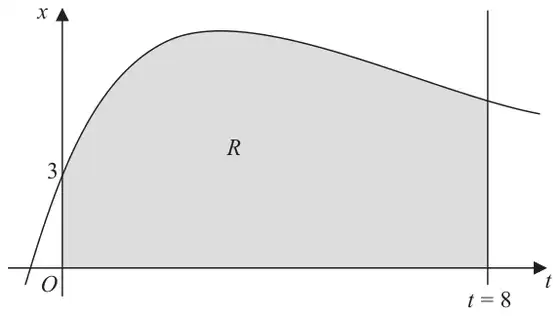
Figure 1 shows part of the curve with equation \(x = 4t\mathrm{e}^{-\frac{1}{3}t} + 3\). The finite region \(R\) shown shaded in Figure 1 is bounded by the curve, the \(x\)-axis, the \(t\)-axis and the line \(t = 8\).
| \(t\) | 0 | 2 | 4 | 6 | 8 |
|---|---|---|---|---|---|
| \(x\) | 3 | 7.107 | 7.218 | 5.223 |
| Scheme | Marks |
|---|---|
| \(6.248046798... = 6.248\) (3dp) 6.248 or awrt 6.248 | B1 |
| (1) |
Notes
B1: 6.248 or awrt 6.248. Look for this on the table or in the candidate’s working.
| Scheme | Marks |
|---|---|
| \(\text{Area} \approx \dfrac{1}{2} \times 2;\ \times \underline{\left[3 + 2\left(7.107 + 7.218 + \text{their } 6.248\right) + 5.223\right]}\) | B1; M1 |
| \(= 49.369 = 49.37\) (2 dp) 49.37 or awrt 49.37 | A1 |
| (3) |
Notes
B1: Outside brackets \(\dfrac{1}{2} \times 2\) or 1
M1: For structure of trapezium rule \(\left[\ \ldots\ldots\ldots\ldots\ \right]\). Allow one miscopy of their values.
A1: 49.37 or anything that rounds to 49.37
Note: It can be possible to award : (a) B0 (b) B1M1A1 (awrt 49.37)
Note: Working must be seen to demonstrate the use of the trapezium rule. Note: actual area is 50.828…
Bracketing mistake: Unless the final answer implies that the calculation has been done correctly,
Award B1M0A0 for \(1 + 3 + 2\left(7.107 + 7.218 + \text{their } 6.248\right) + 5.223\) (nb: answer of 50.369).
Alternative method for part (b): Adding individual trapezia
\(\text{Area} \approx 2 \times \left[\dfrac{3 + 7.107}{2} + \dfrac{7.107 + 7.218}{2} + \dfrac{7.218 + 6.248}{2} + \dfrac{6.248 + 5.223}{2}\right] = 49.369\)
B1: 2 and a divisor of 2 on all terms inside brackets.
M1: First and last ordinates once and two of the middle ordinates twice inside brackets ignoring the 2.
A1: anything that rounds to 49.37
| Scheme | Marks |
|---|---|
| \(\left\{\displaystyle\int (4t\mathrm{e}^{-\frac{1}{3}t} + 3)\,\mathrm{d}t\right\} = -12t\mathrm{e}^{-\frac{1}{3}t} - \displaystyle\int -12\mathrm{e}^{-\frac{1}{3}t}\{\mathrm{d}t\}\) \(\pm At\mathrm{e}^{-\frac{1}{3}t} \pm B\displaystyle\int \mathrm{e}^{-\frac{1}{3}t}\{\mathrm{d}t\},\ A \neq 0,\ B \neq 0\) See notes. | M1 A1 |
| \(+ 3t\) \(3 \to 3t\) | B1 |
| \(= -12t\mathrm{e}^{-\frac{1}{3}t} - 36\mathrm{e}^{-\frac{1}{3}t}\ \{+ 3t\}\) \(-12t\mathrm{e}^{-\frac{1}{3}t} - 36\mathrm{e}^{-\frac{1}{3}t}\) | A1 |
| \(\left[-12t\mathrm{e}^{-\frac{1}{3}t} - 36\mathrm{e}^{-\frac{1}{3}t} + 3t\right]_0^8 =\) \(= \left(-12(8)\mathrm{e}^{-\frac{1}{3}(8)} - 36\mathrm{e}^{-\frac{1}{3}(8)} + 3(8)\right) - \left(-12(0)\mathrm{e}^{-\frac{1}{3}(0)} - 36\mathrm{e}^{-\frac{1}{3}(0)} + 3(0)\right)\) Substitutes limits of 8 and 0 into an integrated function of the form of either \(\pm\lambda t\mathrm{e}^{-\frac{1}{3}t} \pm \mu\mathrm{e}^{-\frac{1}{3}t}\) or \(\pm\lambda t\mathrm{e}^{-\frac{1}{3}t} \pm \mu\mathrm{e}^{-\frac{1}{3}t} + Bt\) and subtracts the correct way round. | dM1 |
| \(= \left(-96\mathrm{e}^{-\frac{8}{3}} - 36\mathrm{e}^{-\frac{8}{3}} + 24\right) - (0 - 36 + 0)\) | |
| \(= 60 - 132\mathrm{e}^{-\frac{8}{3}}\) \(60 - 132\mathrm{e}^{-\frac{8}{3}}\) | A1 |
| (6) |
Notes
M1: For \(4t\mathrm{e}^{-\frac{1}{3}t} \to \pm At\mathrm{e}^{-\frac{1}{3}t} \pm B\displaystyle\int \mathrm{e}^{-\frac{1}{3}t}\{\mathrm{d}t\},\ A \neq 0,\ B \neq 0\)
A1: For \(t\mathrm{e}^{-\frac{1}{3}t} \to \left(-3t\mathrm{e}^{-\frac{1}{3}t} - \displaystyle\int -3\mathrm{e}^{-\frac{1}{3}t}\right)\) (some candidates lose the 4 and this is fine for the first A1 mark).
or \(4t\mathrm{e}^{-\frac{1}{3}t} \to 4\left(-3t\mathrm{e}^{-\frac{1}{3}t} - \displaystyle\int -3\mathrm{e}^{-\frac{1}{3}t}\right)\) or \(-12t\mathrm{e}^{-\frac{1}{3}t} - \displaystyle\int -12\mathrm{e}^{-\frac{1}{3}t}\) or \(12\left(-t\mathrm{e}^{-\frac{1}{3}t} - \displaystyle\int -\mathrm{e}^{-\frac{1}{3}t}\right)\)
These results can be implied. They can be simplified or un-simplified.
B1: \(3 \to 3t\) or \(3 \to 3x\) (bod) .
Note: Award B0 for 3 integrating to \(12t\) (implied), which is a common error when taking out a factor of 4.
Be careful some candidates will factorise out 4 and have \(4\left(\ldots + \dfrac{3}{4}\right) \to 4\left(\ldots + \dfrac{3}{4}t\right)\)
which would then be fine for B1.
Note: Allow B1 for \(\displaystyle\int_0^8 3\,\mathrm{d}t = 24\)
A1: For correct integration of \(4t\mathrm{e}^{-\frac{1}{3}t}\) to give \(-12t\mathrm{e}^{-\frac{1}{3}t} - 36\mathrm{e}^{-\frac{1}{3}t}\) or \(4\left(-3t\mathrm{e}^{-\frac{1}{3}t} - 9\mathrm{e}^{-\frac{1}{3}t}\right)\) or equivalent.
This can be simplified or un-simplified.
dM1: Substitutes limits of 8 and 0 into an integrated function of the form of either \(\pm\lambda t\mathrm{e}^{-\frac{1}{3}t} \pm \mu\mathrm{e}^{-\frac{1}{3}t}\) or
\(\pm\lambda t\mathrm{e}^{-\frac{1}{3}t} \pm \mu\mathrm{e}^{-\frac{1}{3}t} + Bt\) and subtracts the correct way round.
Note: Evidence of a proper consideration of the limit of 0 (as detailed in the scheme) is needed for dM1.
So, just subtracting zero is M0.
A1: An exact answer of \(60 - 132\mathrm{e}^{-\frac{8}{3}}\). A decimal answer of 50.82818444... without a correct answer is A0.
Note: A decimal answer of 50.82818444... without a correct exact answer is A0.
Note: If a candidate gains M1A1B1A1 and then writes down 50.8 or awrt 50.8 with no method for substituting limits of 8 and 0, then award the final M1A0.
IMPORTANT: that is fine for candidates to work in terms of \(x\) rather than \(t\) in part (c).
Note: The "\(3t\)" is needed for B1 and the final A1 mark.
| Scheme | Marks |
|---|---|
| \(\text{Difference} = \left|60 - 132\mathrm{e}^{-\frac{8}{3}} - 49.37\right| = 1.458184439... = 1.46\) (2 dp) 1.46 or awrt 1.46 | B1 |
| (1) | |
| (11 marks) |
Notes
B1: 1.46 or awrt 1.46 or -1.46 or awrt -1.46.
Candidates may give correct decimal answers of 1.458184439... or 1.459184439...
Note: You can award this mark whether or not the candidate has answered part (c) correctly.