
C3 June 2014 Q6
6.
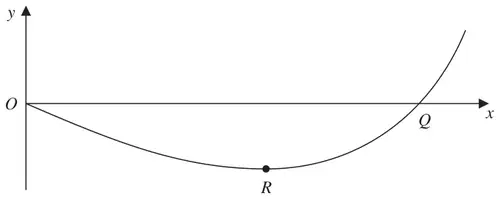
Figure 2 shows a sketch of part of the curve with equation\[y=2\cos\left(\frac{1}{2}x^2\right)+x^3-3x-2\]
The curve crosses the \(x\)-axis at the point \(Q\) and has a minimum turning point at \(R\).
Using the iterative formula\[x_{n+1}=\sqrt{1+\frac{2}{3}x_n\sin\left(\frac{1}{2}x_n^{\,2}\right)},\qquad x_0=1.3\]
| Scheme | Marks |
|---|---|
| \(y_{2.1}=-0.224,\quad y_{2.2}=(+)0.546\) | M1 |
| Change of sign \(\Rightarrow Q\) lies between | A1 |
| (2) |
Notes
M1 Sub both \(x=2.1\) and \(x=2.2\) into \(y\) and achieve at least one correct to 1 sig fig
In radians \(y_{2.1}=\) awrt \(-0.2\quad y_{2.2}=\) awrt/truncating to \(0.5\)
In degrees \(y_{2.1}=\) awrt \(3\quad y_{2.2}=\) awrt \(4\)
A1 Both values correct to 1 sf with a reason and a minimal conclusion.
\(y_{2.1}=\) awrt \(-0.2\quad y_{2.2}=\) awrt/truncating to \(0.5\)
Accept change of sign, positive and negative, \(y_{2.1}\times y_{2.2}=-1\) as reasons and hence root, Q lies between 2.1 and 2.2, QED as a minimal conclusion.
Accept a smaller interval spanning the root of 2.131528, say 2.13 and 2.14, but the A1 can only be scored when the candidate refers back to the question, stating that as root lies between 2.13 and 2.14 it lies between 2.1 and 2.2
| Scheme | Marks |
|---|---|
| At \(R\quad\dfrac{\mathrm{d}y}{\mathrm{d}x}=-2x\sin\left(\dfrac{1}{2}x^2\right)+3x^2-3\) | M1A1 |
| \(-2x\sin\left(\dfrac{1}{2}x^2\right)+3x^2-3=0\Rightarrow\quad x=\sqrt{1+\dfrac{2}{3}x\sin\left(\dfrac{1}{2}x^2\right)}\) cso | M1A1* |
| (4) |
Notes
M1 Differentiating to get \(\dfrac{\mathrm{d}y}{\mathrm{d}x}=\ldots\sin\left(\dfrac{1}{2}x^2\right)+3x^2-3\) where \(\ldots\) is a constant, or a linear function in \(x\).
A1 \(\dfrac{\mathrm{d}y}{\mathrm{d}x}=-2x\sin\left(\dfrac{1}{2}x^2\right)+3x^2-3\)
M1 Sets their \(\dfrac{\mathrm{d}y}{\mathrm{d}x}=0\) and proceeds to make the \(x\) of their \(3x^2\) the subject of the formula
Alternatively they could state \(\dfrac{\mathrm{d}y}{\mathrm{d}x}=0\) and write a line such as \(2x\sin\left(\dfrac{1}{2}x^2\right)=3x^2-3\), before making the \(x\) of \(3x^2\) the subject of the formula
A1* Correct given solution. \(x=\sqrt{1+\dfrac{2}{3}x\sin\left(\dfrac{1}{2}x^2\right)}\)
Watch for missing \(x\)'s in their formula
| Scheme | Marks |
|---|---|
| \(x_1=\sqrt{1+\dfrac{2}{3}\times 1.3\sin\left(\dfrac{1}{2}\times 1.3^2\right)}\) | M1 |
| \(x_1=\) awrt \(1.284\quad x_2=\) awrt \(1.276\) | A1 |
| (2) | |
| (8 marks) |
Notes
M1 Subs \(x=1.3\) into the iterative formula to find at least \(x_1\).
This can be implied by \(x_1=\) awrt \(1.3\) (not just 1.3)
or \(x_1=\sqrt{1+\dfrac{2}{3}\times 1.3\sin\left(\dfrac{1}{2}\times 1.3^2\right)}\) or \(x_1=\) awrt \(1.006\) (degrees)
A1 Both answers correct (awrt 3 decimal places). The subscripts are not important. Mark as the first and second values seen. \(x_1=\) awrt \(1.284\quad x_2=\) awrt \(1.276\)