
C3 June 2014 (R) Q2
2. A curve \(C\) has equation \(y=\mathrm{e}^{4x}+x^4+8x+5\)
On your diagram give the coordinates of the points where each curve crosses the \(y\)-axis and state the equation of any asymptotes.
(4)The iteration formula\[x_{n+1}=\left(-2-\mathrm{e}^{4x_n}\right)^{\frac{1}{3}},\qquad x_0=-1\]can be used to find an approximate value for this root.
| Scheme | Marks |
|---|---|
| \(\dfrac{\mathrm{d}y}{\mathrm{d}x}=4\mathrm{e}^{4x}+4x^3+8\) | M1, A1 |
| Puts \(\dfrac{\mathrm{d}y}{\mathrm{d}x}=0\) to give \(x^3=-2-\mathrm{e}^{4x}\) | A1* |
| (3) |
Notes
M1 Two (of the four) terms differentiated correctly
A1 All correct \(\dfrac{\mathrm{d}y}{\mathrm{d}x}=4\mathrm{e}^{4x}+4x^3+8\)
A1* States or sets \(\dfrac{\mathrm{d}y}{\mathrm{d}x}=0\), and proceeds correctly to achieve printed answer \(x^3=-2-\mathrm{e}^{4x}\).
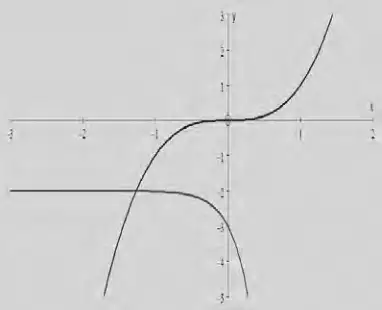
| Scheme | Marks |
|---|---|
| \(y=x^3\) | B1 |
| Shape of \(y=-2-\mathrm{e}^{4x}\) | B1 |
| \(y=-2-\mathrm{e}^{4x}\) cuts y axis at \((0,-3)\) | B1 |
| \(y=-2-\mathrm{e}^{4x}\) has asymptote at \(y=-2\) | B1 |
| (4) |
Notes
B1 Correct shape and position for \(y=x^3\). It must appear to go through the origin.
It must only appear in Quadrants 1 and 3 and have a gradient that is always \(\geqslant 0\). The gradient should appear large at either end. Tolerate slips of the pen. See practice and qualification for acceptable curves.
B1 Correct shape for \(y=-2-\mathrm{e}^{4x}\), its position is not important for this mark. The gradient must be approximately zero at the left hand end and increase negatively as you move from left to right along the curve. See practice and qualification for acceptable curves.
B1 Score for \(y=-2-\mathrm{e}^{4x}\) cutting or meeting the \(y\) axis at \((0,-3)\). Its shape is not important.
Accept for the intention of \((0,-3)\), \(-3\) being marked on the y – axis as well as \((-3,0)\)
Do not accept 3 being marked on the negative y axis.
B1 Score for \(y=-2-\mathrm{e}^{4x}\) having an asymptote stated as \(y=-2\). This is dependent upon the curve appearing to have an asymptote there. Do not accept the asymptote marked as ‘-2’ or indeed \(x=-2\). See practice and qualification for acceptable solutions.
| Scheme | Marks |
|---|---|
| Only one crossing point | B1 |
| (1) |
Notes
B1 Score for a statement to the effect that the graphs cross at one point. Accept minimal statements such as ‘one intersection’. Do not award if their diagram shows more than one intersection. They must have a diagram (which may be incorrect)
| Scheme | Marks |
|---|---|
| \(-1.26376,\quad -1.26126\) Accept answers which round to these answers to 5dp | M1 A1 |
| (2) |
Notes
M1 Awarded for applying the iteration formula once. Possible ways in which this can be scored are the sight of \(\sqrt[3]{-2-\mathrm{e}^{-4}}\), \(\left(-2-\mathrm{e}^{4\times -1}\right)^{\frac{1}{3}}\) or awrt \(-1.264\)
A1 Both values correct awrt \(-1.26376,\ -1.26126\) 5dps. The subscripts are unimportant for this mark. Score as the first and second values seen.
| Scheme | Marks |
|---|---|
| \(\alpha=-1.26\) and so turning point is at \((-1.26,-2.55)\) | M1 A1cao |
| (2) | |
| (12 marks) |
Notes
M1 Score for EITHER rounding their value in part (d) to 2 dp OR finding turning point of \(C\) by substituting a value of \(x\) generated from part (d) into \(y=\mathrm{e}^{4x}+x^4+8x+5\) in order to find the \(y\) value. You may accept the appearance of a \(y\) value as evidence of finding the turning point (as long as an \(x\) value appears to be generated from part (d) and the correct equation is used.) (corrected from the printed mark scheme: the printed note says “their value in part (c)”; the iterated value is found in part (d))
A1 \((-1.26,-2.55)\) and correct solution only. It is a deduction and you cannot accept the appearance of a correct answer for two marks.