
C4 June 2014 Q4
4.
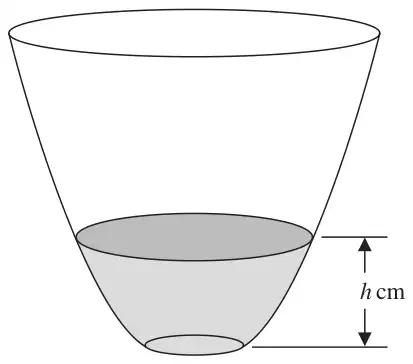
A vase with a circular cross-section is shown in Figure 2. Water is flowing into the vase.
When the depth of the water is \(h\) cm, the volume of water \(V\) cm3 is given by \[V = 4\pi h(h + 4), \qquad 0 \leqslant h \leqslant 25\]
Water flows into the vase at a constant rate of \(80\pi\) cm3s−1
Find the rate of change of the depth of the water, in cm s−1, when \(h = 6\) (5)
| Scheme | Marks |
|---|---|
| \(\dfrac{\mathrm{d}V}{\mathrm{d}t} = 80\pi,\ V = 4\pi h(h + 4) = 4\pi h^2 + 16\pi h\), | |
| \(\dfrac{\mathrm{d}V}{\mathrm{d}h} = 8\pi h + 16\pi\) \(\pm\alpha h \pm \beta,\ \alpha \neq 0,\ \beta \neq 0\) \(8\pi h + 16\pi\) | M1 A1 |
| \(\left\{\dfrac{\mathrm{d}V}{\mathrm{d}h} \times \dfrac{\mathrm{d}h}{\mathrm{d}t} = \dfrac{\mathrm{d}V}{\mathrm{d}t} \Rightarrow\right\}\ \left(8\pi h + 16\pi\right)\dfrac{\mathrm{d}h}{\mathrm{d}t} = 80\pi\) \(\left\{\dfrac{\mathrm{d}h}{\mathrm{d}t} = \dfrac{\mathrm{d}V}{\mathrm{d}t} \div \dfrac{\mathrm{d}V}{\mathrm{d}h} \Rightarrow\right\}\ \dfrac{\mathrm{d}h}{\mathrm{d}t} = 80\pi \times \dfrac{1}{8\pi h + 16\pi}\) \(\left(\text{Candidate's } \dfrac{\mathrm{d}V}{\mathrm{d}h}\right) \times \dfrac{\mathrm{d}h}{\mathrm{d}t} = 80\pi\) or \(80\pi \div \text{Candidate's } \dfrac{\mathrm{d}V}{\mathrm{d}h}\) | M1 oe |
| When \(h = 6\), \(\left\{\dfrac{\mathrm{d}h}{\mathrm{d}t} =\right\}\ \dfrac{1}{8\pi(6) + 16\pi} \times 80\pi\ \left\{= \dfrac{80\pi}{64\pi}\right\}\) dependent on the previous M1 see notes | dM1 |
| \(\dfrac{\mathrm{d}h}{\mathrm{d}t} = \underline{1.25}\) (cm s-1) 1.25 or \(\dfrac{5}{4}\) or \(\dfrac{10}{8}\) or \(\dfrac{80}{64}\) | A1 oe |
| (5) | |
| (5 marks) |
Notes
Alternative Method for the first M1A1
| Scheme | Marks |
|---|---|
| Product rule: \(\left\{\begin{aligned} u &= 4\pi h & v &= h + 4\\ \dfrac{\mathrm{d}u}{\mathrm{d}h} &= 4\pi & \dfrac{\mathrm{d}v}{\mathrm{d}h} &= 1\end{aligned}\right\}\) | |
| \(\dfrac{\mathrm{d}V}{\mathrm{d}h} = 4\pi(h + 4) + 4\pi h\) \(\pm\alpha h \pm \beta,\ \alpha \neq 0,\ \beta \neq 0\) \(4\pi(h + 4) + 4\pi h\) | M1 A1 |
Question 4 Notes
M1: An expression of the form \(\pm\alpha h \pm \beta,\ \alpha \neq 0,\ \beta \neq 0\). Can be simplified or un-simplified.
A1: Correct simplified or un-simplified differentiation of \(V\).
eg. \(8\pi h + 16\pi\) or \(4\pi(h + 4) + 4\pi h\) or \(8\pi(h + 2)\) or equivalent.
Note: Some candidates will use the product rule to differentiate \(V\) with respect to \(h\). (See Alt Method 1).
Note: \(\dfrac{\mathrm{d}V}{\mathrm{d}h}\) does not have to be explicitly stated, but it should be clear that they are differentiating their \(V\).
M1: \(\left(\text{Candidate's } \dfrac{\mathrm{d}V}{\mathrm{d}h}\right) \times \dfrac{\mathrm{d}h}{\mathrm{d}t} = 80\pi\) or \(80\pi \div \text{Candidate's } \dfrac{\mathrm{d}V}{\mathrm{d}h}\)
Note: Also allow 2nd M1 for \(\left(\text{Candidate's } \dfrac{\mathrm{d}V}{\mathrm{d}h}\right) \times \dfrac{\mathrm{d}h}{\mathrm{d}t} = \mathbf{80}\) or \(\mathbf{80} \div \text{Candidate's } \dfrac{\mathrm{d}V}{\mathrm{d}h}\)
Note: Give 2nd M0 for \(\left(\text{Candidate's } \dfrac{\mathrm{d}V}{\mathrm{d}h}\right) \times \dfrac{\mathrm{d}h}{\mathrm{d}t} = \boldsymbol{80\pi t}\) or \(\mathbf{80k}\) or \(\boldsymbol{80\pi t}\) or \(\mathbf{80k} \div \text{Candidate's } \dfrac{\mathrm{d}V}{\mathrm{d}h}\)
dM1: which is dependent on the previous M1 mark.
Substitutes \(h = 6\) into an expression which is a result of a quotient of their \(\dfrac{\mathrm{d}V}{\mathrm{d}h}\) and \(80\pi\) (or 80)
A1: 1.25 or \(\dfrac{5}{4}\) or \(\dfrac{10}{8}\) or \(\dfrac{80}{64}\) (units are not required).
Note: \(\dfrac{80\pi}{64\pi}\) as a final answer is A0.
Note: Substituting \(h = 6\) into a correct \(\dfrac{\mathrm{d}V}{\mathrm{d}h}\) gives \(64\pi\) but the final M1 mark can only be awarded if this is used as a quotient with \(80\pi\) (or 80)