
C3 June 2010 Q6
6.
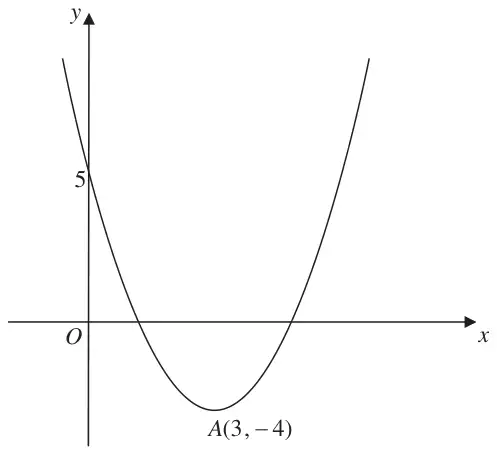
Figure 2 shows a sketch of the curve with the equation \(y = \mathrm{f}(x)\), \(x \in \mathbb{R}\).
The curve has a turning point at \(A(3, -4)\) and also passes through the point \((0, 5)\).
The curve with equation \(y = \mathrm{f}(x)\) is a translation of the curve with equation \(y = x^2\).
| Scheme | Marks |
|---|---|
| (i) \((3, 4)\) | B1 B1 |
| (ii) \((6, -8)\) | B1 B1 |
| (4) |
| Scheme | Marks |
|---|---|
 | B1 B1 B1 |
| (3) |
Notes
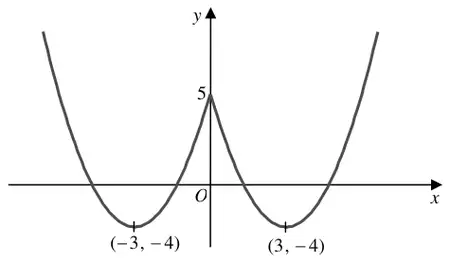
(b) B1: Correct shape for \(x \geqslant 0\), with the curve meeting the positive \(y\)-axis and the turning point is found below the \(x\)-axis. (providing candidate does not copy the whole of the original curve and adds nothing else to their sketch.).
B1: Curve is symmetrical about the \(y\)-axis or correct shape of curve for \(x \lt 0\).
Note: The first two B1B1 can only be awarded if the curve has the correct shape, with a cusp on the positive \(y\)-axis and with both turning points located in the correct quadrants. Otherwise award B1B0.
B1: Correct turning points of \((-3, -4)\) and \((3, -4)\). Also, \((\{0\}, 5)\) is marked where the graph cuts through the \(y\)-axis. Allow \((5, 0)\) rather than \((0, 5)\) if marked in the “correct” place on the \(y\)-axis.
| Scheme | Marks |
|---|---|
| \(\mathrm{f}(x) = (x - 3)^2 - 4\) or \(\mathrm{f}(x) = x^2 - 6x + 5\) | M1A1 |
| (2) |
Notes
(c) M1: Either states \(\mathrm{f}(x)\) in the form \((x \pm \alpha)^2 \pm \beta\); \(\alpha, \beta \ne 0\)
Or uses a complete method on \(\mathrm{f}(x) = x^2 + ax + b\), with \(\mathrm{f}(0) = 5\) and \(\mathrm{f}(3) = -4\) to find both \(a\) and \(b\).
A1: Either \((x - 3)^2 - 4\) or \(x^2 - 6x + 5\)
| Scheme | Marks |
|---|---|
| Either: The function f is a many-one {mapping}. Or: The function f is not a one-one {mapping}. | B1 |
| (1) | |
| (10 marks) |
Notes
(d) B1: Or: The inverse is a one-many {mapping and not a function}.
Or: Because \(\mathrm{f}(0) = 5\) and also \(\mathrm{f}(6) = 5\).
Or: One \(y\)-coordinate has 2 corresponding \(x\)-coordinates {and therefore cannot have an inverse}.