
C3 January 2011 Q6
6. The function f is defined by
\[\mathrm{f} : x \mapsto \frac{3 - 2x}{x - 5}, \quad x \in \mathbb{R},\ x \ne 5\]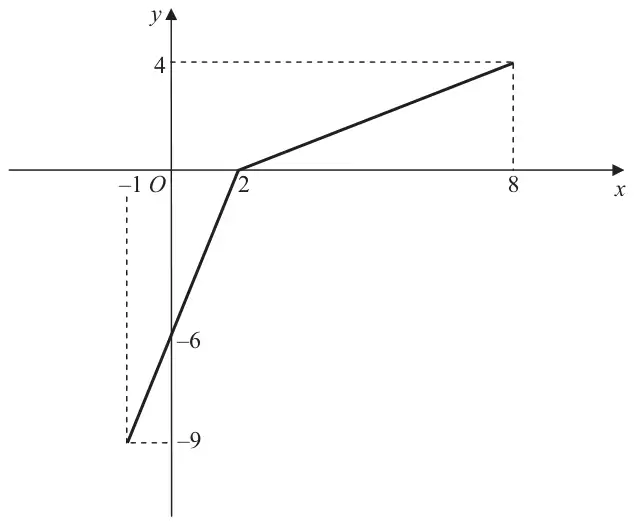
The function g has domain \(-1 \leqslant x \leqslant 8\), and is linear from \((-1, -9)\) to \((2, 0)\) and from \((2, 0)\) to \((8, 4)\). Figure 2 shows a sketch of the graph of \(y = \mathrm{g}(x)\).
Show on each sketch the coordinates of each point at which the graph meets or cuts the axes. (4)
| Scheme | Marks |
|---|---|
| \(y = \dfrac{3 - 2x}{x - 5} \Rightarrow y(x - 5) = 3 - 2x\) | M1 |
| \(xy - 5y = 3 - 2x\) | |
| \(\Rightarrow xy + 2x = 3 + 5y \Rightarrow x(y + 2) = 3 + 5y\) | M1 |
| \(\Rightarrow x = \dfrac{3 + 5y}{y + 2} \qquad \therefore\ \mathrm{f}^{-1}(x) = \underline{\dfrac{3 + 5x}{x + 2}}\) | A1 oe |
| (3) |
Notes
M1: Attempt to make \(x\) (or swapped \(y\)) the subject
M1: Collect \(x\) terms together and factorise.
A1 oe: \(\underline{\dfrac{3 + 5x}{x + 2}}\)
| Scheme | Marks |
|---|---|
| Range of g is \(-9 \leqslant \mathrm{g}(x) \leqslant 4\) or \(-9 \leqslant y \leqslant 4\) | B1 |
| (1) |
Notes
B1: Correct Range
| Scheme | Marks |
|---|---|
| \(\mathrm{g}\,\mathrm{g}(2) = \mathrm{g}(0) = -6\), from sketch. | M1 A1 |
| (2) |
Notes
M1: Deduces that \(\mathrm{g}(2)\) is 0. Seen or implied.
A1: \(-6\)
| Scheme | Marks |
|---|---|
| \(\mathrm{fg}(8) = \mathrm{f}(4)\) | M1 |
| \(= \dfrac{3 - 4(2)}{4 - 5} = \dfrac{-5}{-1} = \underline{5}\) | A1 |
| (2) |
Notes
M1: Correct order g followed by f
A1: 5
| Scheme | Marks |
|---|---|
(e)(ii)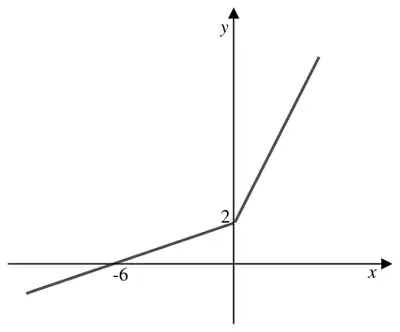 | B1 B1 |
| (4) |
Notes
B1: Correct shape
B1: Graph goes through \((\{0\}, 2)\) and \((-6, \{0\})\) which are marked.
CHECK: the published mark scheme does not include the scheme for (e)(i); only (e)(ii) is printed, with a total of (4) for part (e).
| Scheme | Marks |
|---|---|
| Domain of \(\mathrm{g}^{-1}\) is \(-9 \leqslant x \leqslant 4\) | B1ft |
| (1) | |
| (13 marks) |
Notes
B1ft: Either correct answer or a follow through from part (b) answer