
C3 June 2010 Q4
4. The function f is defined by
\[\mathrm{f} : x \mapsto \left|2x - 5\right|, \quad x \in \mathbb{R}\]The function g is defined by
\[\mathrm{g} : x \mapsto x^2 - 4x + 1, \quad x \in \mathbb{R}, \quad 0 \leqslant x \leqslant 5\]| Scheme | Marks |
|---|---|
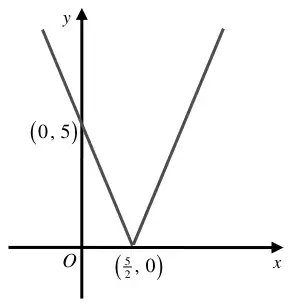 | M1A1 |
| (2) |
Notes
(a) M1: V or

or

graph with vertex on the \(x\)-axis.
A1: \(\left(\tfrac{5}{2}, \{0\}\right)\) and \((\{0\}, 5)\) seen and the graph appears in both the first and second quadrants.
| Scheme | Marks |
|---|---|
| \(\underline{x = 20}\) | B1 |
| \(2x - 5 = -(15 + x)\); \(\Rightarrow \underline{x = -\tfrac{10}{3}}\) | M1;A1 oe. |
| (3) |
Notes
(b) M1: Either \(2x - 5 = -(15 + x)\) or \(-(2x - 5) = 15 + x\)
| Scheme | Marks |
|---|---|
| \(\mathrm{fg}(2) = \mathrm{f}(-3) = \left|2(-3) - 5\right|; = \left|-11\right| = 11\) | M1;A1 |
| (2) |
Notes
(c) M1: Full method of inserting \(\mathrm{g}(2)\) into \(\mathrm{f}(x) = \left|2x - 5\right|\) or for inserting \(x = 2\) into \(\left|2(x^2 - 4x + 1) - 5\right|\). There must be evidence of the modulus being applied.
| Scheme | Marks |
|---|---|
| \(\mathrm{g}(x) = x^2 - 4x + 1 = (x - 2)^2 - 4 + 1 = (x - 2)^2 - 3\). Hence \(\mathrm{g}_{\min} = -3\) | M1 |
| Either \(\mathrm{g}_{\min} = -3\) or \(\mathrm{g}(x) \geqslant -3\) or \(\mathrm{g}(5) = 25 - 20 + 1 = 6\) | B1 |
| \(\underline{-3 \leqslant \mathrm{g}(x) \leqslant 6}\) or \(\underline{-3 \leqslant y \leqslant 6}\) | A1 |
| (3) | |
| (10 marks) |
Notes
(d) M1: Full method to establish the minimum of g. Eg: \((x \pm \alpha)^2 + \beta\) leading to \(\mathrm{g}_{\min} = \beta\). Or for candidate to differentiate the quadratic, set the result equal to zero, find \(x\) and insert this value of \(x\) back into \(\mathrm{f}(x)\) in order to find the minimum.
B1: For either finding the correct minimum value of g (can be implied by \(\mathrm{g}(x) \geqslant -3\) or \(\mathrm{g}(x) \gt -3\)) or for stating that \(\mathrm{g}(5) = 6\).
A1: \(\underline{-3 \leqslant \mathrm{g}(x) \leqslant 6}\) or \(\underline{-3 \leqslant y \leqslant 6}\) or \(\underline{-3 \leqslant \mathrm{g} \leqslant 6}\). Note that: \(-3 \leqslant x \leqslant 6\) is A0.
Note that: \(-3 \leqslant \mathrm{f}(x) \leqslant 6\) is A0. Note that: \(-3 \geqslant \mathrm{g}(x) \geqslant 6\) is A0.
Note that: \(\mathrm{g}(x) \geqslant -3\) or \(\mathrm{g}(x) \gt -3\) or \(x \geqslant -3\) or \(x \gt -3\) with no working gains M1B1A0.
Note that for the final Accuracy Mark:
If a candidate writes down \(-3 \lt \mathrm{g}(x) \lt 6\) or \(-3 \lt y \lt 6\), then award M1B1A0.
If, however, a candidate writes down \(\mathrm{g}(x) \geqslant -3\), \(\mathrm{g}(x) \leqslant 6\), then award A0.
If a candidate writes down \(\mathrm{g}(x) \geqslant -3\) or \(\mathrm{g}(x) \leqslant 6\), then award A0.