
June 2018 Paper 1 Q14
14. A curve \(C\) has parametric equations
\[x = 3 + 2\sin t, \qquad y = 4 + 2\cos 2t, \qquad 0 \leqslant t \lt 2\pi\]The line with equation \(x + y = k\), where \(k\) is a constant, intersects \(C\) at two distinct points.
| Scheme | Marks | AO |
|---|---|---|
| Attempts to use \(\cos 2t = 1 - 2\sin^2 t \Rightarrow \dfrac{y - 4}{2} = 1 - 2\left(\dfrac{x - 3}{2}\right)^2\) | M1 | 2.1 |
| \(\Rightarrow y - 4 = 2 - 4 \times \dfrac{(x - 3)^2}{4} \Rightarrow y = 6 - (x - 3)^2\) * | A1* | 1.1b |
| (2) |
Notes
M1: Uses \(\cos 2t = 1 - 2\sin^2 t\) in an attempt to eliminate \(t\)
A1*: Proceeds to \(y = 6 - (x - 3)^2\) without any errors
Allow a proof where they start with \(y = 6 - (x - 3)^2\) and substitute the parametric coordinates. M1 is scored for a correct \(\cos 2t = 1 - 2\sin^2 t\) but A1 is only scored when both sides are seen to be the same AND a comment is made, hence proven, or similar .
| Scheme | Marks | AO |
|---|---|---|
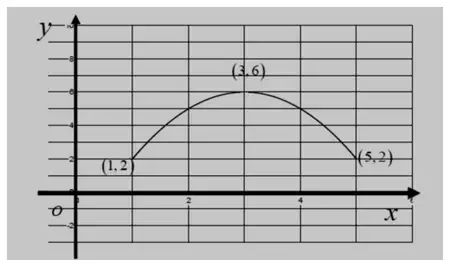 | M1 | 1.1b |
| Fully correct with 'ends' at \((1,2)\) & \((5,2)\) | A1 | 1.1b |
| Suitable reason : Eg states as \(x = 3 + 2\sin t,\ 1 \leqslant x \leqslant 5\) | B1 | 2.4 |
| (3) |
Notes
(b) M1: For sketching a \(\cap\) parabola with a maximum in quadrant one. It does not need to be symmetrical
A1: For sketching a \(\cap\) parabola with a maximum in quadrant one and with end coordinates of \((1, 2)\) and \((5, 2)\)
B1: Any suitable explanation as to why \(C\) does not include all points of \(y = 6 - (x - 3)^2,\ \ x \in \mathbb{R}\)
This should include a reference to the limits on sin or cos with a link to a restriction on \(x\) or \(y\).
For example
‘As \(-1 \leqslant \sin t \leqslant 1\) then \(1 \leqslant x \leqslant 5\)’ Condone in words ‘\(x\) lies between 1 and 5’ and strict inequalities
‘As \(\sin t \leqslant 1\) then \(x \leqslant 5\)’ Condone in words ‘\(x\) is less than 5’
‘As \(-1 \leqslant \cos(2t) \leqslant 1\) then \(2 \leqslant y \leqslant 6\)’ Condone in words ‘\(y\) lies between 2 and 6’
Withhold if the statement is incorrect Eg "because the domain is \(2 \leqslant x \leqslant 5\)"
Do not allow a statement on the top limit of \(y\) as this is the same for both curves
| Scheme | Marks | AO |
|---|---|---|
| Either finds the lower value for \(k = 7\) or deduces that \(k \lt \dfrac{37}{4}\) | B1 | 2.2a |
| Finds where \(x + y = k\) meets \(y = 6 - (x - 3)^2\) \(\Rightarrow k - x = 6 - (x - 3)^2\) and proceeds to 3TQ in \(x\) or \(y\) | M1 | 3.1a |
| Correct 3TQ in \(x\) \(\quad x^2 - 7x + (k + 3) = 0\) Or \(y\) \(\quad y^2 + (7 - 2k)y + \left(k^2 - 6k + 3\right) = 0\) | A1 | 1.1b |
| Uses \(b^2 - 4ac = 0 \Rightarrow 49 - 4 \times 1 \times (k + 3) = 0 \Rightarrow k = \left(\dfrac{37}{4}\right)\) or \((7 - 2k)^2 - 4 \times 1 \times \left(k^2 - 6k + 3\right) = 0 \Rightarrow k = \left(\dfrac{37}{4}\right)\) | M1 | 2.1 |
| Range of values for \(k = \left\{k : 7 \leqslant k \lt \dfrac{37}{4}\right\}\) | A1 | 2.5 |
| (5) | ||
| (10 marks) |
Notes
B1: Deduces either
- the correct that the lower value of \(k = 7\) This can be found by substituting into \((5, 2)\)
\(x + y = k \Rightarrow k = 7\) or substituting \(x = 5\) into \(x^2 - 7x + (k + 3) = 0 \Rightarrow 25 - 35 + k + 3 = 0 \Rightarrow k = 7\) - or deduces that \(k \lt \dfrac{37}{4}\) This may be awarded from later work
M1: For an attempt at the upper value for \(k\).
Finds where \(x + y = k\) meets \(y = 6 - (x - 3)^2\) once by using an appropriate method.
Eg. Sets \(k - x = 6 - (x - 3)^2\) and proceeds to a 3TQ
A1: Correct 3TQ \(x^2 - 7x + (k + 3) = 0\) The = 0 may be implied by subsequent work
M1: Uses the "discriminant" condition. Accept use of \(b^2 = 4ac\) oe or \(b^2 \ldots 4ac\) where ... is any inequality leading to a critical value for \(k\). Eg. one root \(\Rightarrow 49 - 4 \times 1 \times (k + 3) = 0 \Rightarrow k = \dfrac{37}{4}\)
A1: Range of values for \(k = \left\{k : 7 \leqslant k \lt \dfrac{37}{4}\right\}\) Accept \(k \in \left[7, \dfrac{37}{4}\right)\) or exact equivalent
Alternative (c)
| Scheme | Marks | AO |
|---|---|---|
| As above | B1 | 2.2a |
| Finds where \(x + y = k\) meets \(y = 6 - (x - 3)^2\) once by using an appropriate method. Eg. Sets gradient of \(y = 6 - (x - 3)^2\) equal to \(-1\) | M1 | 3.1a |
| \(-2x + 6 = -1 \Rightarrow x = 3.5\) | A1 | 1.1b |
| Finds point of intersection and uses this to find upper value of \(k\). \(y = 6 - (3.5 - 3)^2 = 5.75\) Hence using \(k = 3.5 + 5.75 = 9.25\) | M1 | 2.1 |
| Range of values for \(k = \{k : 7 \leqslant k \lt 9.25\}\) | A1 | 2.5 |