
June 2019 Paper 2 Q4
4.
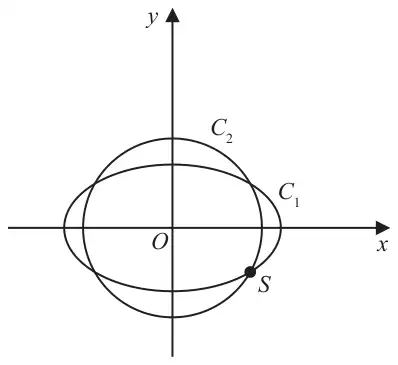
The curve \(C_1\) with parametric equations
\[x = 10\cos t, \quad y = 4\sqrt{2}\sin t, \quad 0 \leqslant t \lt 2\pi\]meets the circle \(C_2\) with equation
\[x^2 + y^2 = 66\]at four distinct points as shown in Figure 2.
Given that one of these points, \(S\), lies in the 4th quadrant, find the Cartesian coordinates of \(S\). (6)
| Scheme | Marks | AO |
|---|---|---|
| \(C_1:\ x = 10\cos t,\ y = 4\sqrt{2}\sin t,\ 0 \leqslant t \lt 2\pi;\ \ C_2: x^2 + y^2 = 66\) | ||
| Way 1 \((10\cos t)^2 + (4\sqrt{2}\sin t)^2 = 66\) | M1 | 3.1a |
| \(100(1 - \sin^2 t) + 32\sin^2 t = 66\) or \(100\cos^2 t + 32(1 - \cos^2 t) = 66\) | M1 A1 | 2.1 1.1b |
| \(100 - 68\sin^2 t = 66 \Rightarrow \sin^2 t = \dfrac{1}{2} \Rightarrow \sin t = \ldots\) or \(68\cos^2 t + 32 = 66 \Rightarrow \cos^2 t = \dfrac{1}{2} \Rightarrow \cos t = \ldots\) | dM1 | 1.1b |
| Substitutes their solution back into the relevant original equation(s) to get the value of the \(x\)-coordinate and value of the corresponding \(y\)-coordinate. Note: These may not be in the correct quadrant | M1 | 1.1b |
| \(S = (5\sqrt{2},\ -4)\) or \(x = 5\sqrt{2},\ y = -4\) or \(S = (\text{awrt } 7.07,\ -4)\) | A1 | 3.2a |
| Note: Give final A0 for writing \(x = 5\sqrt{2},\ y = -4\) followed by \(S = (-4,\ 5\sqrt{2})\) | ||
| (6) | ||
| (6 marks) |
Notes
Way 2
| Scheme | Marks | AO |
|---|---|---|
| \(\{\cos^2 t + \sin^2 t = 1 \Rightarrow\}\ \left(\dfrac{x}{10}\right)^2 + \left(\dfrac{y}{4\sqrt{2}}\right)^2 = 1\ \{\Rightarrow 32x^2 + 100y^2 = 3200\}\) | M1 | 3.1a |
| \(\dfrac{x^2}{100} + \dfrac{66 - x^2}{32} = 1\) or \(\dfrac{66 - y^2}{100} + \dfrac{y^2}{32} = 1\) | M1 A1 | 2.1 1.1b |
| \(32x^2 + 6600 - 100x^2 = 3200\), \(x^2 = 50 \Rightarrow x = \ldots\) or \(2112 - 32y^2 + 100y^2 = 3200\), \(y^2 = 16 \Rightarrow y = \ldots\) | dM1 | 1.1b |
| Substitutes their solution back into the relevant original equation(s) to get the value of the corresponding \(x\)-coordinate or \(y\)-coordinate. Note: These may not be in the correct quadrant | M1 | 1.1b |
| \(S = (5\sqrt{2},\ -4)\) or \(x = 5\sqrt{2},\ y = -4\) or \(S = (\text{awrt } 7.07,\ -4)\) | A1 | 3.2a |
| (6) |
Way 3
| Scheme | Marks | AO |
|---|---|---|
| \(\{C_2: x^2 + y^2 = 66 \Rightarrow\}\ x = \sqrt{66}\cos\alpha,\ y = \sqrt{66}\sin\alpha\) \(\{C_1 = C_2 \Rightarrow\}\ 10\cos t = \sqrt{66}\cos\alpha,\ 4\sqrt{2}\sin t = \sqrt{66}\sin\alpha\) \(\{\cos^2\alpha + \sin^2\alpha = 1 \Rightarrow\}\ \left(\dfrac{10\cos t}{\sqrt{66}}\right)^2 + \left(\dfrac{4\sqrt{2}\sin t}{\sqrt{66}}\right)^2 = 1\) | M1 | 3.1a |
| then continue with applying the mark scheme for Way 1 |
Way 4
| Scheme | Marks | AO |
|---|---|---|
| \((10\cos t)^2 + (4\sqrt{2}\sin t)^2 = 66\) | M1 | 3.1a |
| \(100\left(\dfrac{1 + \cos 2t}{2}\right) + 32\left(\dfrac{1 - \cos 2t}{2}\right) = 66\) | M1 A1 | 2.1 1.1b |
| \(50 + 50\cos 2t + 16 - 16\cos 2t = 66 \Rightarrow 34\cos 2t + 66 = 66\) \(\Rightarrow \cos 2t = \ldots\) | dM1 | 1.1b |
| Substitutes their solution back into the original equation(s) to get the value of the \(x\)-coordinate and value of the \(y\)-coordinate. Note: These may not be in the correct quadrant | M1 | 1.1b |
| \(S = (5\sqrt{2},\ -4)\) or \(x = 5\sqrt{2},\ y = -4\) or \(S = (\text{awrt } 7.07,\ -4)\) | A1 | 3.2a |
| (6) |
Way 5
| Scheme | Marks | AO |
|---|---|---|
| \((10\cos t)^2 + (4\sqrt{2}\sin t)^2 = 66\) | M1 | 3.1a |
| \((10\cos t)^2 + (4\sqrt{2}\sin t)^2 = 66(\sin^2 t + \cos^2 t)\) | M1 A1 | 2.1 1.1b |
| \(100\cos^2 t + 32\sin^2 t = 66\sin^2 t + 66\cos^2 t \Rightarrow 34\cos^2 t = 34\sin^2 t\) \(\Rightarrow \tan t = \ldots\) | dM1 | 1.1b |
| Substitutes their solution back into the relevant original equation(s) to get the value of the \(x\)-coordinate and value of the corresponding \(y\)-coordinate. Note: These may not be in the correct quadrant | M1 | 1.1b |
| \(S = (5\sqrt{2},\ -4)\) or \(x = 5\sqrt{2},\ y = -4\) or \(S = (\text{awrt } 7.07,\ -4)\) | A1 | 3.2a |
| (6) |
Notes for Question 4
Way 1
M1: Begins to solve the problem by applying an appropriate strategy.
E.g. Way 1: A complete process of combining equations for \(C_1\) and \(C_2\) by substituting the parametric equation into the Cartesian equation to give an equation in one variable (i.e. \(t\)) only.
M1: Uses the identity \(\sin^2 t + \cos^2 t \equiv 1\) to achieve an equation in \(\sin^2 t\) only or \(\cos^2 t\) only
A1: A correct equation in \(\sin^2 t\) only or \(\cos^2 t\) only
dM1: dependent on both the previous M marks
Rearranges to make \(\sin t = \ldots\) where \(-1 \leqslant \sin t \leqslant 1\) or \(\cos t = \ldots\) where \(-1 \leqslant \cos t \leqslant 1\)
Note: Condone 3rd M1 for \(\sin^2 t = \dfrac{1}{2} \Rightarrow \sin t = \dfrac{1}{4}\)
M1: See scheme
A1: Selects the correct coordinates for \(S\)
Allow either \(S = (5\sqrt{2},\ -4)\) or \(S = (\text{awrt } 7.07,\ -4)\)
Way 2
M1: Begins to solve the problem by applying an appropriate strategy.
E.g. Way 2: A complete process of using \(\cos^2 t + \sin^2 t \equiv 1\) to convert the parametric equation for \(C_1\) into a Cartesian equation for \(C_1\)
M1: Complete valid attempt to write an equation in terms of \(x\) only or \(y\) only not involving trigonometry
A1: A correct equation in \(x\) only or \(y\) only not involving trigonometry
dM1: dependent on both the previous M marks
Rearranges to make \(x = \ldots\) or \(y = \ldots\)
Note: their \(x^2\) or their \(y^2\) must be \(\gt 0\) for this mark
M1: See scheme
Note: their \(x^2\) and their \(y^2\) must be \(\gt 0\) for this mark
A1: Selects the correct coordinates for \(S\)
Allow either \(S = (5\sqrt{2},\ -4)\) or \(S = (\text{awrt } 7.07,\ -4)\) or \(S = (\sqrt{50},\ -4)\) or \(S = \left(\dfrac{10}{\sqrt{2}},\ -4\right)\)
Way 3
M1: Begins to solve the problem by applying an appropriate strategy.
E.g. Way 3: A complete process of writing \(C_2\) in parametric form, combining the parametric equations of \(C_1\) and \(C_2\) and applying \(\cos^2\alpha + \sin^2\alpha \equiv 1\) to give an equation in one variable (i.e. \(t\)) only.
then continue with applying the mark scheme for Way 1
Way 4
M1: Begins to solve the problem by applying an appropriate strategy.
E.g. Way 4: A complete process of combining equations for \(C_1\) and \(C_2\) by substituting the parametric equation into the Cartesian equation to give an equation in one variable (i.e. \(t\)) only.
M1: Uses the identities \(\cos 2t \equiv 2\cos^2 t - 1\) and \(\cos 2t \equiv 1 - 2\sin^2 t\) to achieve an equation in \(\cos 2t\) only
Note: At least one of \(\cos 2t \equiv 2\cos^2 t - 1\) or \(\cos 2t \equiv 1 - 2\sin^2 t\) must be correct for this mark.
A1: A correct equation in \(\cos 2t\) only
dM1: dependent on both the previous M marks
Rearranges to make \(\cos 2t = \ldots\) where \(-1 \leqslant \cos 2t \leqslant 1\)
M1: See scheme
A1: Selects the correct coordinates for \(S\)
Allow either \(S = (5\sqrt{2},\ -4)\) or \(S = (\text{awrt } 7.07,\ -4)\) or \(S = (\sqrt{50},\ -4)\) or \(S = \left(\dfrac{10}{\sqrt{2}},\ -4\right)\)
Way 5
M1: Begins to solve the problem by applying an appropriate strategy.
E.g. Way 5: A complete process of combining equations for \(C_1\) and \(C_2\) by substituting the parametric equation into the Cartesian equation to give an equation in one variable (i.e. \(t\)) only.
M1: Uses the identity \(\sin^2 t + \cos^2 t \equiv 1\) to achieve an equation in \(\sin^2 t\) only and \(\cos^2 t\) only with no constant term
A1: A correct equation in \(\sin^2 t\) and \(\cos^2 t\) containing no constant term
dM1: dependent on both the previous M marks
Rearranges to make \(\tan t = \ldots\)
M1: See scheme
A1: Selects the correct coordinates for \(S\)
Allow either \(S = (5\sqrt{2},\ -4)\) or \(S = (\text{awrt } 7.07,\ -4)\) or \(S = (\sqrt{50},\ -4)\) or \(S = \left(\dfrac{10}{\sqrt{2}},\ -4\right)\)