
June 2018 Paper 1 Q6
6.
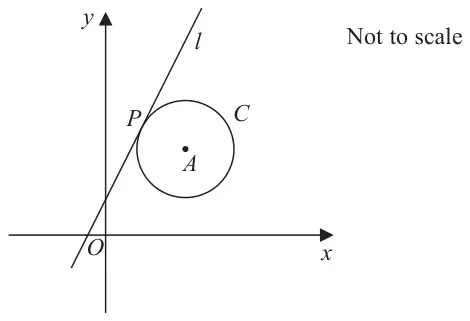
The circle \(C\) has centre \(A\) with coordinates \((7, 5)\).
The line \(l\), with equation \(y = 2x + 1\), is the tangent to \(C\) at the point \(P\), as shown in Figure 3.
The line with equation \(y = 2x + k\), \(\ k \neq 1\) is also a tangent to \(C\).
| Scheme | Marks | AO |
|---|---|---|
| Deduces that gradient of \(PA\) is \(-\dfrac{1}{2}\) | M1 | 2.2a |
| Finding the equation of a line with gradient \(\text{``}{-}\dfrac{1}{2}\text{''}\) and point \((7, 5)\) \(y - 5 = -\dfrac{1}{2}(x - 7)\) | M1 | 1.1b |
| Completes proof \(2y + x = 17\) * | A1* | 1.1b |
| (3) |
Notes
M1: Uses the idea of perpendicular gradients to deduce that gradient of \(PA\) is \(-\dfrac{1}{2}\). Condone \(-\dfrac{1}{2}x\) if followed by correct work. You may well see the perpendicular line set up as \(y = -\dfrac{1}{2}x + c\) which scored this mark
M1: Award for the method of finding the equation of a line with a changed gradient and the point \((7, 5)\)
So sight of \(y - 5 = \dfrac{1}{2}(x - 7)\) would score this mark
If the form \(y = mx + c\) is used expect the candidates to proceed as far as \(c = \ldots\) to score this mark.
A1*: Completes proof with no errors or omissions \(2y + x = 17\)
| Scheme | Marks | AO |
|---|---|---|
| Solves \(2y + x = 17\) and \(y = 2x + 1\) simultaneously | M1 | 2.1 |
| \(P = (3, 7)\) | A1 | 1.1b |
| Length \(PA = \sqrt{(3 - 7)^2 + (7 - 5)^2} = \left(\sqrt{20}\right)\) | M1 | 1.1b |
| Equation of C is \((x - 7)^2 + (y - 5)^2 = 20\) | A1 | 1.1b |
| (4) |
Notes
M1: Awarded for an attempt at the key step of finding the coordinates of point \(P\). ie for an attempt at solving \(2y + x = 17\) and \(y = 2x + 1\) simultaneously. Allow any methods (including use of a calculator) but it must be a valid attempt to find both coordinates. Do not allow where they start \(17 - x = 2x + 1\) as they have set \(2y = y\) but condone bracketing errors, eg \(2 \times 2x + 1 + x = 17\)
A1: \(P = (3, 7)\)
M1: Uses Pythagoras’ Theorem to find the radius or radius \(^2\) using their \(P = (3, 7)\) and \((7, 5)\). There must be an attempt to find the difference between the coordinates in the use of Pythagoras
A1: \((x - 7)^2 + (y - 5)^2 = 20\). Do not accept \((x - 7)^2 + (y - 5)^2 = \left(\sqrt{20}\right)^2\)
| Scheme | Marks | AO |
|---|---|---|
| Attempts to find where \(y = 2x + k\) meets \(C\) using \(\overrightarrow{OA} + \overrightarrow{PA}\) | M1 | 3.1a |
| Substitutes their \((11, 3)\) in \(y = 2x + k\) to find \(k\) | M1 | 2.1 |
| \(k = -19\) | A1 | 1.1b |
| (3) | ||
| (10 marks) |
Notes
Alternative (c)
| Scheme | Marks | AO |
|---|---|---|
| Attempts to find where \(y = 2x + k\) meets \(C\) via simultaneous equations proceeding to a 3TQ in \(x\) (or \(y\)) FYI \(5x^2 + (4k - 34)x + k^2 - 10k + 54 = 0\) | M1 | 3.1a |
| Uses \(b^2 - 4ac = 0\) oe and proceeds to \(k = \ldots\) | M1 | 2.1 |
| \(k = -19\) | A1 | 1.1b |
| (3) |
M1: Attempts to find where \(y = 2x + k\) meets \(C\).
Awarded for using \(\overrightarrow{OA} + \overrightarrow{PA}\). \((11, 3)\) or one correct coordinate of \((11, 3)\) is evidence of this award.
M1: For a full method leading to \(k\). Scored for either substituting their \((11, 3)\) in \(y = 2x + k\)
or, in the alternative, for solving their \((4k - 34)^2 - 4 \times 5 \times \left(k^2 - 10k + 54\right) = 0 \Rightarrow k = \ldots\) Allow use of a calculator here to find roots. Award if you see use of correct formula but it would be implied by ± correct roots
A1: \(k = -19\) only
Alternative I
M1: For solving \(y = 2x + k\) with their \((x - 7)^2 + (y - 5)^2 = 20\) and creating a quadratic eqn of the form \(ax^2 + bx + c = 0\) where both \(b\) and \(c\) are dependent upon \(k\). The terms in \(x^2\) and \(x\) must be collected together or implied to have been collected by their correct use in "\(b^2 - 4ac\)"
FYI the correct quadratic is \(5x^2 + (4k - 34)x + k^2 - 10k + 54 = 0\)
M1: For using the discriminant condition \(b^2 - 4ac = 0\) to find \(k\). It is not dependent upon the previous M and may be awarded from only one term in \(k\).
\((4k - 34)^2 - 4 \times 5 \times \left(k^2 - 10k + 54\right) = 0 \Rightarrow k = \ldots\) Allow use of a calculator here to find roots.
Award if you see use of correct formula but it would be implied by ± correct roots
A1: \(k = -19\) only
Alternative II
M1: For solving \(2y + x = 17\) with their \((x - 7)^2 + (y - 5)^2 = 20\), creating a 3TQ and solving.
M1: For substituting their \((11, 3)\) into \(y = 2x + k\) and finding \(k\)
A1: \(k = -19\) only
Other method are possible using trigonometry.