
C4 June 2018 Q5
5.
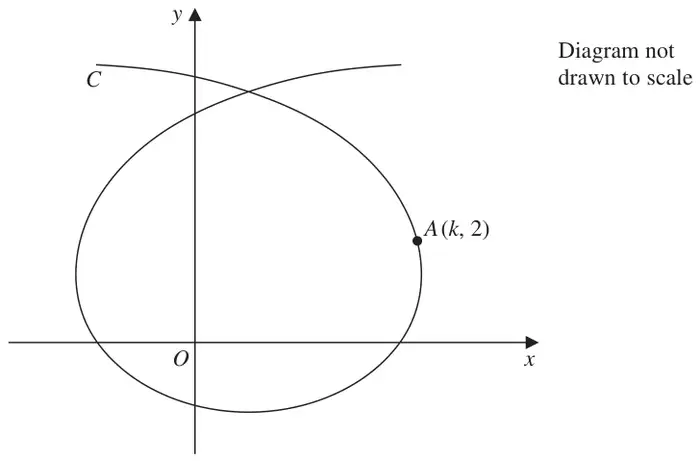
Figure 2 shows a sketch of the curve \(C\) with parametric equations \[x = 1 + t - 5\sin t, \quad y = 2 - 4\cos t, \quad -\pi \leqslant t \leqslant \pi\]
The point \(A\) lies on the curve \(C\).
Given that the coordinates of \(A\) are \((k, 2)\), where \(k > 0\)
Give your answer in the form \(y = px + q\), where \(p\) and \(q\) are exact real values. (5)
| Scheme | Marks |
|---|---|
| \(x = 1 + t - 5\sin t,\ y = 2 - 4\cos t,\ -\pi \leqslant t \leqslant \pi;\ A(k, 2),\ k > 0\), lies on \(C\) | |
| \(\{\text{When } y = 2,\}\ 2 = 2 - 4\cos t \Rightarrow t = -\dfrac{\pi}{2}, \dfrac{\pi}{2}\) \(k \text{ (or } x) = 1 + \dfrac{\pi}{2} - 5\sin\left(\dfrac{\pi}{2}\right)\) or \(k \text{ (or } x) = 1 - \dfrac{\pi}{2} - 5\sin\left(-\dfrac{\pi}{2}\right)\) Sets \(y = 2\) to find \(t\) and some evidence of using their \(t\) to find \(x = \ldots\) | M1 |
| \(\left\{\text{When } t = -\dfrac{\pi}{2},\ k > 0,\right\}\) so \(k = 6 - \dfrac{\pi}{2}\) or \(\dfrac{12 - \pi}{2}\) \(k \text{ (or } x) = 6 - \dfrac{\pi}{2}\) or \(\dfrac{12 - \pi}{2}\) | A1 |
| (2) |
Notes
Note: M1 can be implied by either \(x\) or \(k = 6 - \dfrac{\pi}{2}\) or awrt 4.43 or \(x\) or \(k = \dfrac{\pi}{2} - 4\) or awrt \(-2.43\)
Note: An answer of 4.429… without reference to a correct exact answer is A0
Note: M1 can be earned in part (a) by working in degrees
Note: Give M0 for not substituting their \(t\) back into \(x\). E.g. \(2 = 2 - 4\cos t \Rightarrow t = -\dfrac{\pi}{2} \Rightarrow k = -\dfrac{\pi}{2}\)
Note: If two values for \(k\) are found, they must identify the correct answer for A1
Note: Condone M1 for \(2 = 2 - 4\cos t \Rightarrow t = -\dfrac{\pi}{2}, \dfrac{\pi}{2} \Rightarrow x = 1 - \dfrac{\pi}{2} - 5\sin\left(\dfrac{\pi}{2}\right)\)
| Scheme | Marks |
|---|---|
| \(\dfrac{\mathrm{d}x}{\mathrm{d}t} = 1 - 5\cos t,\ \dfrac{\mathrm{d}y}{\mathrm{d}t} = 4\sin t\) At least one of \(\dfrac{\mathrm{d}x}{\mathrm{d}t}\) or \(\dfrac{\mathrm{d}y}{\mathrm{d}t}\) correct (Can be implied) Both \(\dfrac{\mathrm{d}x}{\mathrm{d}t}\) and \(\dfrac{\mathrm{d}y}{\mathrm{d}t}\) are correct (Can be implied) | B1 B1 |
| \(\dfrac{\mathrm{d}y}{\mathrm{d}x} = \dfrac{4\sin t}{1 - 5\cos t}\) at \(t = -\dfrac{\pi}{2},\ \dfrac{\mathrm{d}y}{\mathrm{d}x} = \dfrac{4\sin\left(-\frac{\pi}{2}\right)}{1 - 5\cos\left(-\frac{\pi}{2}\right)}\ \{= -4\}\) Applies their \(\dfrac{\mathrm{d}y}{\mathrm{d}t}\) divided by their \(\dfrac{\mathrm{d}x}{\mathrm{d}t}\) and substitutes their \(t\) into their \(\dfrac{\mathrm{d}y}{\mathrm{d}x}\) Note: their \(t\) can lie outside \(-\pi \leqslant t \leqslant \pi\) for this mark | M1 |
| • \(y - 2 = -4\left(x - \left(6 - \dfrac{\pi}{2}\right)\right)\) • \(2 = (-4)\left(6 - \dfrac{\pi}{2}\right) + c \Rightarrow y = -4x + 2 + 4\left(6 - \dfrac{\pi}{2}\right)\) Correct straight line method for an equation of a tangent where \(m_T\ (\neq m_N)\) is found using calculus Note: their \(k\) (or \(x\)) must be in terms of \(\pi\) and correct bracketing must be used or implied | M1 |
| \(\{y - 2 = -4x + 24 - 2\pi \Rightarrow\}\ y = -4x + 26 - 2\pi\) dependent on all previous marks in part (b) \(y = -4x + 26 - 2\pi\) \((p = -4,\ q = 26 - 2\pi)\) | A1 cso |
| (5) | |
| (7 marks) |
Notes
Note: The 1st M mark may be implied by their value for \(\dfrac{\mathrm{d}y}{\mathrm{d}x}\)
e.g. \(\dfrac{\mathrm{d}y}{\mathrm{d}x} = \dfrac{4\sin t}{1 - 5\cos t}\), followed by an answer of \(-4\) (from \(t = -\frac{\pi}{2}\)) or 4 (from \(t = \frac{\pi}{2}\))
Note: Give 1st M0 for applying their \(\dfrac{\mathrm{d}x}{\mathrm{d}t}\) divided by their \(\dfrac{\mathrm{d}y}{\mathrm{d}t}\) even if they state \(\dfrac{\mathrm{d}y}{\mathrm{d}x} = \dfrac{\mathrm{d}y}{\mathrm{d}t} \div \dfrac{\mathrm{d}x}{\mathrm{d}t}\)
2nd M1: • applies \(y - 2 = (\text{their } m_T)(x - (\text{their } k))\),
• applies \(2 = (\text{their } m_T)(\text{their } k) + c\) leading to \(y = (\text{their } m_T)x + (\text{their } c)\)
where \(k\) must be in terms of \(\pi\) and \(m_T\ (\neq m_N)\) is a numerical value found using calculus
Note: Correct bracketing must be used for 2nd M1, but this mark can be implied by later working
Note: The final A mark is dependent on all previous marks in part (b) being scored.
This is because the correct answer can follow from an incorrect \(\dfrac{\mathrm{d}y}{\mathrm{d}x}\)
Note: The first 3 marks can be gained by using degrees in part (b)
Note: Condone mixing a correct \(t\) with an incorrect \(x\) or an incorrect \(t\) with a correct \(x\) for the M marks
Note: Allow final A1 for any answer in the form \(y = px + q\)
E.g. Allow final A1 for \(y = -4x + 26 - 2\pi,\ y = -4x + 2 + 4\left(6 - \dfrac{\pi}{2}\right)\) or \(y = -4x + \left(\dfrac{52 - 4\pi}{2}\right)\)
Note: Do not apply isw in part (b). So, an incorrect answer following from a correct answer is A0
Note: Do not allow \(y = 2(-2x + 13 - \pi)\) for A1
Note: \(y = -4x + 26 - 2\pi\) followed by \(y = 2(-2x + 13 - \pi)\) is condoned for final A1