
C4 June 2017 Q8
8.
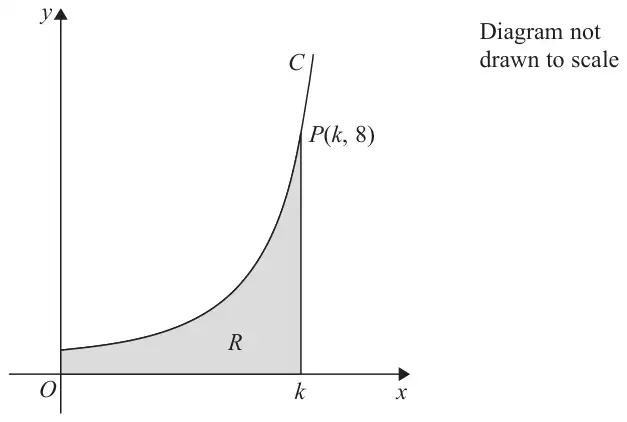
Figure 4 shows a sketch of part of the curve \(C\) with parametric equations \[x = 3\theta\sin\theta, \qquad y = \sec^3\theta, \qquad 0 \leqslant \theta < \frac{\pi}{2}\]
The point \(P(k, 8)\) lies on \(C\), where \(k\) is a constant.
The finite region \(R\), shown shaded in Figure 4, is bounded by the curve \(C\), the \(y\)-axis, the \(x\)-axis and the line with equation \(x = k\).
| Scheme | Marks |
|---|---|
| \(x = 3\theta\sin\theta,\ y = \sec^3\theta,\ 0 \leqslant \theta < \dfrac{\pi}{2}\) | |
| \(\{\text{When } y = 8,\}\ 8 = \sec^3\theta \Rightarrow \cos^3\theta = \dfrac{1}{8} \Rightarrow \cos\theta = \dfrac{1}{2} \Rightarrow \theta = \dfrac{\pi}{3}\) \(k \text{ (or } x) = 3\left(\dfrac{\pi}{3}\right)\sin\left(\dfrac{\pi}{3}\right)\) Sets \(y = 8\) to find \(\theta\) and attempts to substitute their \(\theta\) into \(x = 3\theta\sin\theta\) | M1 |
| so \(k \text{ (or } x) = \dfrac{\sqrt{3}\pi}{2}\) \(\dfrac{\sqrt{3}\pi}{2}\) or \(\dfrac{3\pi}{2\sqrt{3}}\) | A1 |
| Note: Obtaining two value for \(k\) without accepting the correct value is final A0 | |
| (2) |
| Scheme | Marks |
|---|---|
| \(\dfrac{\mathrm{d}x}{\mathrm{d}\theta} = 3\sin\theta + 3\theta\cos\theta\) \(3\theta\sin\theta \to 3\sin\theta + 3\theta\cos\theta\). Can be implied by later working | B1 |
| \(\left\{\displaystyle\int y\,\dfrac{\mathrm{d}x}{\mathrm{d}\theta}\{\mathrm{d}\theta\}\right\} = \displaystyle\int (\sec^3\theta)(3\sin\theta + 3\theta\cos\theta)\{\mathrm{d}\theta\}\) Applies \(\left(\pm K\sec^3\theta\right)\left(\text{their } \dfrac{\mathrm{d}x}{\mathrm{d}\theta}\right)\). Ignore integral sign and \(\mathrm{d}\theta\); \(K \neq 0\) | M1 |
| \(= 3\displaystyle\int \theta\sec^2\theta + \tan\theta\sec^2\theta\,\mathrm{d}\theta\) Achieves the correct result no errors in their working, e.g. bracketing or manipulation errors. Must have integral sign and \(\mathrm{d}\theta\) in their final answer. | A1 * |
| \(x = 0\) and \(x = k \Rightarrow \underline{\alpha = 0}\) and \(\underline{\beta = \dfrac{\pi}{3}}\) \(\alpha = 0\) and \(\beta = \dfrac{\pi}{3}\) or evidence of \(0 \to 0\) and \(k \to \dfrac{\pi}{3}\) | B1 |
| Note: The work for the final B1 mark must be seen in part (b) only. | |
| (4) |
| Scheme | Marks |
|---|---|
| Way 1 | |
| \(\left\{\displaystyle\int \theta\sec^2\theta\,\mathrm{d}\theta\right\} = \theta\tan\theta - \displaystyle\int \tan\theta\{\mathrm{d}\theta\}\) \(\theta\sec^2\theta \to A\theta\mathrm{g}(\theta) - B\displaystyle\int \mathrm{g}(\theta),\ A > 0,\ B > 0\), where \(\mathrm{g}(\theta)\) is a trigonometric function in \(\theta\) and \(\mathrm{g}(\theta) = \text{their} \displaystyle\int \sec^2\theta\,\mathrm{d}\theta\). [Note: \(\mathrm{g}(\theta) \neq \sec^2\theta\)] dependent on the previous M mark Either \(\lambda\theta\sec^2\theta \to A\theta\tan\theta - B\displaystyle\int \tan\theta,\ A > 0,\ B > 0\) or \(\theta\sec^2\theta \to \theta\tan\theta - \displaystyle\int \tan\theta\) | M1 dM1 |
| \(= \theta\tan\theta - \ln(\sec\theta)\) or \(= \theta\tan\theta + \ln(\cos\theta)\) \(\theta\sec^2\theta \to \theta\tan\theta - \ln(\sec\theta)\) or \(\theta\tan\theta + \ln(\cos\theta)\) or \(\lambda\theta\sec^2\theta \to \lambda\theta\tan\theta - \lambda\ln(\sec\theta)\) or \(\lambda\theta\tan\theta + \lambda\ln(\cos\theta)\) | A1 |
| Note: Condone \(\theta\sec^2\theta \to \theta\tan\theta - \ln(\sec x)\) or \(\theta\tan\theta + \ln(\cos x)\) for A1 | |
| \(\left\{\displaystyle\int \tan\theta\sec^2\theta\,\mathrm{d}\theta\right\}\) \(= \dfrac{1}{2}\tan^2\theta\) or \(\dfrac{1}{2}\sec^2\theta\) or \(\dfrac{1}{2u^2}\) where \(u = \cos\theta\) or \(\dfrac{1}{2}u^2\) where \(u = \tan\theta\) \(\tan\theta\sec^2\theta\) or \(\lambda\tan\theta\sec^2\theta \to \pm C\tan^2\theta\) or \(\pm C\sec^2\theta\) or \(\pm Cu^{-2}\), where \(u = \cos\theta\) \(\tan\theta\sec^2\theta \to \dfrac{1}{2}\tan^2\theta\) or \(\dfrac{1}{2}\sec^2\theta\) or \(\dfrac{1}{2\cos^2\theta}\) or \(\tan^2\theta - \dfrac{1}{2}\sec^2\theta\) or \(0.5u^{-2}\), where \(u = \cos\theta\) or \(0.5u^2\), where \(u = \tan\theta\) or \(\lambda\tan\theta\sec^2\theta \to \dfrac{\lambda}{2}\tan^2\theta\) or \(\dfrac{\lambda}{2}\sec^2\theta\) or \(\dfrac{\lambda}{2\cos^2\theta}\) or \(0.5\lambda u^{-2}\), where \(u = \cos\theta\) or \(0.5\lambda u^2\), where \(u = \tan\theta\) | M1 A1 |
| \(\{\text{Area}(R)\} = \left[3\theta\tan\theta - 3\ln(\sec\theta) + \dfrac{3}{2}\tan^2\theta\right]_0^{\frac{\pi}{3}}\) or \(\left[3\theta\tan\theta - 3\ln(\sec\theta) + \dfrac{3}{2}\sec^2\theta\right]_0^{\frac{\pi}{3}}\) | |
| \(= \left(3\left(\dfrac{\pi}{3}\right)\sqrt{3} - 3\ln 2 + \dfrac{3}{2}(3)\right) - (0)\) or \(\left(3\left(\dfrac{\pi}{3}\right)\sqrt{3} - 3\ln 2 + \dfrac{3}{2}(4)\right) - \left(\dfrac{3}{2}\right)\) | |
| \(= \dfrac{9}{2} + \sqrt{3}\pi - 3\ln 2\) or \(\dfrac{9}{2} + \sqrt{3}\pi + 3\ln\left(\dfrac{1}{2}\right)\) or \(\dfrac{9}{2} + \sqrt{3}\pi - \ln 8\) or \(\ln\left(\dfrac{1}{8}\mathrm{e}^{\frac{9}{2} + \sqrt{3}\pi}\right)\) | A1 o.e. |
| (6) | |
| (12 marks) |
Notes
Way 2 for the first 5 marks: Applying integration by parts on \(\displaystyle\int (\theta + \tan\theta)\sec^2\theta\,\mathrm{d}\theta\)
| Scheme | Marks |
|---|---|
| \(\displaystyle\int \left(\theta\sec^2\theta + \tan\theta\sec^2\theta\right)\mathrm{d}\theta = \int (\theta + \tan\theta)\sec^2\theta\,\mathrm{d}\theta,\quad \left\{\begin{aligned} u &= \theta + \tan\theta &&\Rightarrow \frac{\mathrm{d}u}{\mathrm{d}\theta} = 1 + \sec^2\theta \\ \frac{\mathrm{d}v}{\mathrm{d}\theta} &= \sec^2\theta &&\Rightarrow v = \tan\theta = \mathrm{g}(\theta) \end{aligned}\right\}\) | |
| \(\mathrm{h}(\theta)\) and \(\mathrm{g}(\theta)\) are trigonometric functions in \(\theta\) and \(\mathrm{g}(\theta) = \text{their} \displaystyle\int \sec^2\theta\,\mathrm{d}\theta\). [Note: \(\mathrm{g}(\theta) \neq \sec^2\theta\)] | |
| \(= (\theta + \tan\theta)\tan\theta - \displaystyle\int (1 + \sec^2\theta)\tan\theta\{\mathrm{d}\theta\}\) \(A(\theta + \tan\theta)\mathrm{g}(\theta) - B\displaystyle\int (1 + \mathrm{h}(\theta))\mathrm{g}(\theta),\ A > 0,\ B > 0\) dependent on the previous M mark Either \(\lambda\left[(\theta + \tan\theta)\sec^2\theta\right] \to A(\theta + \tan\theta)\tan\theta - B\displaystyle\int (1 + \mathrm{h}(\theta))\tan\theta,\ A \neq 0,\ B > 0\) or \((\theta + \tan\theta)\tan\theta - \displaystyle\int (1 + \mathrm{h}(\theta))\tan\theta\) | M1 dM1 |
| \(= (\theta + \tan\theta)\tan\theta - \displaystyle\int (\tan\theta + \tan\theta\sec^2\theta)\{\mathrm{d}\theta\}\) | |
| \(= (\theta + \tan\theta)\tan\theta - \ln(\sec\theta) - \displaystyle\int \tan\theta\sec^2\theta\{\mathrm{d}\theta\}\) \((\theta + \tan\theta)\tan\theta - \ln(\sec\theta)\) o.e. or \(\lambda\left[(\theta + \tan\theta)\tan\theta - \ln(\sec\theta)\right]\) o.e. | A1 |
| \(= (\theta + \tan\theta)\tan\theta - \ln(\sec\theta) - \dfrac{1}{2}\tan^2\theta\) or \(= (\theta + \tan\theta)\tan\theta - \ln(\sec\theta) - \dfrac{1}{2}\sec^2\theta\) etc. \(\tan\theta\sec^2\theta \to \pm C\tan^2\theta\) or \(\pm C\sec^2\theta\) \((\theta + \tan\theta)\tan\theta - \dfrac{1}{2}\tan^2\theta\) or \((\theta + \tan\theta)\tan\theta - \dfrac{1}{2}\sec^2\theta\) | M1 A1 |
| Note: Allow the first two marks in part (c) for \(\theta\tan\theta - \displaystyle\int \tan\theta\) embedded in their working | |
| Note: Allow the first three marks in part (c) for \(\theta\tan\theta - \ln(\sec\theta)\) embedded in their working | |
| Note: Allow 3rd M1 2nd A1 marks for either \(\tan^2\theta - \dfrac{1}{2}\tan^2\theta\) or \(\tan^2\theta - \dfrac{1}{2}\sec^2\theta\) embedded in their working |
Question 8 Notes
Note (a): Allow M1 for an answer of \(k = \) awrt 2.72 without reference to \(\dfrac{\sqrt{3}\pi}{2}\) or \(\dfrac{3\pi}{2\sqrt{3}}\)
Note (a): Allow M1 for an answer of \(k = 3\left(\arccos\left(\tfrac{1}{2}\right)\right)\sin\left(\arccos\left(\tfrac{1}{2}\right)\right)\) without reference to \(\dfrac{\sqrt{3}\pi}{2}\) or \(\dfrac{3\pi}{2\sqrt{3}}\)
Note (a): E.g. allow M1 for \(\theta = 60^\circ\), leading to \(k = 3(60)\sin(60)\) or \(k = 90\sqrt{3}\)
Note (b): To gain A1, \(\mathrm{d}\theta\) does not need to appear until they obtain \(3\displaystyle\int \left(\theta\sec^2\theta + \tan\theta\sec^2\theta\right)\mathrm{d}\theta\)
Note (b): For M1, their \(\dfrac{\mathrm{d}x}{\mathrm{d}\theta}\), where their \(\dfrac{\mathrm{d}x}{\mathrm{d}\theta} \neq 3\theta\sin\theta\), needs to be a trigonometric function in \(\theta\)
Note (b): Writing \(\displaystyle\int (\sec^3\theta)(3\sin\theta + 3\theta\cos\theta) = 3\int \left(\theta\sec^2\theta + \tan\theta\sec^2\theta\right)\mathrm{d}\theta\) is sufficient for B1M1A1
Note (b): Writing \(\dfrac{\mathrm{d}x}{\mathrm{d}\theta} = 3\sin\theta + 3\theta\cos\theta\) followed by writing \(\displaystyle\int y\,\dfrac{\mathrm{d}x}{\mathrm{d}\theta}\,\mathrm{d}\theta = 3\int \left(\theta\sec^2\theta + \tan\theta\sec^2\theta\right)\mathrm{d}\theta\) is sufficient for B1M1A1
Note (b): The final A mark would be lost for \(\displaystyle\int \frac{1}{\cos^3\theta}3\sin\theta + 3\theta\cos\theta = 3\int \left(\theta\sec^2\theta + \tan\theta\sec^2\theta\right)\mathrm{d}\theta\) [lack of brackets in this particular case].
Note (b): Give 2nd B0 for \(\alpha = 0\) and \(\beta = 60^\circ\), without reference to \(\beta = \dfrac{\pi}{3}\)
Note (c): A decimal answer of 7.861956551... (without a correct exact answer) is A0.
Note (c): First three marks are for integrating \(\theta\sec^2\theta\) with respect to \(\theta\)
Note (c): Fourth and fifth marks are for integrating \(\tan\theta\sec^2\theta\) with respect to \(\theta\)
Note (c): Candidates are not penalised for writing \(\ln|\sec\theta|\) as either \(\ln(\sec\theta)\) or \(\ln\sec\theta\)
Note (c): \(\theta\sec^2\theta \to \theta\tan\theta + \ln(\sec\theta)\) WITH NO INTERMEDIATE WORKING is M0M0A0
Note (c): \(\theta\sec^2\theta \to \theta\tan\theta - \ln(\cos\theta)\) WITH NO INTERMEDIATE WORKING is M0M0A0
Note (c): \(\theta\sec^2\theta \to \theta\tan\theta - \ln(\sec\theta)\) WITH NO INTERMEDIATE WORKING is M1M1A1
Note (c): \(\theta\sec^2\theta \to \theta\tan\theta + \ln(\cos\theta)\) WITH NO INTERMEDIATE WORKING is M1M1A1
Note (c): Writing a correct \(uv - \displaystyle\int v\frac{\mathrm{d}u}{\mathrm{d}\theta}\) with \(u = \theta,\ \dfrac{\mathrm{d}v}{\mathrm{d}\theta} = \sec^2\theta,\ \dfrac{\mathrm{d}u}{\mathrm{d}\theta} = 1\) and \(v = \) their \(g(\theta)\) and making one error in the direct application of this formula is 1st M1 only.
(corrected from the printed mark scheme: the printed note has \(\dfrac{\mathrm{d}u}{\mathrm{d}x}\) and \(\dfrac{\mathrm{d}v}{\mathrm{d}\theta} = \tan\theta\); for \(\displaystyle\int \theta\sec^2\theta\,\mathrm{d}\theta\) by parts these are \(\dfrac{\mathrm{d}u}{\mathrm{d}\theta}\) and \(\dfrac{\mathrm{d}v}{\mathrm{d}\theta} = \sec^2\theta\).)
Alternative method for finding \(\displaystyle\int \tan\theta\sec^2\theta\,\mathrm{d}\theta\)
| Scheme | Marks |
|---|---|
| \(\left\{\begin{aligned} u &= \tan\theta &&\Rightarrow \frac{\mathrm{d}u}{\mathrm{d}\theta} = \sec^2\theta \\ \frac{\mathrm{d}v}{\mathrm{d}\theta} &= \sec^2\theta &&\Rightarrow v = \tan\theta \end{aligned}\right\}\) \(\displaystyle\int \tan\theta\sec^2\theta\,\mathrm{d}\theta = \tan^2\theta - \int \tan\theta\sec^2\theta\,\mathrm{d}\theta\) \(\Rightarrow 2\displaystyle\int \tan\theta\sec^2\theta\,\mathrm{d}\theta = \tan^2\theta\) | |
| \(\displaystyle\int \tan\theta\sec^2\theta\,\mathrm{d}\theta = \frac{1}{2}\tan^2\theta\) \(\tan\theta\sec^2\theta\) or \(\to \pm C\tan^2\theta\) \(\tan\theta\sec^2\theta \to \dfrac{1}{2}\tan^2\theta\) | M1 A1 |
| or \(\left\{\begin{aligned} u &= \sec\theta &&\Rightarrow \frac{\mathrm{d}u}{\mathrm{d}\theta} = \sec\theta\tan\theta \\ \frac{\mathrm{d}v}{\mathrm{d}\theta} &= \sec\theta\tan\theta &&\Rightarrow v = \sec\theta \end{aligned}\right\}\) \(\Rightarrow \displaystyle\int \tan\theta\sec^2\theta\,\mathrm{d}\theta = \sec^2\theta - \int \sec^2\theta\tan\theta\,\mathrm{d}\theta\) \(\Rightarrow 2\displaystyle\int \tan\theta\sec^2\theta\,\mathrm{d}\theta = \sec^2\theta\) | |
| \(\displaystyle\int \tan\theta\sec^2\theta\,\mathrm{d}\theta = \frac{1}{2}\sec^2\theta\) \(\tan\theta\sec^2\theta\) or \(\to \pm C\sec^2\theta\) \(\tan\theta\sec^2\theta \to \dfrac{1}{2}\sec^2\theta\) | M1 A1 |