
C4 June 2017 Q7
7.
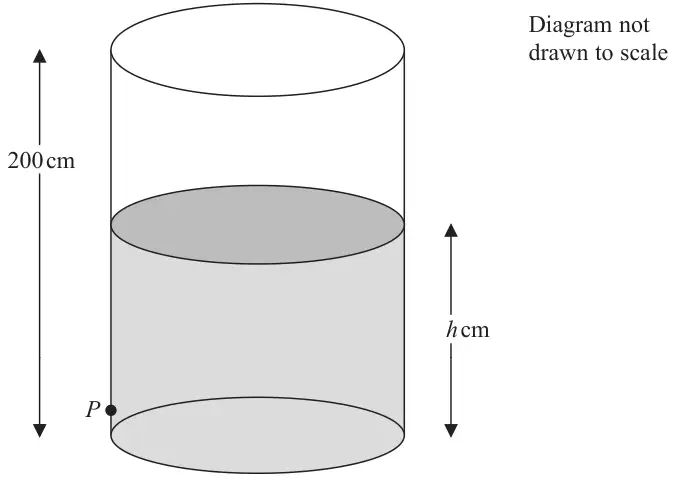
Figure 3 shows a vertical cylindrical tank of height 200 cm containing water. Water is leaking from a hole \(P\) on the side of the tank.
At time \(t\) minutes after the leaking starts, the height of water in the tank is \(h\) cm.
The height \(h\) cm of the water in the tank satisfies the differential equation \[\frac{\mathrm{d}h}{\mathrm{d}t} = k(h - 9)^{\frac{1}{2}}, \qquad 9 < h \leqslant 200\] where \(k\) is a constant.
Given that, when \(h = 130\), the height of the water is falling at a rate of 1.1 cm per minute,
Given that the tank was full of water when the leaking started,
| Scheme | Marks |
|---|---|
| \(\dfrac{\mathrm{d}h}{\mathrm{d}t} = k\sqrt{(h - 9)},\ 9 < h \leqslant 200;\ h = 130,\ \dfrac{\mathrm{d}h}{\mathrm{d}t} = -1.1\) | |
| \(-1.1 = k\sqrt{(130 - 9)} \Rightarrow k = \ldots\) Substitutes \(h = 130\) and either \(\dfrac{\mathrm{d}h}{\mathrm{d}t} = -1.1\) or \(\dfrac{\mathrm{d}h}{\mathrm{d}t} = 1.1\) into the printed equation and rearranges to give \(k = \ldots\) | M1 |
| so, \(k = -\dfrac{1}{10}\) or \(-0.1\) | A1 |
| (2) |
| Scheme | Marks |
|---|---|
| Way 1 | |
| \(\displaystyle\int \frac{\mathrm{d}h}{\sqrt{(h - 9)}} = \int k\,\mathrm{d}t\) Separates the variables correctly. \(\mathrm{d}h\) and \(\mathrm{d}t\) should not be in the wrong positions, although this mark can be implied by later working. Ignore the integral signs. | B1 |
| \(\displaystyle\int (h - 9)^{-\frac{1}{2}}\,\mathrm{d}h = \int k\,\mathrm{d}t\) | |
| \(\dfrac{(h - 9)^{\frac{1}{2}}}{\left(\frac{1}{2}\right)} = kt\ (+c)\) Integrates \(\dfrac{\pm\lambda}{\sqrt{(h - 9)}}\) to give \(\pm\mu\sqrt{(h - 9)};\ \lambda, \mu \neq 0\) \(\dfrac{(h - 9)^{\frac{1}{2}}}{\left(\frac{1}{2}\right)} = kt\) or \(= (\text{their } k)t\), with/without \(+c\), or equivalent, which can be un-simplified or simplified. | M1 A1 |
| \(\{t = 0,\ h = 200 \Rightarrow\}\ 2\sqrt{(200 - 9)} = k(0) + c\) Some evidence of applying both \(t = 0\) and \(h = 200\) to changed equation containing a constant of integration, e.g. \(c\) or \(A\) | M1 |
| \(\Rightarrow c = 2\sqrt{191} \Rightarrow 2(h - 9)^{\frac{1}{2}} = -0.1t + 2\sqrt{191}\) \(\{h = 50 \Rightarrow\}\ 2\sqrt{(50 - 9)} = -0.1t + 2\sqrt{191}\) \(t = \ldots\) dependent on the previous M mark. Applies \(h = 50\) and their value of \(c\) to their changed equation and rearranges to find the value of \(t = \ldots\) | dM1 |
| \(t = 20\sqrt{191} - 20\sqrt{41}\) or \(t = 148.3430145\ldots = 148\) (minutes) (nearest minute) \(t = 20\sqrt{191} - 20\sqrt{41}\) isw or awrt 148 | A1 cso |
| (6) | |
| (8 marks) |
Notes
Way 2
| Scheme | Marks |
|---|---|
| \(\displaystyle\int_{200}^{50} \frac{\mathrm{d}h}{\sqrt{(h - 9)}} = \int_0^T k\,\mathrm{d}t\) Separates the variables correctly. \(\mathrm{d}h\) and \(\mathrm{d}t\) should not be in the wrong positions, although this mark can be implied by later working. Integral signs and limits not necessary. | B1 |
| \(\displaystyle\int_{200}^{50} (h - 9)^{-\frac{1}{2}}\,\mathrm{d}h = \int_0^T k\,\mathrm{d}t\) | |
| \(\left[\dfrac{(h - 9)^{\frac{1}{2}}}{\left(\frac{1}{2}\right)}\right]_{200}^{50} = \big[kt\big]_0^T\) Integrates \(\dfrac{\pm\lambda}{\sqrt{(h - 9)}}\) to give \(\pm\mu\sqrt{(h - 9)};\ \lambda, \mu \neq 0\) \(\dfrac{(h - 9)^{\frac{1}{2}}}{\left(\frac{1}{2}\right)} = kt\) or \(= (\text{their } k)t\), with/without limits, or equivalent, which can be un-simplified or simplified. | M1 A1 |
| \(2\sqrt{41} - 2\sqrt{191} = kt\) or \(kT\) Attempts to apply limits of \(h = 200,\ h = 50\) and (can be implied) \(t = 0\) to their changed equation | M1 |
| \(t = \dfrac{2\sqrt{41} - 2\sqrt{191}}{-0.1}\) dependent on the previous M mark. Then rearranges to find the value of \(t = \ldots\) | dM1 |
| \(t = 20\sqrt{191} - 20\sqrt{41}\) or \(t = 148.3430145\ldots = 148\) (minutes) (nearest minute) \(t = 20\sqrt{191} - 20\sqrt{41}\) or awrt 148 or 2 hours and awrt 28 minutes | A1 cso |
| (6) |
Question 7 Notes
Note (b): Allow first B1 for writing \(\dfrac{\mathrm{d}t}{\mathrm{d}h} = \dfrac{1}{k\sqrt{(h - 9)}}\) or \(\dfrac{\mathrm{d}t}{\mathrm{d}h} = \dfrac{1}{(\text{their } k)\sqrt{(h - 9)}}\) or equivalent
Note (b): \(\dfrac{\mathrm{d}t}{\mathrm{d}h} = \dfrac{1}{k\sqrt{(h - 9)}}\) leading to \(t = \dfrac{2}{k}\sqrt{(h - 9)}\ (+c)\) with/without \(+c\) is B1M1A1
Note (b): After finding \(k = 0.1\) in part (a), it is only possible to gain full marks in part (b) by initially writing \(\dfrac{\mathrm{d}h}{\mathrm{d}t} = -k\sqrt{(h - 9)}\) or \(\displaystyle\int \frac{\mathrm{d}h}{\sqrt{(h - 9)}} = \int -k\,\mathrm{d}t\) or \(\dfrac{\mathrm{d}h}{\mathrm{d}t} = -0.1\sqrt{(h - 9)}\) or \(\displaystyle\int \frac{\mathrm{d}h}{\sqrt{(h - 9)}} = \int -0.1\,\mathrm{d}t\)
Otherwise, those candidates who find \(k = 0.1\) in part (a), should lose at least the final A1 mark in part (b).