
June 2019 Paper 2 Q11
11.
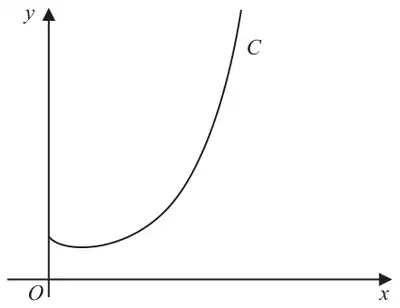
Figure 8 shows a sketch of the curve \(C\) with equation \(y = x^x,\ x \gt 0\)
(Solutions based entirely on graphical or numerical methods are not acceptable.) (5)
The point \(P(\alpha, 2)\) lies on \(C\).
A possible iteration formula that could be used in an attempt to find \(\alpha\) is
\[x_{n+1} = 2x_n^{\,1 - x_n}\]Using this formula with \(x_1 = 1.5\)
| Scheme | Marks | AO |
|---|---|---|
| Way 1 \(\{y = x^x \Rightarrow\}\ \ \ln y = x\ln x\) | B1 | 1.1a |
| \(\dfrac{1}{y}\dfrac{\mathrm{d}y}{\mathrm{d}x} = 1 + \ln x\) | M1 A1 | 1.1b 2.1 |
| \(\left\{\dfrac{\mathrm{d}y}{\mathrm{d}x} = 0 \Rightarrow\right\}\ \ \dfrac{x}{x} + \ln x = 0\) or \(1 + \ln x = 0 \Rightarrow \ln x = k \Rightarrow x = \ldots\) | M1 | 1.1b |
| \(x = \mathrm{e}^{-1}\) or awrt 0.368 | A1 | 1.1b |
| Note: \(k \neq 0\) | ||
| (5) |
Notes
(a) Way 2
| Scheme | Marks | AO |
|---|---|---|
| \(\{y = x^x \Rightarrow\}\ \ y = \mathrm{e}^{x\ln x}\) | B1 | 1.1a |
| \(\dfrac{\mathrm{d}y}{\mathrm{d}x} = \left(\dfrac{x}{x} + \ln x\right)\mathrm{e}^{x\ln x}\) | M1 A1 | 1.1b 2.1 |
| \(\left\{\dfrac{\mathrm{d}y}{\mathrm{d}x} = 0 \Rightarrow\right\}\ \ \dfrac{x}{x} + \ln x = 0\) or \(1 + \ln x = 0 \Rightarrow \ln x = k \Rightarrow x = \ldots\) | M1 | 1.1b |
| \(x = \mathrm{e}^{-1}\) or awrt 0.368 | A1 | 1.1b |
| Note: \(k \neq 0\) | ||
| (5) |
Way 1
B1: \(\ln y = x\ln x\). Condone \(\log_x y = x\log_x x\) or \(\log_x y = x\)
M1: For either \(\ln y \to \dfrac{1}{y}\dfrac{\mathrm{d}y}{\mathrm{d}x}\) or \(x\ln x \to 1 + \ln x\) or \(\dfrac{x}{x} + \ln x\)
A1: Correct differentiated equation.
i.e. \(\dfrac{1}{y}\dfrac{\mathrm{d}y}{\mathrm{d}x} = 1 + \ln x\) or \(\dfrac{1}{y}\dfrac{\mathrm{d}y}{\mathrm{d}x} = \dfrac{x}{x} + \ln x\) or \(\dfrac{\mathrm{d}y}{\mathrm{d}x} = y(1 + \ln x)\) or \(\dfrac{\mathrm{d}y}{\mathrm{d}x} = x^x(1 + \ln x)\)
M1: Sets \(1 + \ln x = 0\) and rearranges to make \(\ln x = k \Rightarrow x = \ldots\); \(k\) is a constant and \(k \neq 0\)
A1: \(x = \mathrm{e}^{-1}\) or awrt 0.368 only (with no other solutions for \(x\))
Note: Give no marks for no working leading to 0.368
Note: Give M0 A0 M0 A0 for \(\ln y = x\ln x \to x = 0.368\) with no intermediate working
Way 2
B1: \(y = \mathrm{e}^{x\ln x}\)
M1: For either \(y = \mathrm{e}^{x\ln x} \Rightarrow \dfrac{\mathrm{d}y}{\mathrm{d}x} = \mathrm{f}(\ln x)\mathrm{e}^{x\ln x}\) or \(x\ln x \to 1 + \ln x\) or \(\dfrac{x}{x} + \ln x\)
A1: Correct differentiated equation.
i.e. \(\dfrac{\mathrm{d}y}{\mathrm{d}x} = \left(\dfrac{x}{x} + \ln x\right)\mathrm{e}^{x\ln x}\) or \(\dfrac{\mathrm{d}y}{\mathrm{d}x} = (1 + \ln x)\mathrm{e}^{x\ln x}\) or \(\dfrac{\mathrm{d}y}{\mathrm{d}x} = x^x(1 + \ln x)\)
M1: Sets \(1 + \ln x = 0\) and rearranges to make \(\ln x = k \Rightarrow x = \ldots\); \(k\) is a constant and \(k \neq 0\)
A1: \(x = \mathrm{e}^{-1}\) or awrt 0.368 only (with no other solutions for \(x\))
Both ways
Note: Give B1 M1 A0 M1 A1 for the following solution:
\(\{y = x^x \Rightarrow\}\ \ \ln y = x\ln x \Rightarrow \dfrac{\mathrm{d}y}{\mathrm{d}x} = 1 + \ln x \Rightarrow 1 + \ln x = 0 \Rightarrow x = \mathrm{e}^{-1}\) or awrt 0.368
Note A common solution
A maximum of 3 marks (i.e. B1 1st M1 and 2nd M1) can be given for the solution\[\log y = x\log x \Rightarrow \dfrac{1}{y}\dfrac{\mathrm{d}y}{\mathrm{d}x} = 1 + \log x\]\[\left\{\dfrac{\mathrm{d}y}{\mathrm{d}x} = 0 \Rightarrow\right\}\ \ 1 + \log x = 0 \Rightarrow x = 10^{-1}\]
- 1st B1 for \(\log y = x\log x\)
- 1st M1 for \(\log y \to \lambda\dfrac{1}{y}\dfrac{\mathrm{d}y}{\mathrm{d}x};\ \lambda \neq 0\) or \(x\log x \to 1 + \log x\) or \(\dfrac{x}{x} + \log x\)
- 2nd M1 can be given for \(1 + \log x = 0 \Rightarrow \log x = k \Rightarrow x = \ldots;\ \ k \neq 0\)
| Scheme | Marks | AO |
|---|---|---|
| Way 1 Attempts both \(1.5^{1.5} = 1.8\ldots\) and \(1.6^{1.6} = 2.1\ldots\) and at least one result is correct to awrt 1 dp | M1 | 1.1b |
| \(1.8\ldots \lt 2\) and \(2.1\ldots \gt 2\) and as \(C\) is continuous then \(1.5 \lt \alpha \lt 1.6\) | A1 | 2.1 |
| (2) |
Notes
(b) Way 2
| Scheme | Marks | AO |
|---|---|---|
| For \(x^x - 2\), attempts both \(1.5^{1.5} - 2 = -0.16\ldots\) and \(1.6^{1.6} - 2 = 0.12\ldots\) and at least one result is correct to awrt 1 dp | M1 | 1.1b |
| \(-0.16\ldots \lt 0\) and \(0.12\ldots \gt 0\) and as \(C\) is continuous then \(1.5 \lt \alpha \lt 1.6\) | A1 | 2.1 |
| (2) |
(b) Way 3
| Scheme | Marks | AO |
|---|---|---|
| For \(\ln y = x\ln x\), attempts both \(1.5\ln 1.5 = 0.608\ldots\) and \(1.6\ln 1.6 = 0.752\ldots\) and at least one result is correct to awrt 1 dp | M1 | 1.1b |
| \(0.608\ldots \lt 0.69\ldots\) and \(0.752\ldots \gt 0.69\ldots\) and as \(C\) is continuous then \(1.5 \lt \alpha \lt 1.6\) | A1 | 2.1 |
| (2) |
(b) Way 4
| Scheme | Marks | AO |
|---|---|---|
| For \(\log y = x\log x\), attempts both \(1.5\log 1.5 = 0.264\ldots\) and \(1.6\log 1.6 = 0.326\ldots\) and at least one result is correct to awrt 2 dp | M1 | 1.1b |
| \(0.264\ldots \lt 0.301\ldots\) and \(0.326\ldots \gt 0.301\ldots\) and as \(C\) is continuous then \(1.5 \lt \alpha \lt 1.6\) | A1 | 2.1 |
| (2) |
Way 1
M1: Attempts both \(1.5^{1.5} = 1.8\ldots\) and \(1.6^{1.6} = 2.1\ldots\) and at least one result is correct to awrt 1 dp
A1: Both \(1.5^{1.5} = \text{awrt } 1.8\ldots\) and \(1.6^{1.6} = \text{awrt } 2.1\ldots\), reason (e.g. \(1.8\ldots \lt 2\) and \(2.1\ldots \gt 2\) or states \(C\) cuts through \(y = 2\)), \(C\) continuous and conclusion
Way 2
M1: Attempts both \(1.5^{1.5} - 2 = -0.16\ldots\) and \(1.6^{1.6} - 2 = 0.12\ldots\) and at least one result is correct to awrt 1 dp
A1: Both \(1.5^{1.5} - 2 = -0.16\ldots\) and \(1.6^{1.6} - 2 = 0.12\ldots\) correct to awrt 1 dp, reason (e.g. \(-0.16\ldots \lt 0\) and \(0.12\ldots \gt 0\), sign change or states C cuts through \(y = 0\)), \(C\) continuous and conclusion
Way 3
M1: Attempts both \(1.5\ln 1.5 = 0.608\ldots\) and \(1.6\ln 1.6 = 0.752\ldots\) and at least one result is correct to awrt 1 dp
A1: Both \(1.5\ln 1.5 = 0.608\ldots\) and \(1.6\ln 1.6 = 0.752\ldots\) correct to awrt 1 dp, reason (e.g. \(0.608\ldots \lt 0.69\ldots\) and \(0.752\ldots \gt 0.69\ldots\) or states they are either side of \(\ln 2\)), \(C\) continuous and conclusion.
Way 4
M1: Attempts both \(1.5\log 1.5 = 0.264\ldots\) and \(1.6\log 1.6 = 0.326\ldots\) and at least one result is correct to awrt 2 dp
A1: Both \(1.5\log 1.5 = 0.264\ldots\) and \(1.6\log 1.6 = 0.326\ldots\) correct to awrt 2 dp, reason (e.g. \(0.264\ldots \lt 0.301\ldots\) and \(0.326\ldots \gt 0.301\ldots\) or states they are either side of \(\log 2\)), \(C\) continuous and conclusion.
| Scheme | Marks | AO |
|---|---|---|
| Attempts \(x_{n+1} = 2x_n^{\,1 - x_n}\) at least once with \(x_1 = 1.5\) Can be implied by \(2(1.5)^{1 - 1.5}\) or awrt 1.63 | M1 | 1.1b |
| \(\{x_4 = 1.67313\ldots \Rightarrow\}\ \ x_4 = 1.673\) (3 dp) cao | A1 | 1.1b |
| (2) |
Notes
M1: An attempt to use the given or their formula once. Can be implied by \(2(1.5)^{1 - 1.5}\) or awrt 1.63
A1: States \(x_4 = 1.673\) cao (to 3 dp)
Note: Give M1 A1 for stating \(x_4 = 1.673\)
Note: M1 can be implied by stating their final answer \(x_4 = \text{awrt } 1.673\)
Note: \(x_2 = 1.63299\ldots,\ x_3 = 1.46626\ldots,\ x_4 = 1.67313\ldots\)
| Scheme | Marks | AO |
|---|---|---|
Give 1st B1 for any of
| B1 | 2.5 |
Give B1 B1 for any of
| B1 | 2.5 |
| (2) | ||
| (11 marks) |
Notes
B1: see scheme
B1: see scheme
Note: Only marks of B1B0 or B1B1 are possible in (d)
Note: Give B0 B0 for “Converges in a cob-web pattern” or “Converges up and down to \(\alpha\)”