
June 2019 Paper 1 Q12
12.
\[\mathrm{f}(x) = 10\mathrm{e}^{-0.25x}\sin x, \qquad x \geqslant 0\]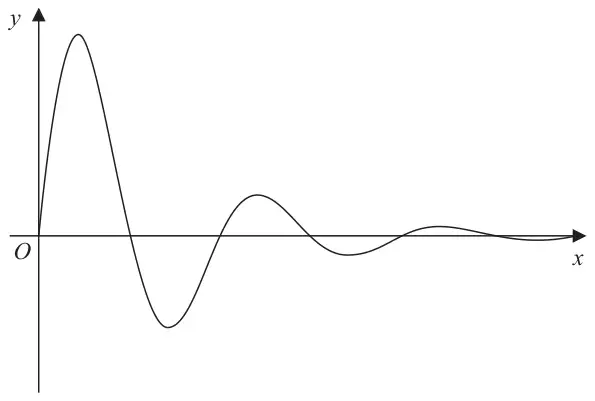
Figure 3 shows a sketch of part of the curve with equation \(y = \mathrm{f}(x)\).
The function \(\mathrm{H}(t)\) is used to model the height, in metres, of a ball above the ground \(t\) seconds after it has been kicked.
Using this model, find
| Scheme | Marks | AO |
|---|---|---|
| \(\mathrm{f}(x) = 10\mathrm{e}^{-0.25x}\sin x\) | ||
| \(\Rightarrow \mathrm{f}^{\prime}(x) = -2.5\mathrm{e}^{-0.25x}\sin x + 10\mathrm{e}^{-0.25x}\cos x\) oe | M1 A1 | 1.1b 1.1b |
| \(\mathrm{f}^{\prime}(x) = 0 \Rightarrow -2.5\cancel{\mathrm{e}^{-0.25x}}\sin x + 10\cancel{\mathrm{e}^{-0.25x}}\cos x = 0\) | M1 | 2.1 |
| \(\dfrac{\sin x}{\cos x} = \dfrac{10}{2.5} \Rightarrow \tan x = 4\,*\) | A1* | 1.1b |
| (4) |
Notes
M1: For attempting to differentiate using the product rule condoning slips, for example the power of e .
So for example score expressions of the form \(\pm\ldots\mathrm{e}^{-0.25x}\sin x \pm \ldots\mathrm{e}^{-0.25x}\cos x\) M1
Sight of \(vdu - udv\) however is M0
A1: \(\mathrm{f}^{\prime}(x) = -2.5\mathrm{e}^{-0.25x}\sin x + 10\mathrm{e}^{-0.25x}\cos x\) which may be unsimplified
M1: For clear reasoning in setting their \(\mathrm{f}^{\prime}(x) = 0\), factorising/ cancelling out the \(\mathrm{e}^{-0.25x}\) term leading to a trigonometric equation in only \(\sin x\) and \(\cos x\)
Do not allow candidates to substitute \(x = \arctan 4\) into \(\mathrm{f}^{\prime}(x)\) to score this mark.
A1*: Shows the steps \(\dfrac{\sin x}{\cos x} = \dfrac{10}{2.5}\) or equivalent leading to \(\Rightarrow \tan x = 4\,*\). \(\dfrac{\sin x}{\cos x}\) must be seen.
| Scheme | Marks | AO |
|---|---|---|
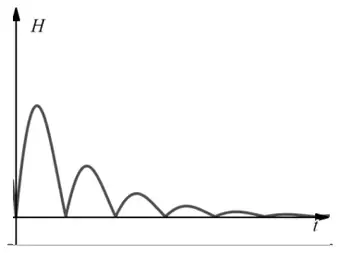 | ||
| "Correct" shape for 2 loops | M1 | 1.1b |
| Fully correct with decreasing heights | A1 | 1.1b |
| (2) |
Notes
M1: Draws at least two "loops". The height of the second loop should be lower than the first loop.
Condone the sight of rounding where there should be cusps
A1: At least 4 loops with decreasing heights and no rounding at the cusps.
The intention should be that the graph should ‘sit’ on the \(x\)-axis but be tolerant.
It is possible to overwrite Figure 3, but all loops must be clearly seen.
| Scheme | Marks | AO |
|---|---|---|
| Solves \(\tan x = 4\) and substitutes answer into \(H(t)\) | M1 | 3.1a |
| \(H(4.47) = \left|10\mathrm{e}^{-0.25 \times 4.47}\sin 4.47\right|\) | M1 | 1.1b |
| awrt 3.18 (metres) | A1 | 3.2a |
| (3) |
Notes
M1: Understands that to solve the problem they are required to substitute an answer to \(\tan t = 4\) into \(H(t)\)
This can be awarded for an attempt to substitute \(t =\) awrt 1.33 or \(t =\) awrt 4.47 into \(H(t)\)
\(H(t) = 6.96\) implies the use of \(t = 1.33\) Condone for this mark only, an attempt to substitute \(t =\) awrt \(76^\circ\) or awrt \(256^\circ\) into \(H(t)\)
M1: Substitutes \(t =\) awrt 4.47 into \(H(t) = \left|10\mathrm{e}^{-0.25t}\sin t\right|\). Implied by awrt 3.2
A1: Awrt 3.18 metres. Condone the lack of units. If two values are given the correct one must be seen to have been chosen
It is possible for candidates to sketch this on their graphical calculators and gain this answer. If there is no incorrect working seen and 3.18 is given, then award 111 for such an attempt.
| Scheme | Marks | AO |
|---|---|---|
| The times between each bounce should not stay the same when the heights of each bounce is getting smaller | B1 | 3.5b |
| (1) | ||
| (10 marks) |
Notes
B1: Makes reference to the fact that the time between each bounce should not stay the same when the heights of each bounce is getting smaller.
Look for " time (or gap) between the bounces will change”
‘bounces would not be equal times apart’
‘bounces would become more frequent’
But do not accept ‘the times between each bounce would be longer or slower’
Do not accept explanations such as there are other factors that would affect this such as "wind resistance", friction etc