
June 2019 Paper 2 Q13
13.
[A sphere of radius \(r\) has volume \(\dfrac{4}{3}\pi r^3\) and surface area \(4\pi r^2\)]
A manufacturer produces a storage tank.
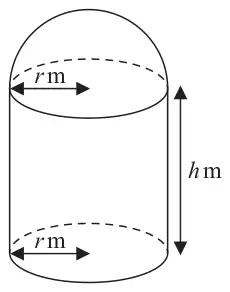
The tank is modelled in the shape of a hollow circular cylinder closed at one end with a hemispherical shell at the other end as shown in Figure 9.
The walls of the tank are assumed to have negligible thickness.
The cylinder has radius \(r\) metres and height \(h\) metres and the hemisphere has radius \(r\) metres.
The volume of the tank is \(6\,\text{m}^3\).
The manufacturer needs to minimise the surface area of the tank.
| Scheme | Marks | AO |
|---|---|---|
| States or uses \(6 = \pi r^2 h + \dfrac{2}{3}\pi r^3\) | B1 | 1.1a |
| \(\Rightarrow h = \dfrac{6}{\pi r^2} - \dfrac{2}{3}r,\ \ \pi h = \dfrac{6}{r^2} - \dfrac{2}{3}\pi r,\ \ \pi rh = \dfrac{6}{r} - \dfrac{2}{3}\pi r^2,\ \ rh = \dfrac{6}{\pi r} - \dfrac{2}{3}r^2\) | ||
| \(A = \pi r^2 + 2\pi rh + 2\pi r^2\ \{\Rightarrow A = 3\pi r^2 + 2\pi rh\}\) | ||
| \(A = 2\pi r^2 + 2\pi r\left(\dfrac{6}{\pi r^2} - \dfrac{2}{3}r\right) + \pi r^2\) | M1 A1 | 3.1a 1.1b |
| \(A = 3\pi r^2 + \dfrac{12}{r} - \dfrac{4}{3}\pi r^2 \Rightarrow A = \dfrac{12}{r} + \dfrac{5}{3}\pi r^2\) * | A1* | 2.1 |
| (4) |
Notes
B1: See scheme
M1: Complete process of substituting their \(h = \ldots\) or \(\pi h = \ldots\) or \(\pi rh = \ldots\) or \(rh = \ldots\), where \(\text{‘}\ldots\text{’} = \mathrm{f}(r)\) into an expression for the surface area which is of the form \(A = \lambda\pi r^2 + \mu\pi rh;\ \lambda, \mu \neq 0\)
A1: Obtains correct simplified or un-simplified \(\{A =\}\ 2\pi r^2 + 2\pi r\left(\dfrac{6}{\pi r^2} - \dfrac{2}{3}r\right) + \pi r^2\)
A1*: Proceeds, using rigorous and careful reasoning, to \(A = \dfrac{12}{r} + \dfrac{5}{3}\pi r^2\)
Note: Condone the lack of \(A = \ldots\) or \(S = \ldots\) for any one of the A marks or for both of the A marks
| Scheme | Marks | AO |
|---|---|---|
| \(\left\{A = 12r^{-1} + \dfrac{5}{3}\pi r^2 \Rightarrow\right\}\ \ \dfrac{\mathrm{d}A}{\mathrm{d}r} = -12r^{-2} + \dfrac{10}{3}\pi r\) | M1 A1 | 3.4 1.1b |
| \(\left\{\dfrac{\mathrm{d}A}{\mathrm{d}r} = 0 \Rightarrow\right\}\ -\dfrac{12}{r^2} + \dfrac{10}{3}\pi r = 0 \Rightarrow -36 + 10\pi r^3 = 0 \Rightarrow r^{\pm 3} = \ldots\ \left\{= \dfrac{18}{5\pi}\right\}\) | M1 | 2.1 |
| \(r = 1.046447736\ldots \Rightarrow r = 1.05\) (m) (3 sf) or awrt 1.05 (m) | A1 | 1.1b |
| Note: Give final A1 for correct exact values for \(r\) | ||
| (4) |
Notes
M1: Uses the model (or their model) and differentiates \(\dfrac{\lambda}{r} + \mu r^2\) to give \(\alpha r^{-2} + \beta r;\ \lambda, \mu, \alpha, \beta \neq 0\)
A1: \(\left\{\dfrac{\mathrm{d}A}{\mathrm{d}r} =\right\}\ -12r^{-2} + \dfrac{10}{3}\pi r\) o.e.
M1: Sets their \(\dfrac{\mathrm{d}A}{\mathrm{d}r} = 0\) and rearranges to give \(r^{\pm 3} = k,\ k \neq 0\) (Note: \(k\) can be positive or negative)
Note: This mark can be implied.
Give M1 (and A1) for \(-36 + 10\pi r^3 = 0 \to r = \left(\dfrac{18}{5\pi}\right)^{\frac{1}{3}} \text{ or } r = \left(\dfrac{36}{10\pi}\right)^{\frac{1}{3}} \text{ or } r = \left(\dfrac{3.6}{\pi}\right)^{\frac{1}{3}}\)
A1: \(r = \text{awrt } 1.05\) (ignoring units) or \(r = \text{awrt } 105\) cm
Note: Give M0 A0 M0 A0 where \(r = 1.05\) (m) (3 sf) or awrt 1.05 (m) is found from no working.
Note: Give final A1 for correct exact values for \(r\). E.g. \(r = \left(\dfrac{18}{5\pi}\right)^{\frac{1}{3}} \text{ or } r = \left(\dfrac{36}{10\pi}\right)^{\frac{1}{3}} \text{ or } r = \left(\dfrac{3.6}{\pi}\right)^{\frac{1}{3}}\)
Note: Give final M0 A0 for \(-\dfrac{12}{r^2} + \dfrac{10}{3}\pi r \gt 0 \Rightarrow r \gt 1.0464\)
Note: Give final M1 A1 for \(-\dfrac{12}{r^2} + \dfrac{10}{3}\pi r \gt 0 \Rightarrow r \gt 1.0464\ldots \Rightarrow r = 1.0464\ldots\)
| Scheme | Marks | AO |
|---|---|---|
| \(A_{\min} = \dfrac{12}{(1.046\ldots)} + \dfrac{5}{3}\pi(1.046\ldots)^2\) | M1 | 3.4 |
| \(\{A_{\min} = 17.20\ldots \Rightarrow\}\ \ A = 17\ (\text{m}^2)\) or \(A = \text{awrt } 17\ (\text{m}^2)\) | A1ft | 1.1b |
| (2) | ||
| (10 marks) |
Notes
M1: Substitutes their \(r = 1.046\ldots\), found from solving \(\dfrac{\mathrm{d}A}{\mathrm{d}r} = 0\) in part (b), into the model with equation \(A = \dfrac{12}{r} + \dfrac{5}{3}\pi r^2\)
Note: Give M0 for substituting their \(r\) which has been found from solving \(\dfrac{\mathrm{d}^2A}{\mathrm{d}r^2} = 0\) or from using \(\dfrac{\mathrm{d}^2A}{\mathrm{d}r^2}\) into the model with equation \(A = \dfrac{12}{r} + \dfrac{5}{3}\pi r^2\)
A1ft: \(\{A =\}\ 17\) or \(\{A =\}\) awrt 17 (ignoring units)
Note: You can only follow through on values of \(r\) for \(0.6 \leqslant \text{their } r \leqslant 1.3\) (and where their \(r\) has been found from solving \(\dfrac{\mathrm{d}A}{\mathrm{d}r} = 0\) in part (b))
| \(r\) | \(A\) | \(A\) (nearest integer) |
|---|---|---|
| 0.6 | 21.88495… | awrt 22 |
| 0.7 | 19.70849… | awrt 20 |
| 0.8 | 18.35103… | awrt 18 |
| 0.9 | 17.57448… | awrt 18 |
| 1.0 | 17.23598… | awrt 17 |
| 1.1 | 17.24463… | awrt 17 |
| 1.2 | 17.53982… | awrt 18 |
| 1.3 | 18.07958… | awrt 18 |
| 1.05 | 17.20124… | awrt 17 |
| 1.04644… | 17.20105… | awrt 17 |
Note: Give M1 A1 for \(A = 17\ (\text{m}^2)\) or \(A = \text{awrt } 17\ (\text{m}^2)\) from no working