
June 2024 Paper 3 Mechanics Q6
6.
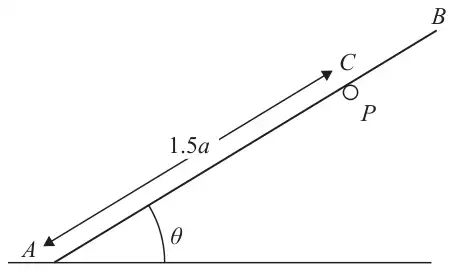
Figure 5 shows a uniform rod \(AB\) of mass \(M\) and length \(2a\).
- the rod has its end \(A\) on rough horizontal ground
- the rod rests in equilibrium against a small smooth fixed horizontal peg \(P\)
- the point \(C\) on the rod, where \(AC = 1.5a\), is the point of contact between the rod and the peg
- the rod is at an angle \(\theta\) to the ground, where \(\tan\theta = \dfrac{4}{3}\)
The rod lies in a vertical plane perpendicular to the peg.
The magnitude of the normal reaction of the peg on the rod at \(C\) is \(S\).
The coefficient of friction between the rod and the ground is \(\mu\).
Given that the rod is in limiting equilibrium,
| Scheme | Marks | AO |
|---|---|---|
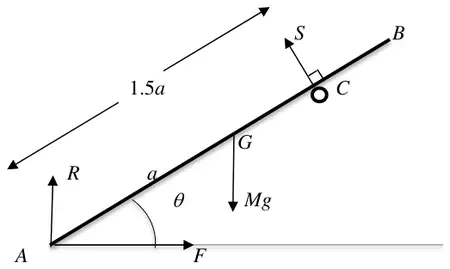 | ||
| Take moments about \(A\) | M1 | 3.1a |
| \(S \times 1.5a = Mga\cos\theta = \left(Mga \times \dfrac{3}{5}\right)\) | A1 | 1.1b |
| \(S = \dfrac{2}{5}Mg\) * | A1* | 2.2a |
| (3) |
Notes
M1: Correct no. of terms, dimensionally correct, condone sin/cos confusion and sign errors.
Allow use of a different letter for the angle.
N.B. They may resolve the weight into two components, parallel and perpendicular to the rod, and then take the moment of each about \(A\), one of which is 0. (see N.B. below)
N.B. M0 if one or both \(a\)’s aren’t there originally.
A1: Correct equation, \(\cos\theta\) may or may not be replaced by \(\dfrac{3}{5}\)
N.B. you may see: \(S \times 1.5a = Mg\cos\theta \times a\)
A1*: Given answer correctly obtained, need to see \(\cos\theta = \dfrac{3}{5}\) used
Allow: \(S = \dfrac{2Mg}{5}\) or \(\dfrac{2Mg}{5} = S\)
A0 if \(S\) is missing
| Scheme | Marks | AO |
|---|---|---|
| ||
| N.B. Marks for the equations should be awarded in the order in which they appear on the script. | ||
| Resolve horizontally: | M1 | 3.4 |
| \(F = S\sin\theta\) | A1 | 1.1b |
| Resolve vertically: | M1 | 3.3 |
| \(R = Mg - S\cos\theta\) | A1 | 1.1b |
| Other possible equations: (any of which is worth max M1A1) (parallel to the rod): \(F\cos\theta + R\sin\theta = Mg\sin\theta\) (perp to the rod): \(F\sin\theta + Mg\cos\theta = S + R\cos\theta\) M(\(B\)): \((S \times 0.5a) + (R \times 2a\cos\theta) = (Mg \times a\cos\theta) + (F \times 2a\sin\theta)\) M(\(C\)): \((R \times 1.5a\cos\theta) = (Mg \times 0.5a\cos\theta) + (F \times 1.5a\sin\theta)\) M(\(G\)): \((R \times a\cos\theta) = (S \times 0.5a) + (F \times a\sin\theta)\) N.B. If they have more than two equations, mark only those that they use to try to find \(\mu\) | ||
| \(F = \mu R\) and two of their equations used to solve for \(\mu\) | DM1 | 3.1a |
| \(\mu = \dfrac{8}{19} = 0.42105\ldots\) | A1 | 2.2a |
| (6) | ||
| (9 marks) |
Notes
M1: Correct no. of terms, dimensionally correct, condone sin/cos confusion and sign errors
A1: Correct first equation, \(S\) does not need to be substituted
M1: Correct no. of terms, dimensionally correct, condone sin/cos confusion and sign errors
A1: Correct second equation, \(S\) does not need to be substituted
DM1: Dependent on previous two M marks for using \(F = \mu R\) and two equations to solve for \(\mu\)
A1: Accept 0.42 or better (as \(g\) cancels)