
June 2024 Paper 3 Q11
11 Fig. 11.1 shows the curve with equation \(y = \mathrm{g}(x)\) where \(\mathrm{g}(x) = x\sin x + \cos x\) and the curve of the gradient function \(y = \mathrm{g}^{\prime}(x)\) for \(-2\pi \leqslant x \leqslant 2\pi\).
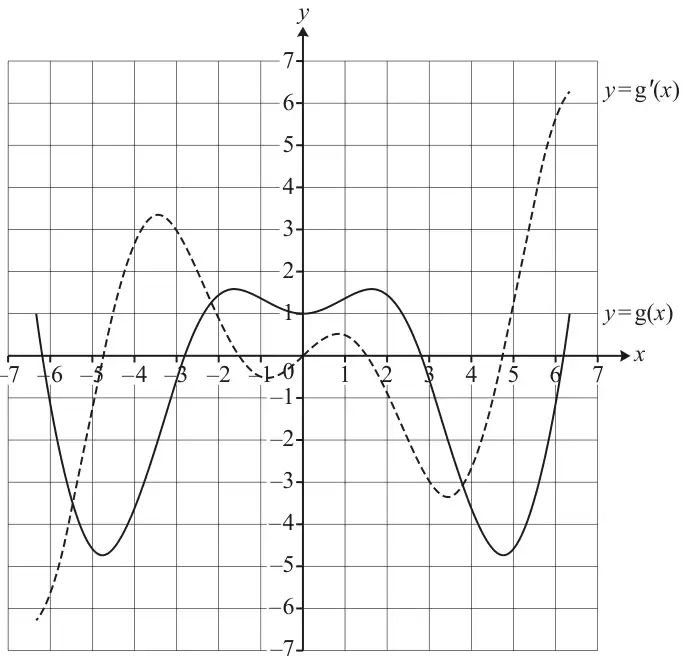
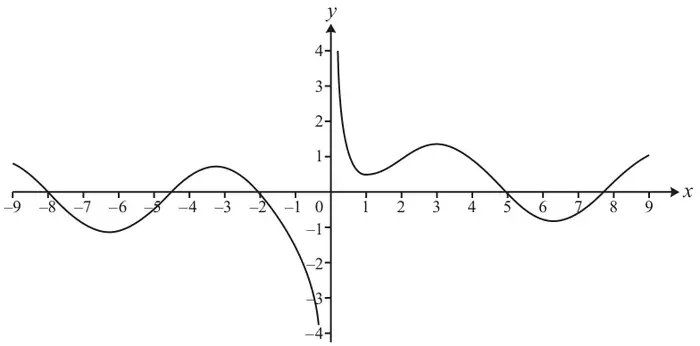
Fig. 11.2 shows part of the curve with equation \(y = \dfrac{1}{x} - \cos x\).
You should write down at least the following.
- The iteration you use
- The starting value
- The solution correct to 4 decimal places
| Scheme | Marks | AO |
|---|---|---|
| \(\dfrac{\mathrm{d}y}{\mathrm{d}x} = x\cos x\) oe | B1 | 1.1 |
| \(x\cos x = 1\) | M1 | 1.1 |
| \(\dfrac{1}{x} = \cos x\) so \(\dfrac{1}{x} - \cos x = 0\) | A1 | 2.1 |
| [3] |
Notes
M1: For their \(\dfrac{\mathrm{d}y}{\mathrm{d}x} = 1\)
A1: Convincing completion to given answer
Additional guidance
The B1 is for differentiating and can be given for seeing x cos x or the unsimplified version sin x + x cos x – sin x.
The M1 is given for x cos x =1 and the final A1 for finishing it off convincingly. If there is no differentiation, then the M1 is not available.
| Scheme | Marks | AO |
|---|---|---|
| For \(\mathrm{f}(x) = \dfrac{1}{x} - \cos x\), \(\mathrm{f}^{\prime}(x) = -\dfrac{1}{x^2} + \sin x\) | M1 | 3.1a |
| Iteration \(x_{n+1} = x_n - \dfrac{\left(\dfrac{1}{x_n} - \cos x_n\right)}{\left(-\dfrac{1}{x_n^2} + \sin x_n\right)}\) | A1 | 1.1 |
| Suitable starting value | M1 | 3.1a |
| 4.9172 | A1 | 1.1 |
| [4] |
Notes
M1: Differentiation (for this mark look for a power of \(x\) and a term in \(\sin x\) or \(\cos x\) with at least one term correct)
A1: oe, e.g. \(x_{n+1} = x_n - \dfrac{\left(x_n - x_n^2\cos x_n\right)}{\left(-1 + x_n^2\sin x_n\right)}\)
(The subscripts are needed)
M1: Starting values from 3.6 to 6.1 inclusive work for the given iteration but there may be other values which also give the required root and should be awarded.
A1: BC – candidates need not show intermediate iterations
If a value outside the expected starting value is used and it converges to 4.9172 then M1A1 is awarded (no need to check)
awrt 4.9172
Alternative method
| Scheme | Marks | AO |
|---|---|---|
| For \(\mathrm{f}(x) = x\cos x - 1\), \(\mathrm{f}^{\prime}(x) = \cos x - x\sin x\) | M1 | |
| Iteration \(x_{n+1} = x_n - \dfrac{\left(x_n\cos x_n - 1\right)}{\left(\cos x_n - x_n\sin x_n\right)}\) | A1 | |
| Suitable starting value | M1 | |
| 4.9172 | A1 |
M1: Differentiation
A1: oe, e.g. \(x_{n+1} = \dfrac{\left(1 - x_n^2\sin x_n\right)}{\left(\cos x_n - x_n\sin x_n\right)}\)
M1: Starting values from 3.6 to 6.1 inclusive work for the given iteration but there may be other values which also give the required root.
A1: BC – candidates need not show intermediate iterations
If a value outside the expected starting value is used and it converges to 4.9172 then M1A1 is awarded
awrt 4.9172
Additional guidance
There are two methods given.
The first M mark is for attempting to differentiate either 1/x – cos x or x cos x -1.
The first A mark is for setting up the iteration function and it must include the subscripts.
The next M mark is for choosing a suitable starting value (accept values between 3.6 and 6.1). They might use \(x_0\) or \(x_1\) or just say ‘starting value’ – but it will be their first value.
The final A mark is for getting the root 4.9172. The question asked for 4dps. They do not need to show all the working (BC means ‘by calculator’) to get the A1. If they choose a value outside the range and it gives 4.9172 then give M1 A1. A value outside the range giving the wrong answer will get M0 A0.
| Scheme | Marks | AO |
|---|---|---|
| The gradient is close to zero so the next iteration is a long way from the root or As it is a turning point, the starting value is invalid as you cannot divide by 0 or The iteration converges to a different root. | B1 | 3.2b |
| [1] |
Notes
B1: Explanation referring to gradient of curve or to convergence to a different root.
Not just that it is close to another root
isw after a correct answer
Additional guidance
The comment needs to be more than just ‘it is close to another root’.