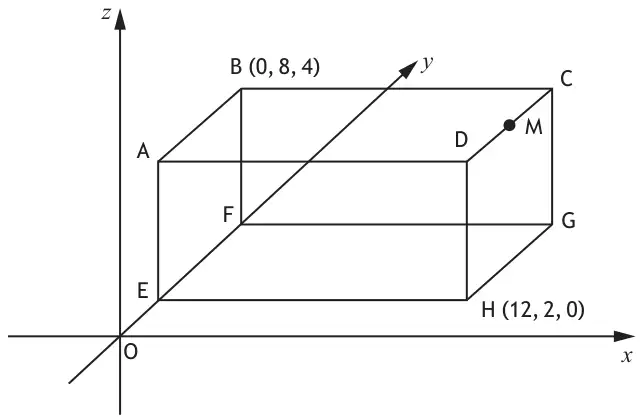
11. The diagram shows a cuboid, ABCDEFGH, relative to the coordinate axes.
B has coordinates \((0, 8, 4)\).
H has coordinates \((12, 2, 0)\).
EH is parallel to the \(x\)-axis.
(a) State the coordinates of G. [1]
(b) M is the midpoint of CD. State the coordinates of M. [1]
Marking instructions (a)
Mark
Generic scheme
Illustrative scheme
•1
state coordinates
(12, 8, 0)
(1)
Notes:
Do not award •1 if brackets are omitted or the answer is stated in component form unless answer is in the form shown in Note 2.
For \(x=12,\ y=8,\ z=0\). award 1/1
Commonly Observed Responses:
(a) 12, 8, 0 award 0/1 (b) \(\begin{pmatrix}12\\8\\0\end{pmatrix}\) award 0/1
Marking instructions (b)
Mark
Generic scheme
Illustrative scheme
•2
state coordinates
(12, 5, 4)
(1)
Notes:
Part (b) should be marked independently of (a).
If brackets are omitted or answer is given in component form in part (a) and part (b), •2 can be awarded if both sets of coordinates are correct eg (i) (a) 12, 8, 0 (b) 12, 5, 4. award 0/1 ✗ in part (a) and award 1/1 ✓1 in part (b) (ii) (a) 12, 8, 0 (b) 12, 5, 0. award 0/1 ✗ in part (a) and award 0/1 ✗ in part (b)
7. Find \(|\mathbf{d}|\), the magnitude of vector \(\mathbf{d}=\begin{pmatrix}4\\-5\\7\end{pmatrix}\).
Express your answer as a surd in its simplest form. [3]
Marking instructions
Mark
Generic scheme
Illustrative scheme
•1
start process
\(4^2+(-5)^2+7^2\)
•2
consistent calculation
\(\sqrt{90}\)
•3
express as a surd in its simplest form
\(3\sqrt{10}\)
(3)
Notes:
Correct answer without working. award 0/3
For the award of •1 accept \(4^2+5^2+7^2\).
•1 and •2 are not available where a candidate only uses two numbers eg \(\sqrt{4^2+(-5)^2}=\sqrt{41}\).
•3 is only available where a surd requires to be simplified.
•3 is not available for simplification of a perfect square.
For incorrect subsequent working •3 is not available.
Commonly Observed Responses:
\(\sqrt{90}\to3\sqrt{10}\) (no other working shown) award 3/3
(a) \(4^2+-5^2+7^2\to\sqrt{90}\to3\sqrt{10}\) award 3/3 (b) \(4^2-5^2+7^2\to\sqrt{90}\to3\sqrt{10}\) award 1/3 ✗✗✓1
(a) \(4^2+(-5)^2+7^2\to\sqrt{40}\to2\sqrt{10}\) award 2/3 ✓✗✓1 (b) \(4^2+-5^2+7^2\to\sqrt{40}\to2\sqrt{10}\) award 2/3 ✓✗✓1 (c) \(4^2-5^2+7^2\to\sqrt{40}\to2\sqrt{10}\) award 2/3 ✗✓1✓1
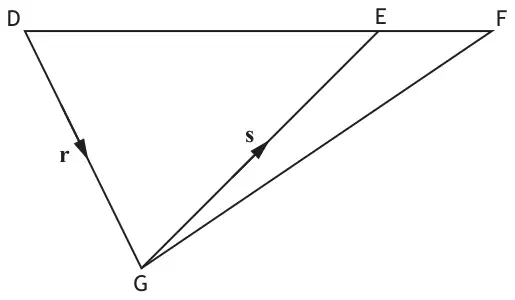
15. In the diagram, \(\overrightarrow{\text{DG}}\) and \(\overrightarrow{\text{GE}}\) are represented by the vectors \(\mathbf{r}\) and \(\mathbf{s}\) respectively, and \(\overrightarrow{\text{DE}}=3\overrightarrow{\text{EF}}\).
Express \(\overrightarrow{\text{GF}}\) in terms of \(\mathbf{r}\) and \(\mathbf{s}\).
Give your answer in its simplest form. [2]
Marking instructions
Mark
Generic scheme
Illustrative scheme
•1
express \(\overrightarrow{\text{GF}}\) as a vector journey
eg \(\overrightarrow{\text{GE}}+\dfrac{1}{3}\overrightarrow{\text{DE}}\) or \(\overrightarrow{\text{GD}}+\overrightarrow{\text{DE}}+\dfrac{1}{3}\overrightarrow{\text{DE}}\) OR \(\mathbf{s}+\dfrac{1}{3}(\mathbf{r}+\mathbf{s})\) OR \(-\mathbf{r}+(\mathbf{r}+\mathbf{s})+\dfrac{1}{3}(\mathbf{r}+\mathbf{s})\)
•2
express \(\overrightarrow{\text{GF}}\) in simplest form
\(\dfrac{4}{3}\mathbf{s}+\dfrac{1}{3}\mathbf{r}\)
(2)
Notes:
Correct answer without working. award 0/2
\(\overrightarrow{\text{GE}}+\overrightarrow{\text{EF}}\) or \(\overrightarrow{\text{GD}}+\overrightarrow{\text{DF}}\) or \(\overrightarrow{\text{GD}}+\overrightarrow{\text{DE}}+\overrightarrow{\text{EF}}\) or \(\overrightarrow{\text{GD}}+3\overrightarrow{\text{EF}}+\overrightarrow{\text{EF}}\) is not enough for the award of •1.
For the award of •2, the resultant vector must include fractional vectors in both \(\mathbf{r}\) and \(\mathbf{s}\). (a) \(\mathbf{r}+\dfrac{1}{3}\mathbf{r}+\dfrac{1}{3}\mathbf{s}=\dfrac{4}{3}\mathbf{r}+\dfrac{1}{3}\mathbf{s}\) award 1/2 ✗✓1 (b) \(\mathbf{s}+\dfrac{1}{3}\mathbf{r}+\mathbf{s}=2\mathbf{s}+\dfrac{1}{3}\mathbf{r}\) award 0/2
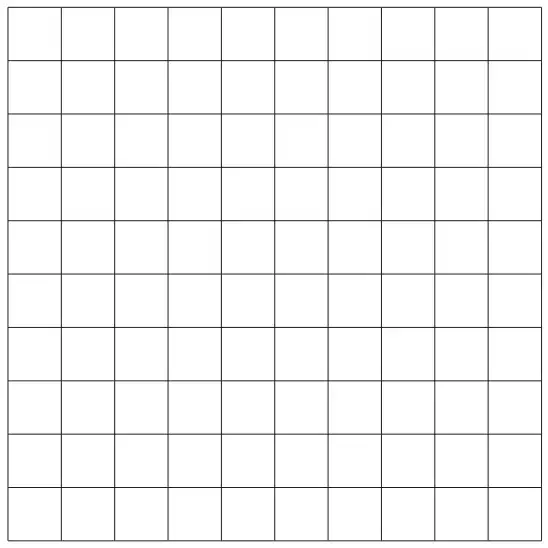
13. Vectors \(\mathbf{p}\) and \(\mathbf{q}\) have components \(\mathbf{p}=\begin{pmatrix}5\\2\end{pmatrix}\) and \(\mathbf{q}=\begin{pmatrix}1\\-3\end{pmatrix}\).
Draw the resultant vector \(\mathbf{p}+\mathbf{q}\) on the grid. [2]
Marking instructions
Mark
Generic scheme
Illustrative scheme
Method 1
•1
correct nose-to-tail diagram
OR
•2
consistent vector \(\mathbf{p}+\mathbf{q}\) drawn (must include arrow)
Method 2
•1
find components of \(\mathbf{p}+\mathbf{q}\)
\(\begin{pmatrix}6\\-1\end{pmatrix}\)
•2
consistent vector \(\mathbf{p}+\mathbf{q}\) drawn (must include arrow)
(2)
Notes:
Correct answer without working. award 2/2
In method 1 the arrows must be included in the nose to tail diagram for the award of •1, unless implied by an arrow on the correct resultant vector.
In method 2 the brackets are not required for the award of •1 but do not accept (6,−1) alone.
Do NOT penalise vectors drawn without a ruler provided the start and end points are accurate.
Where there is evidence of component form and a nose-to-tail diagram, mark both methods and award the higher mark (apply general marking principle (p)).
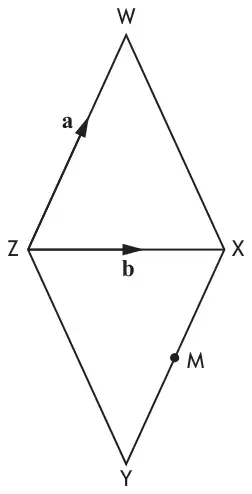
14. The diagram shows a rhombus WXYZ with a diagonal ZX drawn.
\(\overrightarrow{\text{ZW}}\) represents vector \(\mathbf{a}\) and \(\overrightarrow{\text{ZX}}\) represents vector \(\mathbf{b}\).
(a) Express \(\overrightarrow{\text{WX}}\) in terms of \(\mathbf{a}\) and \(\mathbf{b}\). [1]
M is the mid-point of XY.
(b) Express \(\overrightarrow{\text{WM}}\) in terms of \(\mathbf{a}\) and \(\mathbf{b}\). Give your answer in its simplest form. [2]
Marking instructions (a)
Mark
Generic scheme
Illustrative scheme
•1
state vector
\(\mathbf{b}-\mathbf{a}\) or \(-\mathbf{a}+\mathbf{b}\)
(1)
Notes:
For the award of •1 accept \(\mathbf{b}+-\mathbf{a}\).
Marking instructions (b)
Mark
Generic scheme
Illustrative scheme
•2
valid pathway
\(\mathbf{b}-\mathbf{a}-\dfrac{1}{2}\mathbf{a}\) OR \(\overrightarrow{\text{WX}}+\dfrac{1}{2}\overrightarrow{\text{XY}}\) or equivalent
•3
Express \(\overrightarrow{\text{WM}}\) in terms of \(\mathbf{a}\) and \(\mathbf{b}\) in simplest form
\(\mathbf{b}-\dfrac{3}{2}\mathbf{a}\)
(2)
Notes:
Correct answer with no working award 2/2
\(\overrightarrow{\text{WX}}+\overrightarrow{\text{XM}}\) or \(\overrightarrow{\text{WZ}}+\overrightarrow{\text{ZX}}+\overrightarrow{\text{XM}}\) is not enough for the award of •2
For the award of •2 accept: (a) \(\overrightarrow{\text{WZ}}+\overrightarrow{\text{ZX}}+\dfrac{1}{2}\overrightarrow{\text{XY}}\) (b) \(\overrightarrow{\text{WZ}}+\overrightarrow{\text{ZY}}+\dfrac{1}{2}\overrightarrow{\text{YX}}\)
For the award of •3 accept \(\mathbf{b}+-\dfrac{3}{2}\mathbf{a}\), \(\mathbf{b}-1\dfrac{1}{2}\mathbf{a}\) or \(\mathbf{b}-1.5\mathbf{a}\).
Answer must be consistent with part (a) except in the case of Note 6. eg (i) (a) \(\mathbf{a}-\mathbf{b}\) (b) \(\mathbf{a}-\mathbf{b}+\dfrac{1}{2}\mathbf{a}=\dfrac{3}{2}\mathbf{a}-\mathbf{b}\) award 0/1 in (a) ✗ and award 2/2 in (b) ✓1✓1 (ii) (a) \(\mathbf{a}-\mathbf{b}\) (b) \(\mathbf{a}-\mathbf{b}-\dfrac{1}{2}\mathbf{a}=\dfrac{1}{2}\mathbf{a}-\mathbf{b}\) award 0/1 in (a) ✗ and award 1/2 in (b) ✗✓1 (iii) (a) \(\mathbf{a}+\mathbf{b}\) (b) \(\mathbf{a}+\mathbf{b}+\dfrac{1}{2}\mathbf{a}=\dfrac{3}{2}\mathbf{a}+\mathbf{b}\) award 0/1 in (a) ✗ and award 2/2 in (b) ✓1✓1 (iv) (a) \(\mathbf{a}+\mathbf{b}\) (b) \(\mathbf{a}+\mathbf{b}-\dfrac{1}{2}\mathbf{a}=\dfrac{1}{2}\mathbf{a}+\mathbf{b}\) award 0/1 in (a) ✗ and award 1/2 in (b) ✗✓1
An answer in part (b) which has been clearly found independently of part (a) may gain full or partial credit in part (b). eg (a) \(\mathbf{a}-\mathbf{b}\) (b) \(\mathbf{b}-\mathbf{a}-\dfrac{1}{2}\mathbf{a}=\mathbf{b}-\dfrac{3}{2}\mathbf{a}\) award 0/1 in (a) ✗ and award 2/2 in (b) ✓✓
4. Given \(\mathbf{a}=\begin{pmatrix}3\\4\\-1\end{pmatrix}\) and \(\mathbf{b}=\begin{pmatrix}5\\3\\2\end{pmatrix}\), find the resultant vector \(3\mathbf{a}+\mathbf{b}\).
Express your answer in component form. [2]
Marking instructions
Mark
Generic scheme
Illustrative scheme
•1
calculate \(3\mathbf{a}\)
\(\begin{pmatrix}9\\12\\-3\end{pmatrix}\)
•2
solution
\(\begin{pmatrix}14\\15\\-1\end{pmatrix}\)
(2)
Notes:
Correct answer without working award 2/2
Do not award •2 if (a) brackets are omitted from the answer (omission of brackets should only be penalised once in Qu4, or Qu12(b) or Q12 (c)) (b) the answer is given in coordinate form.
For subsequent invalid working •2 is not available. eg (a) \(\begin{pmatrix}14\\15\\-1\end{pmatrix}\to14+15-1=28\) award 1/2 ✓✗ (b) \(\begin{pmatrix}14\\15\\-1\end{pmatrix}\to\sqrt{14^2+15^2+(-1)^2}=\sqrt{422}\) award 1/2 ✓✗
Commonly Observed Responses:
\(\begin{pmatrix}9\\12\\3\end{pmatrix}+\begin{pmatrix}5\\3\\2\end{pmatrix}=\begin{pmatrix}14\\15\\5\end{pmatrix}\) award 1/2 ✗✓1
(a) \(\begin{pmatrix}3\\4\\-1\end{pmatrix}+\begin{pmatrix}5\\3\\2\end{pmatrix}=\begin{pmatrix}8\\7\\1\end{pmatrix}\to\begin{pmatrix}24\\21\\3\end{pmatrix}\quad\left[3(\mathbf{a}+\mathbf{b})\right]\) award 1/2 ✗✓1 (b) \(\begin{pmatrix}9\\12\\-3\end{pmatrix}+\begin{pmatrix}15\\9\\6\end{pmatrix}=\begin{pmatrix}24\\21\\3\end{pmatrix}\quad\left[3\mathbf{a}+3\mathbf{b}\right]\) award 1/2 ✓✗
\(\begin{pmatrix}3\\4\\-1\end{pmatrix}+\begin{pmatrix}5\\3\\2\end{pmatrix}=\begin{pmatrix}8\\7\\1\end{pmatrix}\quad\left[\mathbf{a}+\mathbf{b}\right]\) award 0/2
We'd like to use Google Analytics cookies to count visits and see which pages help most. They're optional, and the site works exactly the same either way. Privacy policy

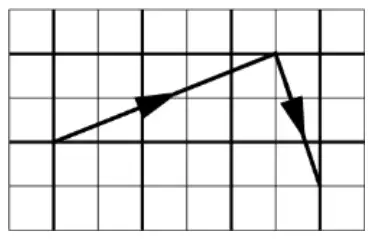
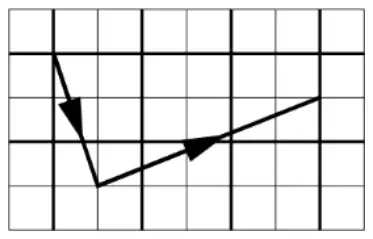
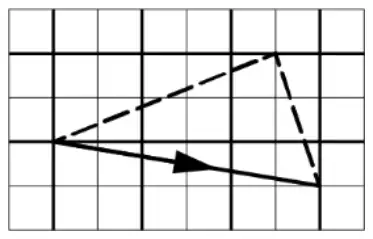
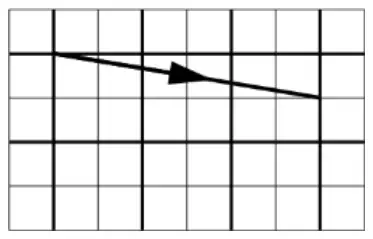
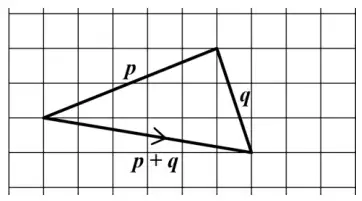 award 2/2
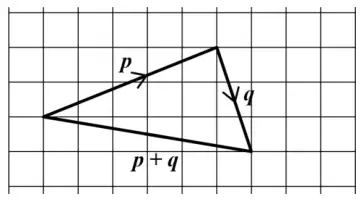 award 1/2 ✓✗
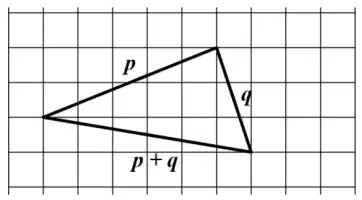 award 0/2 ✗✗
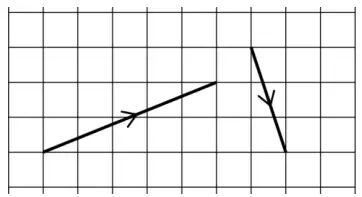 award 0/2 ✗✗