
May 2024 Paper 2 Q14
14. The diagram shows a rhombus WXYZ with a diagonal ZX drawn.
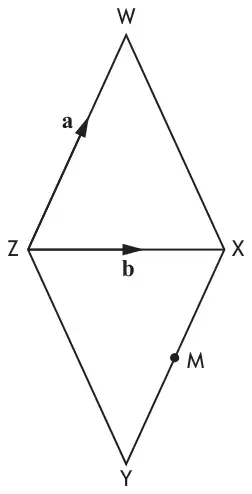
\(\overrightarrow{\text{ZW}}\) represents vector \(\mathbf{a}\) and \(\overrightarrow{\text{ZX}}\) represents vector \(\mathbf{b}\).
(a) Express \(\overrightarrow{\text{WX}}\) in terms of \(\mathbf{a}\) and \(\mathbf{b}\). [1]
M is the mid-point of XY.
(b) Express \(\overrightarrow{\text{WM}}\) in terms of \(\mathbf{a}\) and \(\mathbf{b}\).
Give your answer in its simplest form. [2]
Give your answer in its simplest form. [2]
| Mark | Generic scheme | Illustrative scheme |
|---|---|---|
| •1 | state vector | \(\mathbf{b}-\mathbf{a}\) or \(-\mathbf{a}+\mathbf{b}\) |
| (1) |
Notes:
- For the award of •1 accept \(\mathbf{b}+-\mathbf{a}\).
| Mark | Generic scheme | Illustrative scheme |
|---|---|---|
| •2 | valid pathway | \(\mathbf{b}-\mathbf{a}-\dfrac{1}{2}\mathbf{a}\) OR \(\overrightarrow{\text{WX}}+\dfrac{1}{2}\overrightarrow{\text{XY}}\) or equivalent |
| •3 | Express \(\overrightarrow{\text{WM}}\) in terms of \(\mathbf{a}\) and \(\mathbf{b}\) in simplest form | \(\mathbf{b}-\dfrac{3}{2}\mathbf{a}\) |
| (2) |
Notes:
- Correct answer with no working award 2/2
- \(\overrightarrow{\text{WX}}+\overrightarrow{\text{XM}}\) or \(\overrightarrow{\text{WZ}}+\overrightarrow{\text{ZX}}+\overrightarrow{\text{XM}}\) is not enough for the award of •2
- For the award of •2 accept:
(a) \(\overrightarrow{\text{WZ}}+\overrightarrow{\text{ZX}}+\dfrac{1}{2}\overrightarrow{\text{XY}}\)
(b) \(\overrightarrow{\text{WZ}}+\overrightarrow{\text{ZY}}+\dfrac{1}{2}\overrightarrow{\text{YX}}\) - For the award of •3 accept \(\mathbf{b}+-\dfrac{3}{2}\mathbf{a}\), \(\mathbf{b}-1\dfrac{1}{2}\mathbf{a}\) or \(\mathbf{b}-1.5\mathbf{a}\).
- Answer must be consistent with part (a) except in the case of Note 6.
eg (i) (a) \(\mathbf{a}-\mathbf{b}\) (b) \(\mathbf{a}-\mathbf{b}+\dfrac{1}{2}\mathbf{a}=\dfrac{3}{2}\mathbf{a}-\mathbf{b}\) award 0/1 in (a) ✗ and award 2/2 in (b) ✓1✓1
(ii) (a) \(\mathbf{a}-\mathbf{b}\) (b) \(\mathbf{a}-\mathbf{b}-\dfrac{1}{2}\mathbf{a}=\dfrac{1}{2}\mathbf{a}-\mathbf{b}\) award 0/1 in (a) ✗ and award 1/2 in (b) ✗✓1
(iii) (a) \(\mathbf{a}+\mathbf{b}\) (b) \(\mathbf{a}+\mathbf{b}+\dfrac{1}{2}\mathbf{a}=\dfrac{3}{2}\mathbf{a}+\mathbf{b}\) award 0/1 in (a) ✗ and award 2/2 in (b) ✓1✓1
(iv) (a) \(\mathbf{a}+\mathbf{b}\) (b) \(\mathbf{a}+\mathbf{b}-\dfrac{1}{2}\mathbf{a}=\dfrac{1}{2}\mathbf{a}+\mathbf{b}\) award 0/1 in (a) ✗ and award 1/2 in (b) ✗✓1 - An answer in part (b) which has been clearly found independently of part (a) may gain full or partial credit in part (b).
eg (a) \(\mathbf{a}-\mathbf{b}\) (b) \(\mathbf{b}-\mathbf{a}-\dfrac{1}{2}\mathbf{a}=\mathbf{b}-\dfrac{3}{2}\mathbf{a}\) award 0/1 in (a) ✗ and award 2/2 in (b) ✓✓
Commonly Observed Responses:
For answer in parts (a) and (b) award as follows:
| 1. (a) \(\mathbf{b}-\mathbf{a}\) (b) \(\mathbf{b}-\mathbf{a}+\dfrac{1}{2}\mathbf{a}=\mathbf{b}-\dfrac{1}{2}\mathbf{a}\) | award 1/1 in (a) ✓ and award 1/2 in (b) ✗✓1 |