
May 2025 Paper 1 Q13
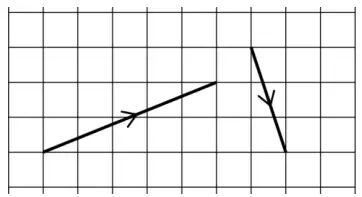
13. Vectors \(\mathbf{p}\) and \(\mathbf{q}\) have components \(\mathbf{p}=\begin{pmatrix}5\\2\end{pmatrix}\) and \(\mathbf{q}=\begin{pmatrix}1\\-3\end{pmatrix}\).
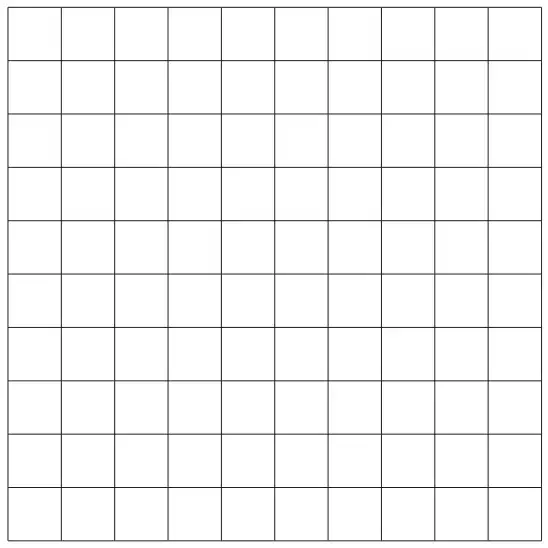
Draw the resultant vector \(\mathbf{p}+\mathbf{q}\) on the grid. [2]
| Mark | Generic scheme | Illustrative scheme |
|---|---|---|
| Method 1 | ||
| •1 | correct nose-to-tail diagram | 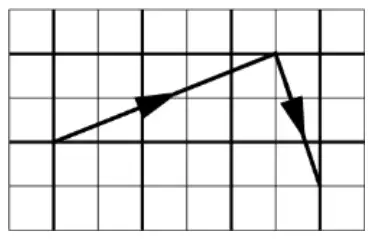 OR 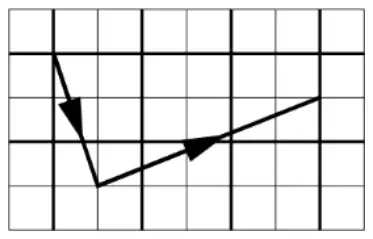 |
| •2 | consistent vector \(\mathbf{p}+\mathbf{q}\) drawn (must include arrow) | 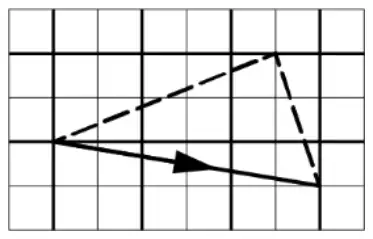 |
| Method 2 | ||
| •1 | find components of \(\mathbf{p}+\mathbf{q}\) | \(\begin{pmatrix}6\\-1\end{pmatrix}\) |
| •2 | consistent vector \(\mathbf{p}+\mathbf{q}\) drawn (must include arrow) | 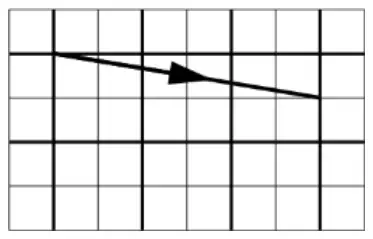 |
| (2) |
Notes:
- Correct answer without working. award 2/2
- In method 1 the arrows must be included in the nose to tail diagram for the award of •1, unless implied by an arrow on the correct resultant vector.
- In method 2 the brackets are not required for the award of •1 but do not accept (6,−1) alone.
- Do NOT penalise vectors drawn without a ruler provided the start and end points are accurate.
- Where there is evidence of component form and a nose-to-tail diagram, mark both methods and award the higher mark (apply general marking principle (p)).
Commonly Observed Responses:
- (a)
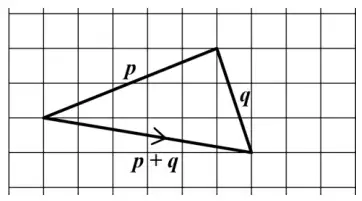 award 2/2
(b)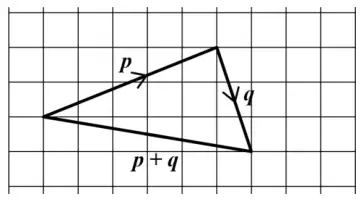 award 1/2 ✓✗
(c)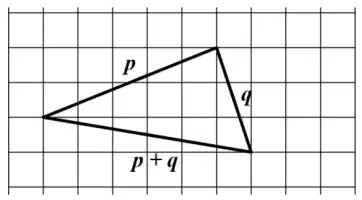 award 0/2 ✗✗
 award 0/2 ✗✗