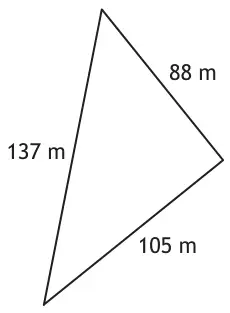
•1 and •3 are not available where a candidate starts by stating that \(88^2+105^2=137^2\)
eg \(88^2+105^2=137^2\)
•1 ✗ •3 ✗
\(18769=18769\)
•2 ✓
so it is right-angled.
award 1/3 ✗✓✗
•3 is not available where a candidate starts by stating that IF \(88^2+105^2=137^2\) unless explicit comparison is demonstrated
eg IF \(88^2+105^2=137^2\)
•1 ✓ •3 ✗
\(18769=18769\)
•2 ✓
so it is right-angled.
award 2/3 ✓✓✗
For the award of •3: (a) accept \(88^2+105^2=137^2\) as evidence of explicit comparison unless candidate has started with this statement (see Notes 1 and 2). (b) accept 18769 = 18769 as evidence of explicit comparison where the two separate calculations each lead to 18769. (c) do NOT accept statement “\(c^2=a^2+b^2\) so it is right-angled” unless \(c\), \(a\) and \(b\) have been labelled on diagram or assigned to sides, and statement is consistent with labelling.
Inappropriate use of RAD or GRAD should only be penalised once in Q2, Q7, Q8 or Q10. (a) 1.57…, it is not right-angled (RAD). (b) 100, it is not right-angled (GRAD).
Commonly Observed Responses:
1. (a) \((\cos x=)\,\dfrac{88^2+137^2-105^2}{2\times88\times137}\to(\cos x=)\,\dfrac{88}{137}\to50.033\ldots\to\) not right angled
award 2/3 ✗✓1✓1
(b) \((\cos x=)\,\dfrac{105^2+137^2-88^2}{2\times105\times137}\to(\cos x=)\,\dfrac{105}{137}\to39.966\ldots\to\) not right angled
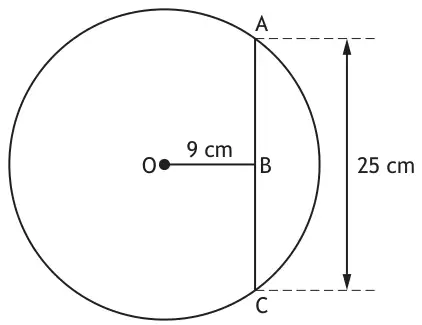
5. The diagram shows a circle, centre O, with chord AC.
AC is 25 centimetres.
B is the midpoint of AC.
OB is 9 centimetres.
Calculate the length of the radius of the circle. [3]
Marking instructions
Mark
Generic scheme
Illustrative scheme
•1
marshal facts and recognise right angled triangle
•2
consistent Pythagoras statement
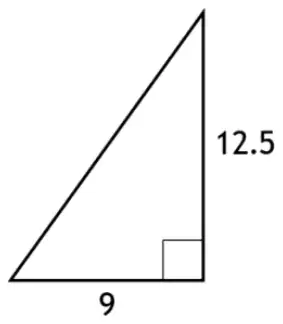
\(12.5^2+9^2\)
•3
calculate radius
\(15.4(02\ldots)\) (cm)
(3)
Notes:
Correct answer without working. award 0/3
In the absence of a diagram or diagram with no right angle marked, accept \(12.5^2+9^2\) as evidence for the award of •1 and •2.
BEWARE: where a diagram is shown, working must be consistent with the diagram; •2 is not available for an incorrect diagram leading to \(12.5^2+9^2\).
Valid trigonometry may be used to calculate the length of the radius eg cosine rule.
•3 is not available for subsequent invalid working.
Accept 15 (cm) with working. award 3/3
Commonly Observed Responses:
1. \(12.5^2-9^2\to8.67\ldots\)
(a) working inconsistent with correct diagram
award 2/3 ✓✗✓1
(b) working consistent with candidate’s diagram (cosine rule may be used to calculate third side)
award 2/3 ✗✓1✓1
(c) no diagram or diagram with no right angle marked
award 1/3 ✗✗✓1
2. \(25^2-9^2\to23.32\ldots\) or \(25^2+9^2\to26.57\ldots\)
(a) working consistent with candidate’s diagram (cosine rule may be used to calculate third side)
award 2/3 ✗✓1✓1
(b) no diagram or diagram with no right angle marked
award 1/3 ✗✗✓1
Corrected by Westie's Workshop
The board's marking instructions printed “Valid trigonometry may used to calculate the length of the radius”. Changed to “Valid trigonometry may be used to calculate the length of the radius” because a word is missing: the sentence needs “be” to make sense.
Original: see the board's marking instructions PDF (link above).
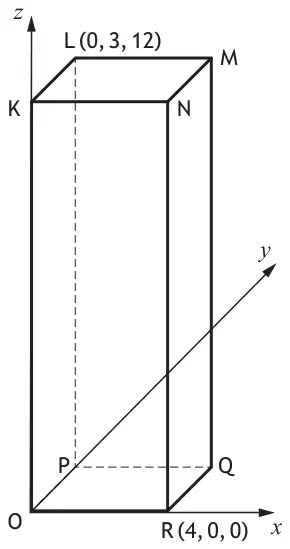
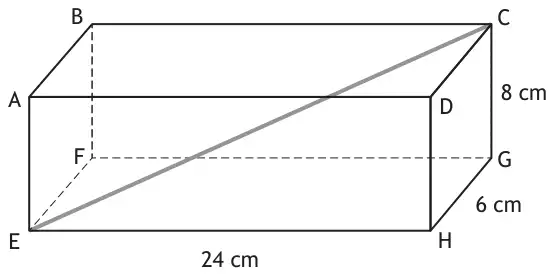
8. The diagram shows a cuboid, KLMNOPQR, relative to the coordinate axes.
L has coordinates (0, 3, 12).
R has coordinates (4, 0, 0).
(a) Write down the coordinates of M. [1]
(b) Calculate the length of the space diagonal OM. [3]
Marking instructions (a)
Mark
Generic scheme
Illustrative scheme
•1
state coordinates
\((4,3,12)\)
(1)
Notes:
Brackets must be shown.
If coordinates appear in (b) they must be clearly indicated as M, or used in the calculation of OM.
For \(\begin{pmatrix}4\\3\\12\end{pmatrix}\) award 0/1
Marking instructions (b)
Mark
Generic scheme
Illustrative scheme
•2
start valid strategy
\(3^2+4^2\) or \(3^2+12^2\) or \(4^2+12^2\) (stated or implied by •3)
•3
continue strategy
\(3^2+4^2+12^2\)
•4
calculate length of space diagonal
13
(3)
Notes:
Correct answer without working. award 0/3
Accept •2 \(\begin{pmatrix}4\\3\\12\end{pmatrix}\to\) •3 \(3^2+4^2+12^2\to\) •4 13 award 3/3
Calculation must use the coordinate stated in (a) or 3, 4 and 12.
Where a candidate uses coordinates containing a zero stated in (a) then only •2 is available. eg \(\sqrt{4^2+0^2+12^2}=12.6\) award 1/3 ✓1✗✗
Premature rounding: rounded working must be to at least one decimal place. (a) \(\sqrt{4^2+12^2}=12.6\ldots\to\sqrt{12.6^2+3^2}=12.95\ldots\) award 3/3 (b) \(\sqrt{4^2+12^2}=12.6\ldots\to\sqrt{13^2+3^2}=13.34\ldots\) award 2/3 ✓✓✗
Accept correct use of cosine rule.
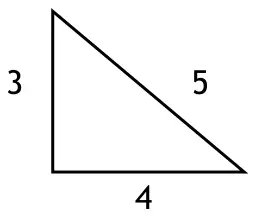
Where a candidate demonstrates recognition of 3,4,5 triple, accept: (a) Evidence may appear on the given diagram. (b) 5, since 3,4 5 is a Pythagorean triple. (c) \(3^2+4^2=5^2\).
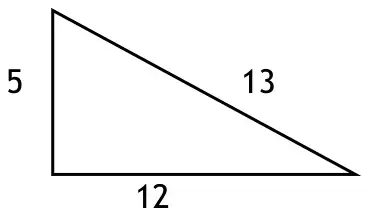
Where a candidate demonstrates recognition of 5, 12, 13 triple, accept: (a) Evidence may appear on the given diagram. (b) 13, since 5, 12, 13 is a Pythagorean triple. (c) \(5^2+12^2=13^2\).
For an invalid strategy involving the addition or subtraction of the lengths of two edges followed by a Pythagoras calculation. eg \(4+3=7\to\sqrt{7^2+12^2}=13.89\ldots\) award 0/3
Where a candidate uses four lengths, only •2 is available. eg (a) \(\sqrt{3^2+4^2+12^2+5^2}\;(=13.9)\) award 1/3 ✓✗✗ (b) \(\sqrt{3^2+4^2}+\sqrt{4^2+12^2}\;(=17.6)\) award 1/3 ✓✗✗
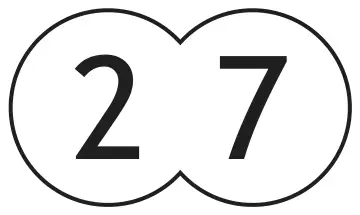
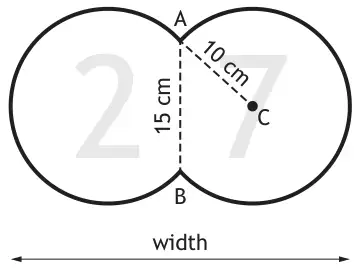
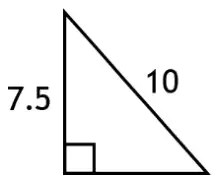
The sign consists of parts of two identical circles.
AB is a chord to both circles.
AB has length 15 centimetres.
The radius AC has length 10 centimetres.
Calculate the width of the sign. [4]
Marking instructions
Mark
Generic scheme
Illustrative scheme
•1
marshal facts and recognise right-angled triangle (diagram must include right angle)
•2
consistent Pythagoras statement
\(10^2-7.5^2\)
•3
calculate third side
\(6.6\ldots\)
•4
calculate width
\(33.2(\ldots\text{cm})\)
(4)
Notes:
Correct answer without working award 0/4
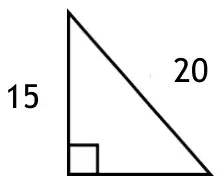
In the absence of a diagram or diagram with no right angle marked accept \(10^2-7.5^2\) or \(20^2-15^2\) as evidence for the award of •1 and •2.
For the award of •2 accept \(10^2=x^2+7.5^2\) or \(20^2=x^2+15^2\).
BEWARE (a) Where a diagram is shown, working must be consistent with the diagram. (b) •2 is not available for an incorrect diagram leading to \(10^2-7.5^2\).
•4 is only available following a Pythagoras or trigonometric calculation within a valid right-angled triangle using side lengths of either 10 and 7.5 or 20 and 15.
Alternative method:
•1
•2
\(20^2-15^2\)
•3
\(13.2\ldots\)
•4
\(33.2(\ldots\text{cm})\)
Commonly Observed Responses:
1. \(10^2+7.5^2\to12.5\to45\)
(a) working inconsistent with correct diagram
award 3/4 ✓✗✓1✓1
(b) working consistent with candidate’s diagram (cosine rule may be used to calculate third side)
award 3/4 ✗✓1✓1✓1
(c) no diagram or diagram with no right angle marked
award 2/4 ✗✗✓1✓1
2. \(15^2-10^2\to11.18\ldots\to42.36\) (see Note 5)
(a) working consistent with candidate’s diagram
award 2/4 ✗✓1✓1✗
(b) no diagram or diagram with no right angle marked
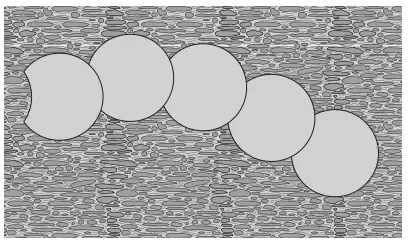
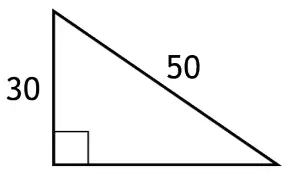
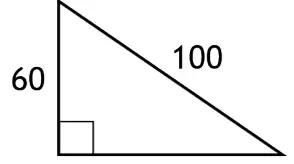
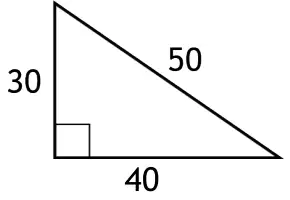
10. Alan buys some identical paving slabs to make a path.
Each slab is part of a circle.
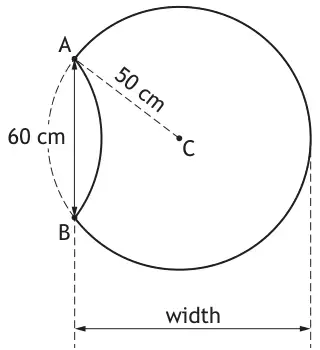
The diagram below shows a single slab.
The circle, centre C, has a radius of 50 centimetres.
Length AB is 60 centimetres.
Calculate the width of the paving slab. [4]
Marking instructions
Mark
Generic scheme
Illustrative scheme
Method 1
Method 1
•1
marshal facts and recognise right angled triangle
•2
consistent Pythagoras statement
\(50^2-30^2\)
•3
calculate third side
40
•4
calculate width
90
Method 2
Method 2
•1
marshal facts and recognise right angled triangle
•2
consistent Pythagoras statement
\(100^2-60^2\)
•3
calculate third side
80
•4
calculate width
90
(4)
Notes:
Correct answer without working award 0/4
In the absence of a diagram accept \(50^2-30^2\) or \(100^2-60^2\) as evidence for the award of •1 and •2.
BEWARE Where a diagram is shown, working must be consistent with the diagram; •2 is not available for an incorrect diagram leading to \(50^2-30^2\) or \(100^2-60^2\).
•4 is only available following a Pythagoras calculation within a valid right-angled triangle except in the examples outlined in note 5 eg \(d=100\to100-60=40\to40+50=90\) award 0/4
Where a candidate demonstrates recognition of 3,4,5 Pythagorean triple, for the award of •1, •2 and •3 accept: (a) (b) 40, since 3, 4, 5 triangle or Pythagorean triple.
Where a candidate uses 60 and 50 or 50 and 50 within a Pythagorean statement, •1 and •4 are not available eg (a) consistent with their diagram: \(60^2-50^2\to10\sqrt{11}\to50+10\sqrt{11}\) award 2/4 ✗✓1✓1✗ (b) no diagram: \(60^2-50^2\to10\sqrt{11}\to50+10\sqrt{11}\) award 1/4 ✗✗✓1✗
Where a candidate’s Pythagoras statement leads to an invalid solution, do not award •3 but •4 is still available eg \(30^2-50^2\to\sqrt{\pm1600}\to40\to90\) •3 ✗ •4 ✓1
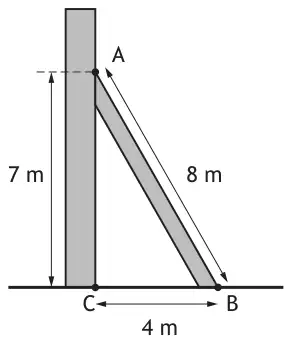
•1 is not available where a candidate starts by stating that \(4^2+7^2=8^2\) or \(4^2+7^2\ne8^2\)
\(4^2+7^2=8^2\) or \(4^2+7^2\ne8^2\)
✗•1
\(65\ne64\)
✓•2✓•3
No, as angle is not a right angle
✓•4award 3/4 ✗✓✓✓
There must be an explicit comparison stated for the award of •3
For the award of •3 accept eg (a) \(\sqrt{65}\ne\sqrt{64}\) (b) \(\sqrt{65}\ne8\) (c) \(a^2+b^2\ne c^2\) or \(\text{AC}^2+\text{CB}^2\ne\text{AB}^2\) (labelling consistent with diagram) (d) 65 > 64
The conclusion must include reference to 90° or a right angle.
Inappropriate use of RAD or GRAD should only be penalised once in Qu 4, 8, 11 or 15 (a) 1.55… (RAD), no, as angle is not a right angle (b) 98 (.86…) (GRAD), no, as angle is not a right angle
Commonly Observed Responses:
1. (a) \(4^2+7^2=65\to8.06\ldots=8;\ 8=8\to\) yes, as angle is a right angle
award 3/4 ✓✓✗✓1
(b) \(4^2+7^2=65\to8;\ 8=8\to\) yes, as angle is a right angle
award 3/4 ✓✗✓1✓1
2. If triangle is right-angled then \(4^2+7^2=8^2\to65\ne64;\) No, as angle is not a right angle
award 4/4
3. (a) \(4^2+8^2\) and \(7^2\to80,\ 49\to80\ne49\to\) no, as angle is not a right angle
award 3/4 ✗✓1✓1✓1
(b) \(4^2+8^2=7^2\to80,\ 49\to80\ne49\to\) no, as angle is not a right angle
award 3/4 ✗✓1✓1✓1
4. (a) \(\dfrac{4^2+7^2-8^2}{2\times4\times7}=\dfrac{1}{56}=0.017(\ldots)^\circ\) or \(\text{C}=0.017(\ldots)\to\) no, as angle is not a right angle
award 3/4 ✓✓✗✓1
(b) \(\dfrac{4^2+7^2-8^2}{2\times4\times7}=\dfrac{1}{56}=0.017(\ldots)\to\) no, as angle is not a right angle
Premature rounding: rounded working must be to at least 1 decimal place: (a) \(\sqrt{24^2+6^2}=24.7\ldots\to\sqrt{24.7^2+8^2}=25.96\ldots\) award 3/3 (b) \(\sqrt{24^2+6^2}=24.7\ldots\to\sqrt{25^2+8^2}=26(.2\ldots)\) award 2/3 ✓✓✓2
Accept correct use of trigonometry. Finding the size of an angle in a right-angled triangle is not sufficient for the award of •1 or •2
For an invalid strategy involving the addition or subtraction of the lengths of two edges followed by a Pythagoras calculation eg \(24+6=30\to\sqrt{30^2+8^2}=31.0\ldots\) award 0/3
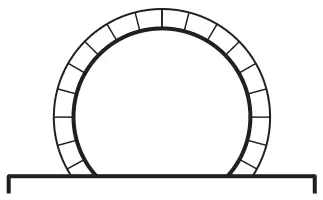
8. A train tunnel has a circular cross-section with a horizontal floor.
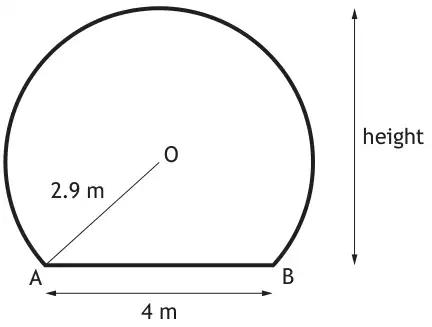
A diagram of the cross-section is shown below.
The centre of the circle is O.
Chord AB is 4 metres.
The radius OA is 2.9 metres.
Calculate the height of the tunnel. [4]
Marking instructions
Mark
Generic scheme
Illustrative scheme
•1
marshal facts and recognise right-angled triangle
•2
consistent Pythagoras statement
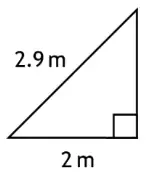
\(2.9^2-2^2\)
•3
calculate third side
2.1
•4
calculate height
5 (m)
(4)
Notes:
Correct answer without working award 0/4
In the absence of a diagram, accept \(2.9^2-2^2\) as evidence for the awards of •1 and •2
BEWARE where a diagram of a right-angled triangle is shown, working must be consistent with the diagram. •2 is not available for an incorrect diagram leading to \(2.9^2-2^2\)
•2 is available for a valid trig. method leading to the length of the third side (a) award •2 for eg \(x=\cos^{-1}\left(\dfrac{2}{2.9}\right)\to2\tan x\) or \(2.9\sin x\) (b) do not award •2 for eg \(\cos^{-1}\left(\dfrac{2}{2.9}\right)=46.3(9\ldots)\)
•4 is awarded for adding 2.9 to a value which has been calculated using Pythagoras’ theorem or trigonometry
•1 and •2 are not available for: (a) \(4^2-2.9^2\to2.75\ldots;\ \text{height}=5.65\ldots\) award 2/4 ✗✗✓1✓1 (b) \(4^2+2.9^2\to4.94\ldots;\ \text{height}=7.84\ldots\) award 2/4 ✗✗✓1✓1
Where a candidate assumes an angle of \(45^\circ\) in the right-angled triangle, only •1 and •4 are available
Disregard errors due to premature rounding provided there is evidence
We'd like to use Google Analytics cookies to count visits and see which pages help most. They're optional, and the site works exactly the same either way. Privacy policy