re-arrange (collect constants on one side and variables on other side)
\(-6\lt 2x\) or \(-2x\lt 6\)
•3
solve for \(x\)
\(-3\lt x\) or \(x\gt -3\)
(3)
Notes:
Correct answer without valid working. award 0/3 Treat repeated substitution as invalid working.
(a) There must be evidence that the candidate has dealt with the negative coefficient of \(x\) on the LHS of the inequations by either: (i) reversing the direction of the inequality sign at •3. eg \(x+8\lt 3x-6+20\to-2x\lt 18\to x\gt -9\). award 2/3 ✓✗✓1 or (ii) collecting the \(x\) terms on the RHS of the inequation at •2. eg \(x+8\lt 3x-6+20\to-18\lt 2x\to-9\lt x\). award 2/3 ✓✗✓1 (b) Where a candidate requires to do neither of the above, then •3 is not available. eg \(x+8\lt 3x-6+20\to2x\lt 18\to x\lt 9\). award 1/3 ✓✗✗
For subsequent incorrect working, •3 is not available. eg (a) \(-3\lt x\to x\lt -3\). award 2/3 ✓✓✗ (b) \(-3\lt x\to x=-3\). award 2/3 ✓✓✗
Commonly Observed Responses:
\(x+8\lt 3x-2+20\to-2x\lt 10\to x\gt -5\) award 2/3 ✗✓1✓1
(a) \(x+8=3x-6+20\to-2x=6\to x\gt -3\) award 3/3 (b) \(x+8=3x-6+20\to-2x=6\to x=-3\) award 2/3 ✓✓✗
13. Solve the equation \(\dfrac{5x+1}{2}=\dfrac{4x}{3}+1\). [3]
Marking instructions
Mark
Generic scheme
Illustrative scheme
•1
eliminate denominators
\(3(5x+1)=8x+6\) or equivalent
•2
rearrange into the form \(ax=b\)
\(7x=3\)
•3
solve for \(x\)
\(x=\dfrac{3}{7}\)
(3)
Notes:
Correct answer without working. award 0/3
For repeated substitution. award 0/3
For the award of •1. (a) accept \(\dfrac{15x+3}{6}=\dfrac{8x}{6}+1\to15x+3=8x+6\) (b) do not accept \(\dfrac{15x+3}{6}=\dfrac{8x}{6}+1\) alone.
•3 is not available for division by a single digit leading to an integer answer.
Do not award •3 for a decimal approximation of \(\dfrac{3}{7}\), but do not penalise incorrect conversion to a mixed number or decimal approximation following an answer of \(\dfrac{3}{7}\). (a) \(3(5x+1)=8x+6\to7x=3\to x=\dfrac{3}{7}\to0.428\ldots\) award 3/3 (b) \(3(5x+1)=8x+6\to7x=3\to0.428\ldots\) award 2/3 ✓✓✗
For subsequent incorrect working •3 is not available.
rearrange (collect constants on one side and variables on the other side)
\(-14\lt 2x\) or \(-2x\lt 14\)
•3
solve for \(x\)
\(-7\lt x\) or \(x\gt -7\)
(3)
Notes:
Correct answer without valid working award 0/3 Treat repeated substitution as invalid working.
(a) There must be evidence that the candidate has dealt with the negative coefficient of \(x\) on the LHS of the inequation by either: (i) reversing the direction of the inequality sign at •3 eg \(5x-10+4\lt 7x+8\to-2x\lt 22\to x\gt -11\) award 2/3 ✓✗✓1 OR (ii) collecting the \(x\) term(s) on the RHS of the inequation at •2 eg \(5x-10+4\lt 7x+8\to2\lt 2x\to1\lt x\) award 2/3 ✓✗✓1 (b) Where a candidate requires to do neither of the above, then •3 is not available eg \(5x-10+4\lt 7x+8\to2x\lt 14\to x\lt 7\) award 1/3 ✓✗✗
For subsequent incorrect working, •3 is not available. eg (a) \(-7\lt x\to x\lt -7\) award 2/3 ✓✓✗ (b) \(-7\lt x\to x=-7\) award 2/3 ✓✓✗
14. Solve, algebraically, the inequation \(\dfrac{x+1}{3}-2>\dfrac{3x}{5}\). [3]
Marking instructions
Mark
Generic scheme
Illustrative scheme
Method 1
Method 1
•1
eliminate denominators
\(5(x+1)-30>9x\) or equivalent
•2
rearrange into the form \(ax>b\) or \(b>ax\)
\(-4x>25\) or \(-25>4x\)
•3
solve for \(x\)
\(x<-\dfrac{25}{4}\) or \(-\dfrac{25}{4}>x\)
Method 2
Method 2
•1
collect algebraic terms and express as a fraction in simplest form
\(\dfrac{5-4x}{15}>2\) or equivalent
•2
rearrange into the form \(ax>b\) or \(b>ax\)
\(-4x>25\) or \(-25>4x\)
•3
solve for \(x\)
\(x<-\dfrac{25}{4}\) or \(-\dfrac{25}{4}>x\)
Method 3
Method 3
•1
express left hand side as a fraction in simplest form
\(\dfrac{x-5}{3}>\dfrac{3x}{5}\) or equivalent
•2
rearrange into the form \(ax>b\) or \(b>ax\)
\(-4x>25\) or \(-25>4x\)
•3
solve for \(x\)
\(x<-\dfrac{25}{4}\) or \(-\dfrac{25}{4}>x\)
(3)
Notes:
Correct answer without working award 0/3 Treat repeated substitution as invalid working.
For the award of •3 accept eg \(x<-6\dfrac{1}{4}\), \(-6.25>x\), \(x<\dfrac{25}{-4}\)
For the award of •3 the answer must be a non-integer value. Do not award •3 for a decimal approximation of \(-\dfrac{25}{4}\), but do not penalise incorrect conversion to a mixed number or decimal approximation following an answer of \(-\dfrac{25}{4}\) (a) \(5(x+1)-30>9x\to-4x>25\to x<-\dfrac{25}{4}\to x<-6.3\) award 3/3 (b) \(5(x+1)-30>9x\to-4x>25\to x<-6.3\) award 2/3 ✓✓✗
(a) There must be evidence that the candidate has dealt with the negative coefficient of \(x\) on the LHS of the inequation by either: (i) reversing the direction of the inequality sign at •3 eg \(5(x+1)-30>9x\to-4x>25\to x<-\dfrac{25}{4}\) award 3/3 OR (ii) collecting the \(x\) term(s) on the RHS of the inequation at •2 eg \(5(x+1)-30>9x\to-25>4x\to-\dfrac{25}{4}>x\) award 3/3 (b) Where a candidate requires to do neither of the above, then •3 does not gain a mark eg \(5(x+1)-30>9x\to4x>25\to x>\dfrac{25}{4}\) award 1/3 ✓✗✓2
For subsequent incorrect working •3 is not available eg \(-\dfrac{25}{4}>x\to x>-\dfrac{25}{4}\) award 2/3 ✓✓✗
Commonly Observed Responses:
\(5(x+1)-2>9x\to-4x>-3\to x<\dfrac{3}{4}\) award 2/3 ✗✓1✓1
(a) \(5(x+1)-30=9x\to-4x=25\to x=-\dfrac{25}{4}\to x<-\dfrac{25}{4}\) award 3/3 (b) \(5(x+1)-30=9x\to-4x=25\to x=-\dfrac{25}{4}\) award 2/3 ✓✓✗
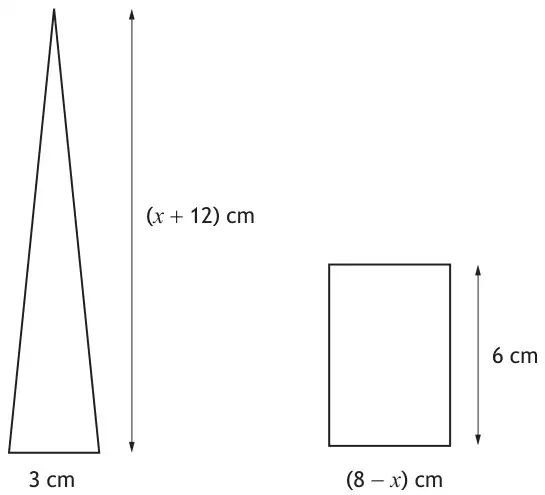
For \(\dfrac{1}{2}\times3\times x+12\) (a) accept as bad form if correct expansion appears in part (b) (b) do not accept otherwise
Do not penalise subsequent incorrect expansion of bracket in part (a) eg (a) \(\dfrac{3}{2}(x+12)=3x+18\) award 1/1 (b) \(3x+18\) award 0/1
If no expression appears in part (a), accept answer to part (a) written in part (b)
Commonly Observed Responses:
\(\dfrac{3}{2}(x+12)\sin\mathrm{C}\) award 0/1
Marking instructions (b)
Mark
Generic scheme
Illustrative scheme
•2
construct expression for area of rectangle and equate to area of triangle
\(\dfrac{3}{2}(x+12)=6(8-x)\)
•3
start to solve equation
\(3(x+12)=12(8-x)\) or \(\dfrac{3}{2}x+18=6(8-x)\)
•4
re-arrange equation
\(15x=60\) or \(7.5x=30\) or equivalent
•5
solve for \(x\)
\(x=4\)
(4)
Notes:
For guess and check award 0/4
•3 is not available if the expression for the area of the triangle does not include a fraction eg for an answer of \(3(x+12)\) in part (a): \(3(x+12)=6(8-x)\to9x=12\to x=\dfrac{4}{3}\) award 3/4 ✓1✗✓1✓1
Do not award •5 for a decimal approximation to a fraction. However, do not penalise incorrect conversion to a mixed number or decimal approximation following a fraction answer (in its simplest form) (a) \(3(x+12)=6(8-x)\to9x=12\to x=1.\dot{3}\) award 3/4 ✓1✗✓1✓1 (b) \(3(x+12)=6(8-x)\to9x=12\to x=\dfrac{4}{3}\to x=1.33\ldots\) award 3/4 ✓1✗✓1✓1 (c) \(3(x+12)=6(8-x)\to9x=12\to x=1.33\ldots\) award 2/4 ✓1✗✓1✓2
If solution to part (a) contains \(\sin\mathrm{C}\), only •2 and •3 are available: eg \(\dfrac{3}{2}(x+12)\sin\mathrm{C}=6(8-x)\to3(x+12)\sin\mathrm{C}=12(8-x)\) award 2/4 ✓1✓1✗✗
•5 is not available for division by a single digit leading to an integer answer eg (a) \(\ldots\to9x=12\to x=\dfrac{4}{3}\) award •5 (b) \(\ldots\to6x=48\to x=8\) do not award •5
We'd like to use Google Analytics cookies to count visits and see which pages help most. They're optional, and the site works exactly the same either way. Privacy policy