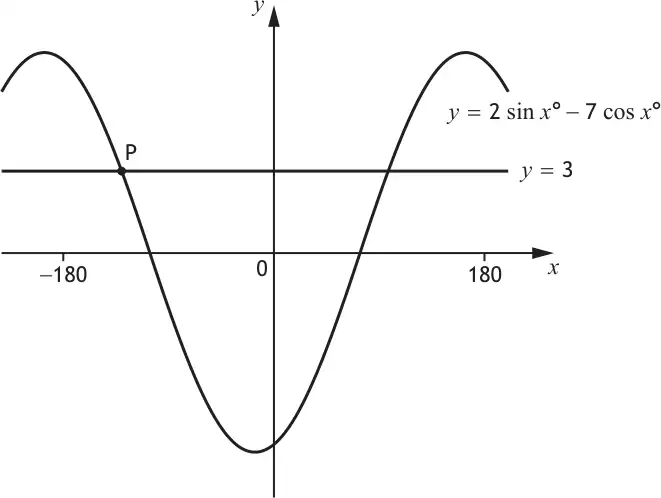
\(k\cos a^\circ=2\) AND \(k\sin a^\circ=7\) stated explicitly
•3
process for \(k\)
\(k=\sqrt{53}\)
•4
process for \(a\) and express in required form
\(\sqrt{53}\sin(x-74.05)^\circ\)
(4)
Notes:
Do not penalise the omission of degree symbols.
Accept \(k\left(\sin x^\circ\cos a^\circ-\cos x^\circ\sin a^\circ\right)\) for •1.
Treat \(k\sin x^\circ\cos a^\circ-\cos x^\circ\sin a^\circ\) as bad form only if the equations at the •2 stage both contain \(k\).
\(\sqrt{53}\sin x^\circ\cos a^\circ-\sqrt{53}\cos x^\circ\sin a^\circ\) or \(\sqrt{53}\left(\sin x^\circ\cos a^\circ-\cos x^\circ\sin a^\circ\right)\) are acceptable for •1 and •3.
•2 is not available for \(k\sin x^\circ=7\) and \(k\cos x^\circ=2\). However, •4 may still be gained. See Candidate F.
Accept \(-k\sin a^\circ=-7\) and \(k\cos a^\circ=2\) for •2.
•4 is not available for a value of \(a\) given in radians.
Accept values of \(a\) which round to 74.
Candidates may state and use any form of the wave function for •1, •2 and •3. However, •4 is only available if the wave is interpreted in the form \(k\sin(x-a)^\circ\).
Evidence for •4 may not appear until part (b) and must appear by the •5 stage.
(a) Express \(5\cos x-9\sin x\) in the form \(k\cos(x+a)\) where \(k>0\) and \(0<a<2\pi\). [4]
(b) Hence solve \(5\cos x-9\sin x=7\) for \(0\leqslant x<2\pi\). [3]
Marking instructions (a)
Mark
Generic scheme
Illustrative scheme
•1
use compound angle formula
\(k\cos x\cos a-k\sin x\sin a\) stated explicitly
•2
compare coefficients
\(k\cos a=5\) and \(k\sin a=9\) stated explicitly
•3
process for \(k\)
\(\sqrt{106}\)
•4
process for \(a\) and express in required form
\(\sqrt{106}\cos(x+1.06\ldots)\)
(4)
Notes:
Accept \(k(\cos x\cos a-\sin x\sin a)\) for •1.
Treat \(k\cos x\cos a-\sin x\sin a\) as bad form only if the equations at the •2 stage both contain \(k\).
\(\sqrt{106}\cos x\cos a-\sqrt{106}\sin x\sin a\) or \(\sqrt{106}(\cos x\cos a-\sin x\sin a)\) are acceptable for •1 and •3.
•2 is not available for \(k\cos x=5\) and \(k\sin x=9\), however •4 may still be gained. See Candidate E.
Accept \(-k\sin a=-9\) and \(k\cos a=5\) for •2.
•4 is not available for a value of \(a\) given in degrees.
Accept values of \(a\) which round to 1.1.
Candidates may state and use any form of the wave function for •1, •2 and •3. However, •4 is only available if the wave is interpreted in the form \(k\cos(x+a)\).
Evidence for •4 may not appear until part (b) and must appear by the •5 stage.
Commonly Observed Responses:
Candidate A
•1 ^
\(\sqrt{106}\cos a=5\) \(\sqrt{106}\sin a=9\)
•2 ✓ •3 ✓
\(\tan a=\dfrac{9}{5}\) \(a=1.06\ldots\)
\(\sqrt{106}\cos(x+1.06\ldots)\)
•4 ✓
Candidate B
\(k\cos x\cos a-k\sin x\sin a\)
•1 ✓
\(\cos a=5\) \(\sin a=9\)
•2 ✗
\(\tan a=\dfrac{9}{5}\) \(a=1.06\ldots\) (Not consistent with equations at •2)
\(\sqrt{106}\cos(x+1.06\ldots)\)
•3 ✓ •4 ✗
Candidate C
\(\cos x\cos a-\sin x\sin a\)
•1 ✗
\(\cos a=5\) \(\sin a=9\)
•2 ✗
\(k=\sqrt{106}\)
•3 ✓
\(\tan a=\dfrac{9}{5}\) \(a=1.06\ldots\) (Not consistent with equations at •2)
(In the illustrative scheme the two solutions are also set out in columns: the left column, 0.82… (7.106…) and 6.04…, is headed •6, and the right column, 5.46… and 4.396…, is headed •7.)
Notes:
In part (b), where candidates work in degrees throughout, the maximum mark available is 2/3.
•7 is only available for two solutions within the stated range. Ignore ‘solutions’ outwith the range.
At •7 accept values of \(x\) which round to 6.0, 6.05 or 4.4.
The board's marking instructions printed “x + 60⊗9… = 312.8…”. Changed to “x + 60.9… = 312.8…” because the “⊗” is a printing slip for the decimal point (the line above has cos(x + 60.9…)).
The board's marking instructions printed “346.2.π/180”. Changed to “346.2π/180” because there is a stray extra full stop.
Original: see the board's mark scheme PDF (link above).
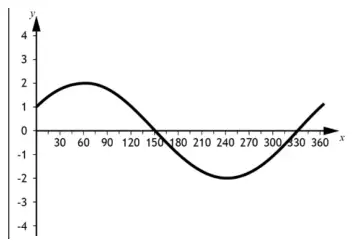
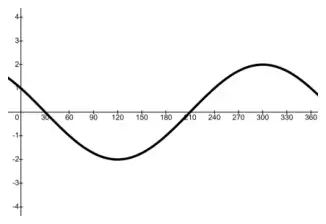
(a) Express \(\cos x^\circ+\sqrt{3}\sin x^\circ\) in the form \(k\cos(x-a)^\circ\), where \(k\gt0\) and \(0\lt a\lt360\). [4]
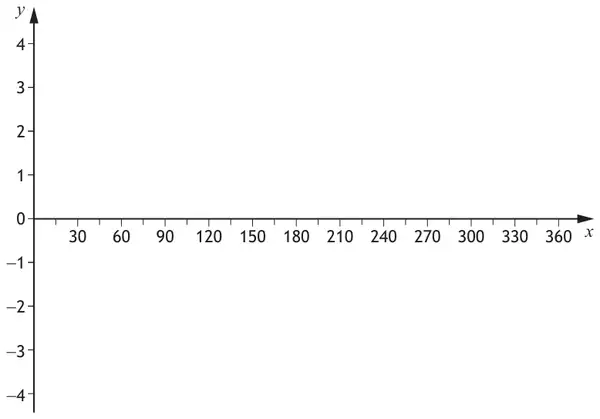
(b) Hence, or otherwise, sketch the graph with equation \(y=\cos x^\circ+\sqrt{3}\sin x^\circ\), \(0\leqslant x\leqslant360\). Use the diagram provided in your answer booklet (shown below). [3]
Accept \(k\left(\cos x^\circ\cos a^\circ+\sin x^\circ\sin a^\circ\right)\) for •1. Treat \(k\cos x^\circ\cos a^\circ+\sin x^\circ\sin a^\circ\) as bad form only if the equations at the •2 stage both contain \(k\).
Do not penalise the omission of degree signs.
\(2\cos x^\circ\cos a^\circ+2\sin x^\circ\sin a^\circ\) or \(2\left(\cos x^\circ\cos a^\circ+\sin x^\circ\sin a^\circ\right)\) is acceptable for •1 and •3.
•2 is not available for \(k\cos x^\circ=1,\ k\sin x^\circ=\sqrt{3}\), however •4 may still be gained- see Candidate E
•3 is only available for a single value of \(k,\ k\gt0\).
•3 is not available to candidates who work with \(\sqrt{4}\) throughout parts (a) and (b) without explicitly simplifying at any stage. •4 is still available.
•4 is not available for a value of \(a\) given in radians.
Candidates may use any form of the wave function for •1, •2 and •3. However, •4 is only available if the wave is interpreted in the form \(k\cos(x-a)^\circ\).
Do not penalise the omission of degree symbols in this question.
Accept \(k\left(\sin x^\circ\cos a^\circ+\cos x^\circ\sin a^\circ\right)\) at •1.
Treat \(k\sin x^\circ\cos a^\circ+\cos x^\circ\sin a^\circ\) as bad form only if the equations at the •2 stage both contain \(k\).
\(\sqrt{58}\sin x^\circ\cos a^\circ+\sqrt{58}\cos x^\circ\sin a^\circ\) or \(\sqrt{58}\left(\sin x^\circ\cos a^\circ+\cos x^\circ\sin a^\circ\right)\) are acceptable for •1 and •3.
•2 is not available for \(k\cos x^\circ=-3\) and \(k\sin x^\circ=7\), however •4 may still be gained - see Candidate E.
•3 is only available for a single value of \(k,\ k>0\).
•4 is not available for a value of \(a\) given in radians.
Accept values of \(a\) which round to 113.
Candidates may use any form of the wave function for •1, •2 and •3. However, •4 is only available if the wave is interpreted in the form \(k\sin(x+a)^\circ\).
Treat \(k\sin x\cos a+\cos x\sin a\) as bad form only if the equations at the •2 stage both contain \(k\).
\(\sqrt{41}\sin x\cos a+\sqrt{41}\cos x\sin a\) or \(\sqrt{41}(\sin x\cos a+\cos x\sin a)\) are acceptable for •1 and •3.
•2 is not available for \(k\cos x=4\) and \(k\sin x=5\), however •4 may still be gained. See Candidate E.
•3 is only available for a single value of \(k\), \(k>0\).
•4 is not available for a value of \(a\) given in degrees.
Accept values of \(a\) which round to 0.9.
Candidates may use any form of the wave function for •1, •2 and •3. However, •4 is only available if the wave is interpreted in the form \(k\sin(x+a)\).
Evidence for •4 may not appear until part (b) and must appear by the •5 stage.
Commonly Observed Responses:
Candidate A
•1 ^
\(\sqrt{41}\cos a=4\) \(\sqrt{41}\sin a=5\)
•2 ✓ •3 ✓
\(\tan a=\dfrac{5}{4}\) \(a=0.896\ldots\)
\(\sqrt{41}\sin(x+0.896\ldots)\)
•4 ✓
Candidate B
\(k\sin x\cos a+k\cos x\sin a\)
•1 ✓
\(\cos a=4\) \(\sin a=5\)
•2 ✗
\(\tan a=\dfrac{5}{4}\) \(a=0.896\ldots\) (callout: “Not consistent with equations at •2.”)
We'd like to use Google Analytics cookies to count visits and see which pages help most. They're optional, and the site works exactly the same either way. Privacy policy