\(\Rightarrow\) DE is parallel to EF (common direction) and E is a common point \(\Rightarrow\) D,E and F are collinear
(3)
Notes:
Do not penalise inconsistent vector notation (for example lack of arrows or brackets).
The comparison at •2 may be expressed as a ratio, for example DE : EF = 2 : 1.
If no comparison of vectors or the trivial comparison ‘\(\overrightarrow{\text{DE}}=\overrightarrow{\text{EF}}\)’ is made at •2, then •3 is not available.
•3 can only be awarded if a candidate has stated ‘parallel’, ‘common point’ and ‘collinear’.
Candidates who state or imply that ‘points are parallel’ or ‘vectors are collinear’ or state ‘parallel and share a common point \(\Rightarrow\)collinear’ do not gain •3. There must be reference to the points.
Do not accept ‘\(d\), \(e\) and \(f\) are collinear’ at •3.
\(\Rightarrow\) DE is parallel to EF (common direction) and E is a common point \(\Rightarrow\) D,E and F are collinear
•3 ✓
[Annotation in the marking instructions: callout on \(\therefore 2\overrightarrow{\text{DE}}=\overrightarrow{\text{EF}}\): “ignore working subsequent to correct statement on previous line”]
Marking instructions (b)
Mark
Generic scheme
Illustrative scheme
Method 1
Method 1
•4
interpret ratio
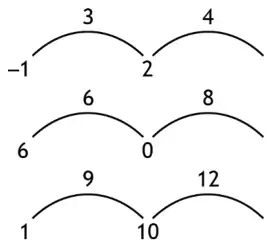
\(\begin{pmatrix}3\\-6\\9\end{pmatrix}\) and \(\begin{pmatrix}4\\-8\\12\end{pmatrix}\) or \(\begin{pmatrix}7\\-14\\21\end{pmatrix}\)
•5
find coordinates of G
\((6,-8,22)\)
Method 2
Method 2
•4
interpret ratio
eg \(\overrightarrow{\text{FG}}=\dfrac{4}{3}\overrightarrow{\text{DF}}\) or \(\overrightarrow{\text{DG}}=\dfrac{7}{3}\overrightarrow{\text{DF}}\)
•5
find coordinates of G
\((6,-8,22)\)
Method 3
Method 3
•4
use section formula
\(\dfrac{1}{3}(-4\mathbf{d}+7\mathbf{f})\) or \(\mathbf{f}=\dfrac{3}{7}\mathbf{g}+\dfrac{4}{7}\mathbf{d}\)
•5
find coordinates of G
\((6,-8,22)\)
(2)
Notes:
Do not penalise inconsistent vector notation (for example lack of arrows or brackets).
For (6,−8,22) without working award 2/2.
For \(\begin{pmatrix}6\\-8\\22\end{pmatrix}\) without working award 1/2.
For \(\left(\dfrac{17}{4},-\dfrac{9}{2},\dfrac{67}{4}\right)\) (ratio of 4:3 with working) award 1/2. See Candidate C.
No marks are available for finding an internal division point, for example \(\left(\dfrac{2}{7},\dfrac{24}{7},\dfrac{34}{7}\right)\) or using other ratios.
Do not penalise inconsistent vector notation (for example lack of arrows or brackets).
Where an invalid pathway has been stated, award 0/2.
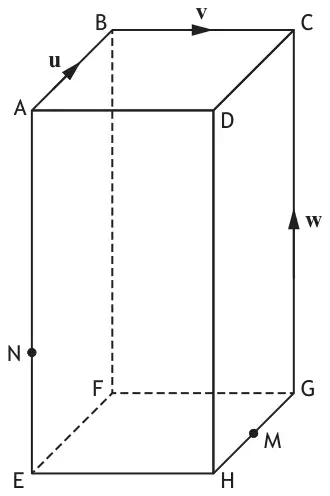
•1 may be awarded for the appearance of \(\dfrac{1}{2}\mathbf{u}-\mathbf{u}-\mathbf{v}+\mathbf{w}-\dfrac{2}{3}\mathbf{w}\). •2 is not available for an unsimplified expression.
Where no pathway has been stated, see Candidates A and B.
Commonly Observed Responses:
Candidate A - no pathway stated and incorrect expression in \(\mathbf{u}\), \(\mathbf{v}\) AND \(\mathbf{w}\)
\(-\dfrac{1}{2}\mathbf{u}-\mathbf{v}\ldots\)
Award 1/2
Candidate B - no pathway stated and incorrect expression in \(\mathbf{v}\), \(\mathbf{w}\) AND \(\mathbf{u}\)
2. Vectors \(\mathbf{u}\) and \(\mathbf{v}\) are defined as \(\mathbf{u}=\begin{pmatrix}3\\2\\6\end{pmatrix}\) and \(\mathbf{v}=\begin{pmatrix}-5\\-2\\4\end{pmatrix}\).
(a) Find \(\mathbf{u}\cdot\mathbf{v}\). [1]
(b) Calculate the acute angle between \(\mathbf{u}\) and \(\mathbf{v}\). [4]
Do not penalise candidates who treat negative signs with a lack of rigour when calculating a magnitude. For example, accept \(\sqrt{5^2+2^2+4^2}=\sqrt{45}\) or \(\sqrt{-5^2+-2^2+4^2}=\sqrt{45}\) for •3. However, do not accept \(\sqrt{5^2-2^2+4^2}=\sqrt{45}\) for •3.
•4 is not available to candidates who simply state the formula \(\cos\theta=\dfrac{\mathbf{u}.\mathbf{v}}{|\mathbf{u}||\mathbf{v}|}\). However, \(7\times\sqrt{45}\times\cos\theta=5\) or \(\theta=\cos^{-1}\left(\dfrac{5}{7\sqrt{45}}\right)\) is acceptable for •4.
Accept correct answers rounded to \(84^\circ\) or 1.5 radians (or 93 gradians).
Do not penalise the omission or incorrect use of units.
•5 is only available as a result of using a valid strategy.
Express \(\overrightarrow{\text{BE}}\) in terms of \(\mathbf{i}\), \(\mathbf{j}\) and \(\mathbf{k}\). [2]
Marking instructions
Mark
Generic scheme
Illustrative scheme
•1
identify an appropriate pathway
eg \(\overrightarrow{\text{BC}}+\overrightarrow{\text{CD}}+\overrightarrow{\text{DE}}\) stated or implied by •2
•2
find \(\overrightarrow{\text{BE}}\)
\((0\mathbf{i}+)\,5\mathbf{j}+4\mathbf{k}\)
(2)
Notes:
Do not penalise inconsistent vector notation (for example lack of arrows or brackets).
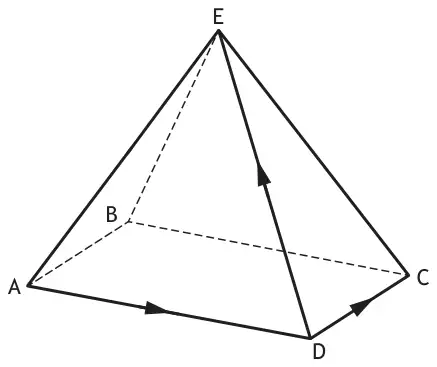
•1 is not available for \(\overrightarrow{\text{BD}}+\overrightarrow{\text{DE}}\) or \(\overrightarrow{\text{BC}}+\overrightarrow{\text{CE}}\) or similar. However, see Candidate C.
•2 is only available where a valid pathway has been stated.
Do not accept \(\begin{pmatrix}0\mathbf{i}\\5\mathbf{j}\\4\mathbf{k}\end{pmatrix}\) or \(\begin{pmatrix}0\\5\\4\end{pmatrix}\) for •2.
Where an invalid pathway ‘leads’ to \(5\mathbf{j}+4\mathbf{k}\) award 0/2.
\(\ldots\Rightarrow\) AB is parallel to BC (common direction) AND B is a common point \(\Rightarrow\) A, B and C are collinear.
(3)
Notes:
Do not penalise inconsistent vector notation (for example lack of arrows or brackets).
If no comparison of vectors or the trivial comparison ‘\(\overrightarrow{\text{AB}}=\overrightarrow{\text{BC}}\)’ is made at •2, then •3 is not available.
•3 can only be awarded if a candidate has stated ‘parallel’, ‘common point’ and ‘collinear’.
Candidates who state that ‘points are parallel’ or ‘vectors are collinear’ or ‘parallel and share a common point \(\Rightarrow\) collinear’ do not gain •3. There must be a reference to the points.
Do not accept ‘\(a\), \(b\) and \(c\) are collinear’ at •3.
\(\begin{pmatrix}9\\-3\\6\end{pmatrix}=3\begin{pmatrix}3\\-1\\2\end{pmatrix}\) AND \(\begin{pmatrix}6\\-2\\4\end{pmatrix}=2\begin{pmatrix}3\\-1\\2\end{pmatrix}\)
\(\Rightarrow\) AB is parallel to BC and B is a common point \(\Rightarrow\) A, B and C are collinear
•3 ✓
[Annotation in the marking instructions: pointing to \(\overrightarrow{\text{AB}}=\frac{2}{3}\overrightarrow{\text{BC}}\): Ignore working subsequent to correct statement made on previous line]
Marking instructions (b)
Mark
Generic scheme
Illustrative scheme
•4
state ratio
3:2
(1)
Notes:
Answers in (b) must be consistent with the components of the vectors in (a) or the comparison of the vectors in (a). See Candidates C and D. However, award •4 for ‘3:2’ with no working.
In this question, the answer for •4 must be stated explicitly in part (b).
The only acceptable variations for •4 must be related explicitly to AB and BC. For \(\dfrac{\text{BC}}{\text{AB}}=\dfrac{2}{3}\), \(\dfrac{\text{AB}}{\text{BC}}=\dfrac{3}{2}\) or \(\text{BC}:\text{AB}=2:3\) stated in part (b) award •4. See Candidate E.
Accept unitary ratios for •4, for example \(\dfrac{3}{2}:1\) or \(1:\dfrac{2}{3}\).
Where candidates state multiple ratios which are not equivalent, award 0/1.
4. P and Q have coordinates \((-6,1,2)\) and \((-1,11,-8)\) respectively.
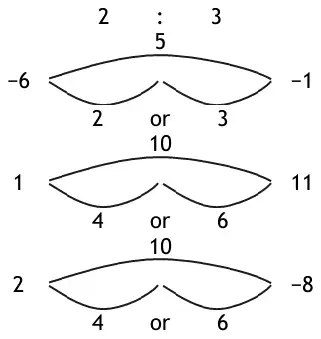
Find the coordinates of the point R which divides PQ in the ratio 2:3. [2]
Marking instructions
Mark
Generic scheme
Illustrative scheme
Method 1
Method 1
•1
interpret ratio
\(\begin{pmatrix}2\\4\\-4\end{pmatrix},\ \begin{pmatrix}-2\\-4\\4\end{pmatrix},\ \begin{pmatrix}3\\6\\-6\end{pmatrix}\) or \(\begin{pmatrix}-3\\-6\\6\end{pmatrix}\)
•2
find coordinates of R
\((-4,5,-2)\)
Method 2
Method 2
•1
interpret ratio
eg \(\overrightarrow{\mathrm{PR}}=\dfrac{2}{5}\overrightarrow{\mathrm{PQ}}\), \(\overrightarrow{\mathrm{QR}}=\dfrac{3}{5}\overrightarrow{\mathrm{QP}}\) or \(\overrightarrow{\mathrm{PR}}=\dfrac{2}{3}\overrightarrow{\mathrm{RQ}}\)
•2
find coordinates of R
\((-4,5,-2)\)
Method 3
Method 3
•1
use section formula
\(\dfrac{1}{5}(3\mathbf{p}+2\mathbf{q})\)
•2
find coordinates of R
\((-4,5,-2)\)
(2)
Notes:
For \((-4,5,-2)\) without working award 2/2.
For \(\begin{pmatrix}-4\\5\\-2\end{pmatrix}\) without working award 1/2.
For \((-3,7,-4)\) (ratio of 3:2 with working) award 1/2. See Candidate A.
For \(\begin{pmatrix}-3\\7\\-4\end{pmatrix}\) without working award 0/2.
\(\cos\text{DEF}=\dfrac{16}{\sqrt{53}\times\sqrt{14}}\) or \(\sqrt{53}\times\sqrt{14}\times\cos\text{DEF}=16\)
•7
calculate angle
\(54.028\ldots^\circ\) or \(0.942\ldots\) radians
(4)
Notes:
Do not penalise candidates who treat negative signs with a lack of rigour when calculating a magnitude. For example accept \(\sqrt{1^2+4^2+6^2}=\sqrt{53}\) or \(\sqrt{1^2+-4^2+6^2}=\sqrt{53}\) for •4. However, do not accept \(\sqrt{1^2-4^2+6^2}=\sqrt{53}\) for •4.
•6 is not available to candidates who simply state the formula \(\cos\theta=\dfrac{\overrightarrow{\text{ED}}.\overrightarrow{\text{EF}}}{\left|\overrightarrow{\text{ED}}\right|\left|\overrightarrow{\text{EF}}\right|}\). However, \(\cos\theta=\dfrac{16}{\sqrt{53}\times\sqrt{14}}\) and \(\sqrt{53}\times\sqrt{14}\times\cos\theta=16\) are acceptable for •6.
Accept correct answers rounded to \(54^\circ\) or 0.9 radians (or 60 gradians).
Do not penalise the omission or incorrect use of units.
•7 is only available as a result of using a valid strategy.
We'd like to use Google Analytics cookies to count visits and see which pages help most. They're optional, and the site works exactly the same either way. Privacy policy