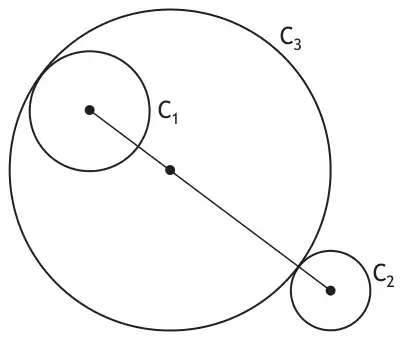
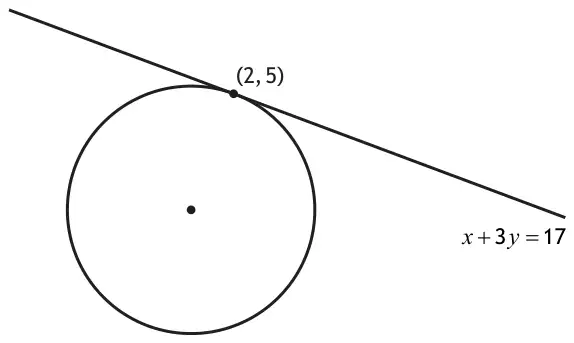
Circles C1, C2 and C3 are touching as shown in the diagram. The centre of circle C3 lies on the line joining the centres of C1 and C2.
(c) Determine the equation of C3. [3]
Marking instructions (a)
Mark
Generic scheme
Illustrative scheme
•1
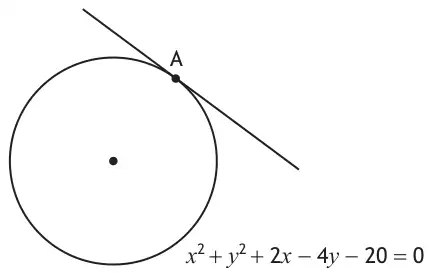
state coordinates of centre
(−5, 6)
•2
state radius
3
(2)
Notes:
Accept \(x=-5,\ y=6\) for •1.
Do not accept ‘\(a=\ldots,b=\ldots\)’ or ‘−5,6’ for •1.
Marking instructions (b)
Mark
Generic scheme
Illustrative scheme
•3
find coordinates of centre
(7, −3)
•4
find radius
2
(2)
Notes:
Accept \(x=7,\ y=-3\) for •3.
Do not accept ‘\(g=\ldots,\ f=\ldots\)’ or ‘7,−3’ for •3.
Do not penalise candidates who treat negatives with a lack of rigour when calculating the radius. For example, accept \(\sqrt{7^2+3^2-54}=2\) or \(\sqrt{7^2+-3^2-54}=2\) or \(\sqrt{-7^2+3^2-54}=2\) for •4. However, do not accept \(\sqrt{7^2-3^2-54}=2\) for •4.
Commonly Observed Responses:
Candidate A - repeated error within a question
(a) −5,6
•1 ✗
(b) 7,−3
•3 ✓1
Candidate B - two errors
(a) 5,−6
•1 ✗
(b) 7,−3
•3 ✗
Marking instructions (c)
Mark
Generic scheme
Illustrative scheme
•5
find distance between centres of C1 and C2
15
•6
calculate radius of C3
8
•7
find centre of C3 and state equation of C3
(−1, 3) stated explicitly and \((x+1)^2+(y-3)^2=64\)
(3)
Notes:
•5 may be awarded for \(\sqrt{(-5-7)^2+(6+3)^2}\) within a valid calculation for the radius of C3.
•6 is only available where a valid approach to finding the distance between the centres of C1 and C2 has been used.
Where candidates use a radius without valid supporting working, •7 is not available.
Accept the centre of C3 written as a position vector.
Ratio \(=15:10\) & stepping out \(\therefore\) C3\((-1,3)\) (may be drawn as similar triangles)
Let \(x=r_3-r_1\). Since \(r_3=13-x\), \(x=(13-x)-3\ \Rightarrow\ x=5\) \(\Rightarrow\) Ratio \(=5:10\ \therefore\) C3\((-1,3)\) (may also use \(y+3=r_3-r_1\))
9. Find the coordinates of the points of intersection of the line with equation \(y=x+1\) and the circle with equation \(x^2+y^2-2x+6y-15=0\). [4]
Marking instructions
Mark
Generic scheme
Illustrative scheme
•1
substitute
\(x^2+(x+1)^2-2x+6(x+1)-15(=0)\)
•2
write in standard quadratic form
\(2x^2+6x-8=0\)
•3
find \(x\)-coordinates
\(-4,\quad 1\)
•4
find \(y\)-coordinates
\(-3,\quad 2\)
(4)
(Horizontal/vertical marking: in the original, •3 and •4 are also printed above the two columns of the answers, so •3 may be awarded for \(-4,\ -3\) and •4 for \(1,\ 2\).)
Notes:
•2 is only available if ‘\(=0\)’ appears at the •1 or •2 stage.
Accept \(x^2+3x-4=0\) for •2.
The quadratic at •2 must lead to two distinct real roots for •3 and •4 to be available.
Where candidates arrive at an equation which is not a quadratic at •2 stage, then •3 and •4 are not available.
Where candidates identify both solutions by inspection, full marks may be awarded provided they justify that their points lie on both the line and the circle. Where candidates identify both solutions, but justify in only one equation, award 2/4.
Commonly Observed Responses:
Candidate A - substituting for \(x\)
\((y-1)^2+y^2-2(y-1)+6y-15=0\)
•1 ✓
\(2y^2+2y-12=0\)
•2 ✓
\(y=-3\) or \(y=2\)
•3 ✓
\(x=-4\) or \(x=1\)
•4 ✓
Candidate B - not squaring
\(x^2+(x+1)-2x+6(x+1)-15=0\)
•1 ✗ •2 ✗
\(x^2+5x-8=0\)
\(x=\dfrac{-5+\sqrt{57}}{2}\) and \(\dfrac{-5-\sqrt{57}}{2}\)
•3 ✓1
\(y=\dfrac{-3+\sqrt{57}}{2}\) and \(\dfrac{-3-\sqrt{57}}{2}\)
•4 ✓1
The working for •2 is not of equivalent difficulty
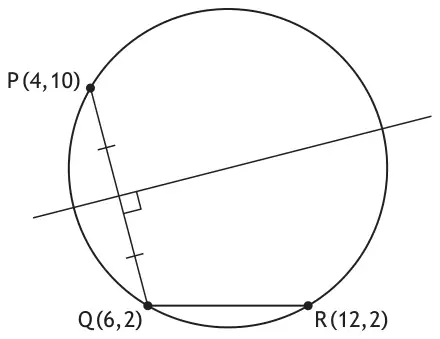
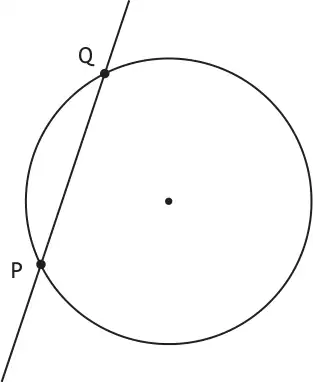
13. P and Q are the points \((4,10)\) and \((6,2)\) respectively.
(a) Find the equation of the perpendicular bisector of PQ. [4]
The point R has coordinates \((12,2)\).
A circle passes through the points P, Q and R.
The chord QR is horizontal.
(b) Find the equation of the circle. [4]
Marking instructions (a)
Mark
Generic scheme
Illustrative scheme
•1
find midpoint of PQ
(5,6)
•2
find gradient of PQ
\(-4\) or \(-\dfrac{8}{2}\)
•3
find perpendicular gradient
\(\dfrac{1}{4}\)
•4
find equation of perpendicular bisector
\(4y=x+19\)
(4)
Notes:
•4 is only available as a consequence of using a perpendicular gradient and a mid-point.
The gradient of the perpendicular bisector must appear in fully simplified form at •3 or •4 stage for •3 to be awarded.
At •4 accept \(4y-x=19\), \(4y-x-19=0\), or any other rearrangement of the equation where the constant terms have been simplified.
Marking instructions (b)
Mark
Generic scheme
Illustrative scheme
•5
identify \(x\)-coordinate of centre
9
•6
find \(y\)-coordinate of centre
7
•7
find radius
\(\sqrt{34}\)
•8
state equation of circle
\((x-9)^2+(y-7)^2=34\)
(4)
Notes:
Do not accept “centre = (9,2)” as evidence of •5.
Where candidates use PQ, QR or PR as the diameter of the circle no marks are available.
•7 and •8 are only available as a consequence of using the point of intersection of two perpendicular bisectors and a point on the circumference of the circle.
Accept \(r^2=34\) for •7.
\((x-9)^2+(y-7)^2=\left(\sqrt{34}\right)^2\) does not gain •8.
Commonly Observed Responses:
Candidate A - horizontal line through midpoint of PQ
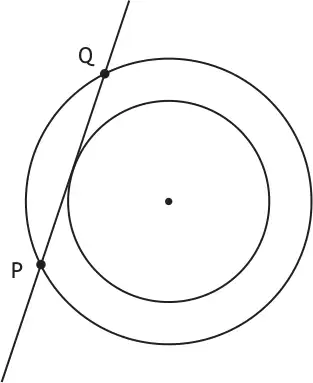
10. The circle C1 has equation \(x^2+y^2+18x-2y-8=0\).
(a) Find the centre and radius of C1. [2]
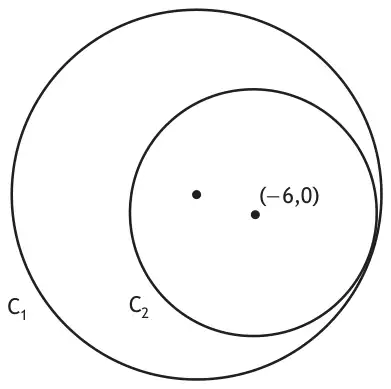
A second circle, C2, touches C1 internally.
The centre of C2 is (−6, 0).
(b) Determine the equation of C2. [2]
Marking instructions (a)
Mark
Generic scheme
Illustrative scheme
•1
state centre
\((-9,1)\)
•2
calculate radius
\(\sqrt{90}\) or \(3\sqrt{10}\) or \(9.48\ldots\)
(2)
Notes:
Accept \(x=-9,\ y=1\) for •1.
Do not accept ‘\(g=-9, f=1\)’ or ‘\(-9,1\)’ for •1.
Do not penalise candidates who treat negative signs with a lack of rigour when calculating the radius. For example accept \(\sqrt{9^2+-1^2+8}=\sqrt{90}\) or \(\sqrt{9^2+1^2+8}=\sqrt{90}\) or \(\sqrt{-9^2+1^2+8}=\sqrt{90}\) for •2. However, do not accept \(\sqrt{9^2-1^2+8}=\sqrt{90}\) for •2.
Marking instructions (b)
Mark
Generic scheme
Illustrative scheme
•3
determine the distance between the centres and subtract to find a numerical expression for the radius of C2
eg \(\sqrt{90}-\sqrt{10}\)
•4
determine equation of C2
\((x+6)^2+y^2=40\)
(2)
Notes:
Do not penalise the use of decimals.
The distance between the centres, and the radius of C2 must be consistent with the sizes of the circles in the original diagram (\(d<r_{\text{C}_2}<r_{\text{C}_1}\)).
Where a candidate uses an incorrect radius without supporting working, •4 is not available.
11. Circle C1 has equation \((x-4)^2+(y+2)^2=37\). Circle C2 has equation \(x^2+y^2+2x-6y-7=0\).
(a) Calculate the distance between the centres of C1 and C2. [3]
(b) Hence, show that C1 and C2 intersect at two distinct points. [3]
Marking instructions (a)
Mark
Generic scheme
Illustrative scheme
•1
state centre of C1
\((4,-2)\)
•2
state centre of C2
\((-1,3)\)
•3
calculate distance between centres
\(\sqrt{50}\) or \(5\sqrt{2}\) or 7.07…
(3)
Notes:
Accept \(x=4,\ y=-2\) for •1 and \(x=-1,\ y=3\) •2. Do not accept \(g=1,\ f=-3\) for •2.
Do not penalise lack of brackets in •1 and •2.
Marking instructions (b)
Mark
Generic scheme
Illustrative scheme
•4
state radius of C1
\(r_1=\sqrt{37}\) or \(6.08\ldots\)
•5
calculate radius of C2
\(r_2=\sqrt{17}\) or \(4.12\ldots\)
•6
demonstrate and communicate result
\(10.20\ldots>7.07\ldots\ (>1.95\ldots)\) \(\therefore\) circles intersect at two distinct points
(3)
Notes:
Accept \(\sqrt{1^2+3^2+7}=\sqrt{17}\) or \(\sqrt{1^2+-3^2+7}=\sqrt{17}\) for •5. However, do not accept \(\sqrt{(-1)^2+3^2+7}=\sqrt{17}\).
At •6 comparison must be made using decimals. Do not accept \(\sqrt{37}+\sqrt{17}>\sqrt{50}\) without any further working.
Evidence for •4 and •5 may be found in part (a).
For candidates who use simultaneous equations, award •4 for substitution of \(y=x+1\) into the equation of one of the circles, •5 for rearranging in standard quadratic form and •6 for obtaining distinct \(x\)-coordinates.
Do not penalise the omission of “at two distinct points” at •6.
We'd like to use Google Analytics cookies to count visits and see which pages help most. They're optional, and the site works exactly the same either way. Privacy policy