
May 2024 Paper 1 Q13
13. P and Q are the points \((4,10)\) and \((6,2)\) respectively.
(a) Find the equation of the perpendicular bisector of PQ. [4]
The point R has coordinates \((12,2)\).
A circle passes through the points P, Q and R.
The chord QR is horizontal.
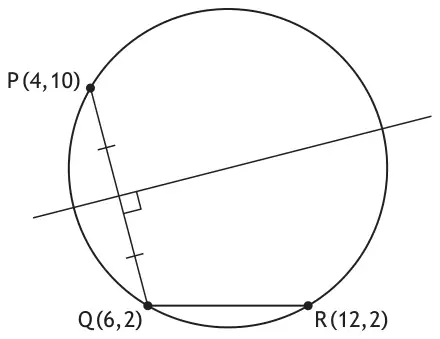
(b) Find the equation of the circle. [4]
| Mark | Generic scheme | Illustrative scheme |
|---|---|---|
| •1 | find midpoint of PQ | (5,6) |
| •2 | find gradient of PQ | \(-4\) or \(-\dfrac{8}{2}\) |
| •3 | find perpendicular gradient | \(\dfrac{1}{4}\) |
| •4 | find equation of perpendicular bisector | \(4y=x+19\) |
| (4) |
Notes:
- •4 is only available as a consequence of using a perpendicular gradient and a mid-point.
- The gradient of the perpendicular bisector must appear in fully simplified form at •3 or •4 stage for •3 to be awarded.
- At •4 accept \(4y-x=19\), \(4y-x-19=0\), or any other rearrangement of the equation where the constant terms have been simplified.
| Mark | Generic scheme | Illustrative scheme |
|---|---|---|
| •5 | identify \(x\)-coordinate of centre | 9 |
| •6 | find \(y\)-coordinate of centre | 7 |
| •7 | find radius | \(\sqrt{34}\) |
| •8 | state equation of circle | \((x-9)^2+(y-7)^2=34\) |
| (4) |
Notes:
- Do not accept “centre = (9,2)” as evidence of •5.
- Where candidates use PQ, QR or PR as the diameter of the circle no marks are available.
- •7 and •8 are only available as a consequence of using the point of intersection of two perpendicular bisectors and a point on the circumference of the circle.
- Accept \(r^2=34\) for •7.
- \((x-9)^2+(y-7)^2=\left(\sqrt{34}\right)^2\) does not gain •8.
Commonly Observed Responses:
Candidate A - horizontal line through midpoint of PQ
| Centre = (9,6) | •5 ✓ •6 ✗ |
| Radius = 5 | •7 ✗ |
| Equation: \((x-9)^2+(y-6)^2=25\) | •8 ✗ |
Candidate B - perpendicular bisector of PR
| Perpendicular bisector of PR: \(y=x-2\) | |
| Centre = (9,7) | •5 ✓ •6 ✓ |
| \(\vdots\) |