7. The complex number \(z=2+i\) is a root of the polynomial equation \(z^4-2z^3-z^2+2z+10=0\).
(a) State a second root of the equation. [1]
(b) Find the remaining roots. [5]
Marking instructions (a)
Mark
Generic scheme
Illustrative scheme
•1
state second root
\(2-i\)
(1)
Marking instructions (b)
Mark
Generic scheme
Illustrative scheme
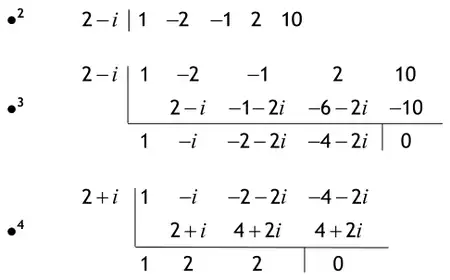
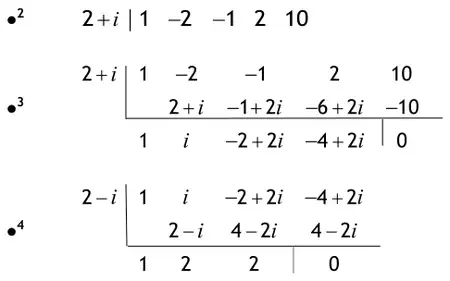
•2
obtain two linear factors
\(z-(2+i),\ z-(2-i)\)
•3
obtain quadratic factor
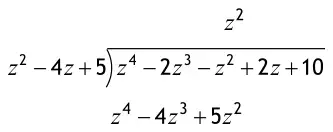
\(z^2-4z+5\)
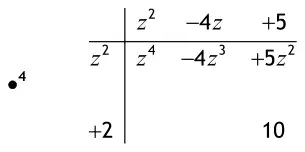
•4
set up and begin algebraic division or equivalent 1
•5
obtain second quadratic factor 1,2
\(z^2+2z+2\)
•6
obtain remaining two roots 2
\(-1\pm i\)
(5)
Notes:
Where, having correctly stated the first quadratic factor, a candidate produces the second with no intermediate working, award •4 and •5.
Where a candidate produces a second quadratic expression which is not a factor, •5 is not available but •6 may still be, provided the expression has a negative discriminant.
Accept arguments expressed in degrees provided the degree symbol appears at least once in part (a) or (b). Otherwise, withhold •2.
Any working leading to the calculation of the argument or modulus must be consistent (General Marking Principle (n)). For example, do not accept \(\tan\dfrac{1}{\sqrt{3}}=\dfrac{\pi}{6}\).
18. Let \(z=x+iy\) be a complex number, where \(x,\,y\in\mathbb{R}\).
(a)
(i) Express \(\overline{z}+iz\) in Cartesian form, where \(\overline{z}\) is the complex conjugate of \(z\). [2]
(ii) Given \(x>y\), find the argument of \(\overline{z}+iz\). [1]
When \(x<y,\ \overline{z}+iz=r\left(\cos\left(-\dfrac{3\pi}{4}\right)+i\sin\left(-\dfrac{3\pi}{4}\right)\right)\) where \(r\) is the modulus of \(\overline{z}+iz\).
(b) Use de Moivre’s theorem to find, in polar form, both square roots of \(\overline{z}+iz\). [2]
Marking instructions (a)(i)
Mark
Generic scheme
Illustrative scheme
•1
state conjugate
\(x-iy\)
•2
obtain expression 1
\(x-y+i(x-y)\)
(2)
Notes:
For •2, accept \(x-y-i(y-x)\).
Marking instructions (a)(ii)
Mark
Generic scheme
Illustrative scheme
•3
find argument 1,2
\(\dfrac{\pi}{4}\) or \(45^\circ\)
(1)
Notes:
Do not withhold •3 for an argument in degrees where the degree symbol is omitted.
Do not award •3 if a candidate obtains a correct value from incorrect working (eg \(\tan(1)=\dfrac{\pi}{4}\)).
Accept \(-67.5^\circ\) and \(112.5^\circ\) respectively. Disregard the omission of degree symbols.
Do not withhold •5 where a candidate has produced an acceptable second argument but has produced an incorrect or unsimplified modulus which is equal to their previous one.
Do not award •5 where a candidate proceeds from a first square root with an argument of \(-\dfrac{3\pi}{4}\).
3. Two complex numbers are defined as \(z=11+10i\) and \(w=3-2i\).
Find \(\dfrac{z}{w}\) in the form \(a+bi\), where \(a,\ b\in\mathbb{R}\). [2]
Marking instructions
Mark
Generic scheme
Illustrative scheme
•1
multiply numerator and denominator by complex conjugate of \(w\) 1,2
\(\dfrac{11+10i}{3-2i}\times\dfrac{3+2i}{3+2i}\)
•2
complete process 2
\(1+4i\)
(2)
Notes:
Where a candidate writes \(\dfrac{11+10i}{3-2i}\times 3+2i\), award •1 only if they have clearly attempted to multiply both numerator and denominator by \(3+2i\).
Where a candidate does not multiply both numerator and denominator by a complex number, award 0/2.
Commonly Observed Responses:
Where a candidate equates fraction to \(a+ib\):
\((3a+2b)+i(-2a+3b)\) (like terms need not be collected)
14. A complex number is defined by \(w=a+ib\), where \(a\) and \(b\) are positive real numbers.
Given \(w^2=8+6i\), determine the values of \(a\) and \(b\). [4]
Marking instructions
Mark
Generic scheme
Illustrative scheme
•1
substitute, expand and apply \(i^2=-1\) 1
\(a^2-b^2+2abi\)
•2
equate real and imaginary parts
\(a^2-b^2=8\) and \(2ab=6\)
•3
substitute for \(b\) or \(a\) 2
eg \(a^2-\dfrac{9}{a^2}=8\)
•4
rearrange into quartic in standard form and solve 2,3,4
\(a^4-8a^2-9=0\) and \(a=3,\ b=1\)
(4)
Notes:
The imaginary part need not be simplified for the award of •1.
For the award of •3 and •4, there must be suitable algebraic justification. Answers obtained by trial and error are not acceptable.
For the award of •4, \(a\) and \(b\) must both be positive.
Provided appropriate algebraic justification is present, •4 may be awarded for \(w=3+i\).
Commonly Observed Responses:
Candidates who use de Moivre’s theorem:
•1 determine modulus or argument
\(\left|w^2\right|=10\) or \(\theta=36.9^\circ\) (0.64 radians)
•2 express in polar form
\(10\left(\cos36.9^\circ+i\sin36.9^\circ\right)\) or \(10\left(\cos0.64+i\sin0.64\right)\)
•3 apply de Moivre’s theorem
\(\sqrt{10}\left(\cos\dfrac{36.9^\circ}{2}+i\sin\dfrac{36.9^\circ}{2}\right)\) or \(\sqrt{10}\left(\cos\dfrac{0.64}{2}+i\sin\dfrac{0.64}{2}\right)\) (Do not award •3 if the argument of \(w^2\) is 0 or of the form \(2k\pi\) or \(360k^\circ,\ k\in\mathbb{Z}\).)
\(\cos 4\theta=\cos^4\theta-6\cos^2\theta\left(1-\cos^2\theta\right)+\left(1-\cos^2\theta\right)^2\) leading to \(\cos 4\theta=8\cos^4\theta-8\cos^2\theta+1\)
(2)
Notes:
Do not withhold •5 for the omission of ‘\(\cos 4\theta=\)’ provided it appears at •6.
Marking instructions (c)(ii)
Mark
Generic scheme
Illustrative scheme
•7
expression for \(\cot 4\theta\) in terms of \(\sin\theta\) and \(\cos\theta\) 1
Beware of incorrect working leading to \(a=10\) in •3. Where a candidate produces \(z^2-6z+10\) and proceeds to use algebraic division, •3 is not available for any remainder other than zero or \(a-10\).
For an answer with no working or insufficient working award 0/1.
Beware of incorrect working leading to \(b=50\) in •4. Where a candidate uses algebraic division, •4 is not available for any remainder other than zero or \(b-50\).
3. Given that \(z_1=5+3i\) and \(z_2=6+2i\), express \(z_1\overline{z_2}\) in the form \(a+ib\) where \(a\) and \(b\) are real numbers. [2]
Marking instructions
Mark
Generic scheme
Illustrative scheme
•1
find conjugate
\(6-2i\)
•2
multiply 1
\(36+8i\)
(2)
Notes:
Where a candidate does not identify \(\overline{z_2}\), •2 is still available for any correct expansion and simplification of the form \((a+bi)(c+di)\).
Commonly Observed Responses:
\((5+3i)(6+2i)\) leading to \(24+28i\)
award 1/2.
\(\dfrac{5+3i}{6+2i}\times\dfrac{6-2i}{6-2i}\) leading to \(\dfrac{9+2i}{10}\)
award 1/2.
\(\dfrac{5+3i}{6-2i}\times\dfrac{6+2i}{6+2i}\) leading to \(\dfrac{6+7i}{10}\)
We'd like to use Google Analytics cookies to count visits and see which pages help most. They're optional, and the site works exactly the same either way. Privacy policy