May 2026 Paper 1 Q7
7. The complex number \(z=2+i\) is a root of the polynomial equation \(z^4-2z^3-z^2+2z+10=0\).
(a) State a second root of the equation. [1]
(b) Find the remaining roots. [5]
| Mark | Generic scheme | Illustrative scheme |
|---|---|---|
| •1 | state second root | \(2-i\) |
| (1) |
| Mark | Generic scheme | Illustrative scheme |
|---|---|---|
| •2 | obtain two linear factors | \(z-(2+i),\ z-(2-i)\) |
| •3 | obtain quadratic factor | \(z^2-4z+5\) |
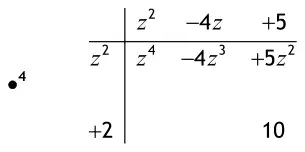
| •4 | set up and begin algebraic division or equivalent 1 | 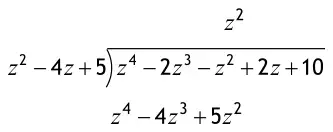 |
| •5 | obtain second quadratic factor 1,2 | \(z^2+2z+2\) |
| •6 | obtain remaining two roots 2 | \(-1\pm i\) |
| (5) |
Notes:
- Where, having correctly stated the first quadratic factor, a candidate produces the second with no intermediate working, award •4 and •5.
- Where a candidate produces a second quadratic expression which is not a factor, •5 is not available but •6 may still be, provided the expression has a negative discriminant.
Commonly Observed Responses:
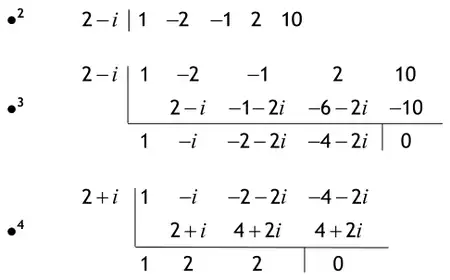
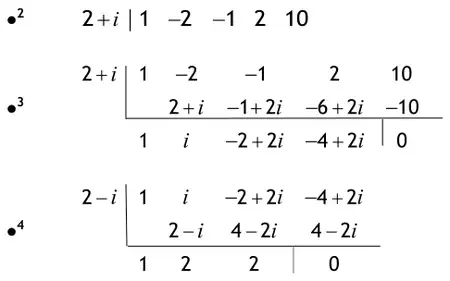
Synthetic division
Division by \(2-i\):
Division by \(2+i\):
Grid Method