(a)In this part of the question, you will be assessed on the quality of your organisation, communication and accuracy in writing.
She keeps a record of her run each day this week.
Day
Sun
Mon
Tues
Wed
Thurs
Fri
Sat
Distance
4·6 km
5·4 km
2·2 km
6·2 km
7·2 km
2·2 km
3·4 km
Time
26 mins
31 mins
12 mins
35 mins
40 mins
14 mins
22 mins
Last week, her average speed for the week was 9·6 kilometres per hour. Calculate Gwenda’s percentage improvement in her average speed from last week to this week. You must show all your working. [6 + 2 OCW]
Percentage improvement is ……………… %
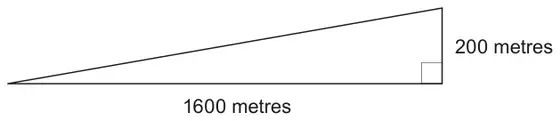
(b) The diagram shows the cross-section of one part of her run.
Diagram not drawn to scale
Calculate the angle of elevation of the road. [3]
(c)
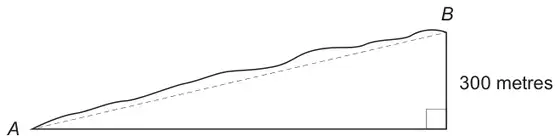
Diagram not drawn to scale
Gwenda runs on another section of uneven road from \(A\) to \(B\). The rise in this section of the road is 300 metres. The angle of elevation of \(B\) from \(A\) is 10°.
(i) Calculate an estimate of how far Gwenda has run. State any assumption you have made. [4]
Assumption: ………………………………
(ii) What is the impact of your assumption on your answer? [1]
Mark scheme (a)
Scheme
Marks
Comments
Sight of 31.2 and 3 or 180
B1
\(\dfrac{31.2}{3}\) OR (9.6 km/h =) 0.16 (km/min) with \(\dfrac{31.2}{180}\)
M2
Allow 31.2/7 ÷ 3/7 FT \(\dfrac{\text{‘their total distance’}}{\text{‘their total time in hours’}}\) M1 for \(\dfrac{\text{'their total distance'}}{\text{'their total time in minutes'}}\) allow 31.2/7 ÷ 180/7
10.4 (km/h) OR 0.17(3.. km/min)
A1
FT from 1 arithmetic error in calculating either 31.2 or 3, i.e. one of these values needs to be correct Do not FT from denominator in minutes unless 0.16 (km/min) seen Allow a final answer from a correct method that rounds to 10.4, e.g. 10.3(54..km/h) from PA
If no marks so far, allow SC1 for evaluating ‘a distance ÷ time in hours’ correctly (Sun to Sat : 10.615.., 10.45, 11, 10.6286, 10.8, 9.4286, 9.2727…)
% improvement 100 × (10.4 – 9.6) ÷ 9.6 or 100 × 10.4 ÷ 9.6 - 100 or equivalent
M1
FT ‘their 10.4’ provided it is >9.6 OR FT ‘their 0.17(3…)’ provided it is >0.16
8(.333…%)
A1
(Note: use of 10.354… leads to 7.85%)
If previously M0, A0 for % improvement, allow SC1 for an answer of 108%, or similar from FT
Organisation and communication
OC1
For OC1, candidates will be expected to: • present their response in a structured way • explain to the reader what they are doing at each step of their response • lay out their explanations and working in a way that is clear and logical • write a conclusion that draws together their results and explains what their answer means
Writing
W1
For W1, candidates will be expected to: • show all their working • make few, if any, errors in spelling, punctuation and grammar • use correct mathematical form in their working • use appropriate terminology, units, etc.
Mark scheme (b)
Scheme
Marks
Comments
tan elevation = \(\dfrac{200}{1600}\) or equivalent
M1
Angle of elevation is 7(.125….°)
A2
A1 for tan-1 0.125 or tan-1 (200/1600)
Mark scheme (c)
Scheme
Marks
Comments
(i) run = \(\dfrac{300}{\sin 10^\circ}\) 1727(.631… m) or 1728(m)
M2
A1
M1 for sin10° = 300/run
ISW Accept reasonable estimates (rounding or truncation) following correct working, e.g. 1700, 1730, 1750
Assumption, e.g. ‘road is straight’, ‘used a right-angled triangle’, ‘the road is smooth’, ‘Gwenda runs in a straight line’
E1
Depends on a previous attempt to use right-angled triangle trigonometry or Pythagoras’ theorem
Accept ‘Gwenda doesn’t zigzag up the hill’
(ii) Impact, e.g. ‘run could be longer', 'it is an under estimate', ‘bumps could make it longer’
E1
Independent of (c)(i) Allow ‘it is inaccurate’
Do not accept 'shorter' alone However, accept ‘shorter than the actual length’
We'd like to use Google Analytics cookies to count visits and see which pages help most. They're optional, and the site works exactly the same either way. Privacy policy