
Numeracy Higher November 2021 Unit 1 Q8
8. The graph below shows the velocity, \(v\), in m/s, of a particle at time \(t\) seconds, for the first 8 seconds of its journey.
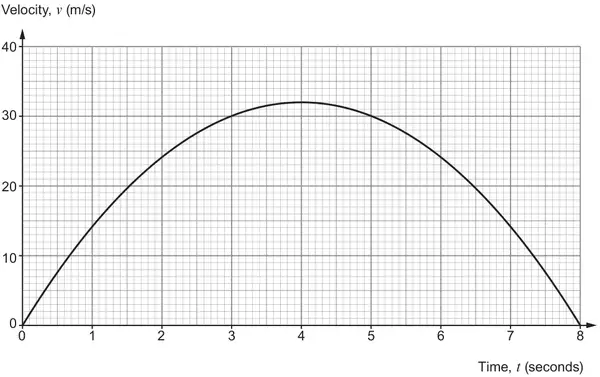
(a) At time \(t\) = 2 seconds, estimate the acceleration of the particle.
Simplify your answer as far as possible.
State the units of your answer. [4]
Simplify your answer as far as possible.
State the units of your answer. [4]
(b)
(i) Use the trapezium rule with 8 strips of equal width to estimate the distance travelled by the particle in the first 8 seconds. [3]
(ii) The actual distance travelled during the first 6 seconds is exactly 144 m.
Use this to calculate the average velocity of the particle over the first 6 seconds.
Use this to calculate the average velocity of the particle over the first 6 seconds.
Give your answer in miles per hour (mph). [5]
From the formula list: Area of trapezium \(= \dfrac{1}{2}(a+b)h\)
| Scheme | Marks | Comments |
|---|---|---|
| Tangent drawn at t = 2 seconds | M1 | Attempt to draw a tangent at time t = 2 seconds |
| Idea of increase in y ÷ increase in x | m1 | Allow one error in counting squares or in reading the scale for m1 only |
| Correctly evaluated gradient for their tangent | A1 | Accept the gradient as an improper fraction or decimal or percentage If their answer is a fraction, it needs to be in its lowest terms Mark final answer |
| m/s2 or ms−2 | U1 |
| Scheme | Marks | Comments |
|---|---|---|
| (i) (Area =) \(\dfrac{1}{2}\) × 1 × (0+0 + 2(14+24+30+32+30+24+14)) OR \(\dfrac{1}{2}\) × 1 × (28+48+60+64+60+48+28) or equivalent | M2 | Award M1 for at most one repeated error |
| = 168 (m) | A1 | FT from M1 |
| (ii) (Average velocity in mph =) 144 | These M1 marks may be awarded in any order | |
| ÷ 6 | M1 | (144 ÷ 6 = 24) |
| ÷ 1000 | M1 | (144 ÷ 1000 = 0.144) |
| × 60 × 60 | M1 | (144 × 60 × 60 = 518400) |
| \(\dfrac{\times 5}{8}\) or ÷ 1.6 or equivalent | M1 | (144 × 5 ÷ 8 = 90) |
| = 54 (mph) | A1 | CAO |
8(b)(i) Alternative method:
| Scheme | Marks | Comments |
|---|---|---|
| \(\dfrac{0 + 14}{2}\) × 1 + \(\dfrac{14 +24}{2}\) × 1 + \(\dfrac{24 + 30}{2}\) × 1 + \(\dfrac{30 + 32}{2}\) × 1 + \(\dfrac{32 + 30}{2}\) × 1 + \(\dfrac{30 + 24}{2}\) × 1 + \(\dfrac{24 + 14}{2}\) × 1 + \(\dfrac{14 + 0}{2}\) × 1 or equivalent [= 7 + 19 + 27 + 31 + 31 + 27 + 19 + 7] | M2 | Each area may be seen as the sum of the area of a rectangle and triangle M1 for the sum of these 8 areas with 1 one (possibly repeated) error in reading the scale |
| = 168 (m) | A1 | FT from M1 |