10. A train completed a 16 000 m journey between two stations.
(a) Here is a description of the journey.
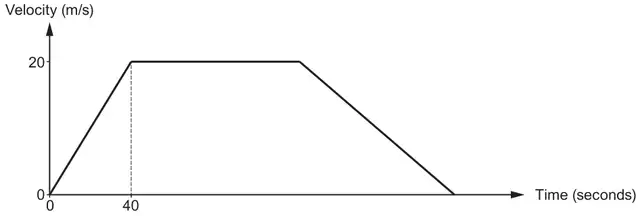
The train accelerated uniformly from rest to 20 m/s in 40 seconds.
It then remained at a constant speed of 20 m/s for a period of time.
The train then decelerated uniformly for 80 seconds until it stopped.
A sketch of the velocity-time graph that represents this journey is shown below.
Diagram not drawn to scale
(i) Calculate the distance the train travelled in the first 40 seconds of the journey. [2]
(ii) Calculate the total time for this 16 000 m journey. Give your answer in seconds. [5]
Total time for this 16 000 m journey is …………… seconds.
(b) When the train begins its next journey, it accelerates uniformly at \(1{\cdot}0\dot{8}\dot{1}\) m/s2. Write this acceleration as a mixed number in its simplest form. [3]
Mark scheme (a)
(i)
Scheme
Marks
Comments
½ × 40 × 20 = 400 (m)
M1 A1
(ii)
Scheme
Marks
Comments
(time at 20 m/s =) \(\dfrac{16000 - 400 - 0.5{\times}80{\times}20}{20}\) OR \(\dfrac{16000 - 400 - 2{\times}400}{20}\)
ISW. FT ‘their 740’ provided at least M2 previously awarded
Alternative method 1 (a)(ii)
Scheme
Marks
Comments
\(\dfrac{1}{2}\) ((time at 20) + 120 + (time at 20)) × 20 = 16000
M2
FT ‘their 400’ from (a)(i) Or equivalent e.g. only considering the journey from t=40 \(\dfrac{1}{2}\) ((time at 20)+80 + (time at 20))×20 = 16000 − 400 M1 for one of:
\(\dfrac{1}{2}\) ((time at 20) + 120 + (time at 20))×20
\(\dfrac{1}{2}\) ((time at 20) + 80 + (time at 20))×20
(time at 20m/s =) \(\dfrac{16000 \times 2 - 2400}{40}\) or equivalent (=29600/40)
We'd like to use Google Analytics cookies to count visits and see which pages help most. They're optional, and the site works exactly the same either way. Privacy policy