
Numeracy Foundation November 2023 Unit 1 Q2
2. A website lists the number of passengers who used UK airports in 2018.
The table below shows some of these numbers.
They have been rounded to the nearest million.
One of the numbers is also represented in the pictogram below.
| Airport | Number of passengers (to the nearest million) |
|---|---|
| Cardiff | …………………… |
| Bristol | 9 000 000 |
| Birmingham | …………………… |
| Exeter | …………………… |
| Leeds-Bradford | 4 000 000 |
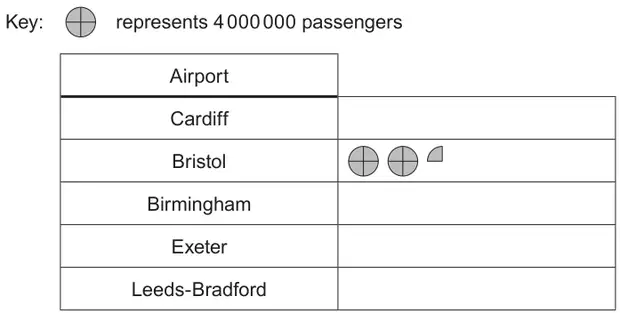
In the table:
- the number of passengers who used Cardiff was 50% of the number of passengers who used Leeds-Bradford
- the number of passengers who used Birmingham was 3 times the number of passengers who used Leeds-Bradford
- the number of passengers who used Exeter was \(\dfrac{1}{4}\) of the number of passengers who used Leeds-Bradford.
Complete the table and the pictogram. [6]
In 2018, approximately eighty million passengers used Heathrow airport.
The number of passengers who used Gatwick airport in 2018 was 46 086 089.
Chris said:
“Gatwick had more than half the number of passengers that Heathrow had.”
Is Chris correct?
Give a reason for your answer. [1]
Yes ☐ No ☐
On the busiest day, two hundred and sixty-one thousand nine hundred and nine passengers used Heathrow airport.
Write this number using digits. [1]
A plane flying from the UK to Corfu used 2508 litres of fuel per hour.
The flight was 3 hours long.
How many litres of fuel did the plane use? [2]
| Scheme | Marks | Comments | ||||||||||||
|---|---|---|---|---|---|---|---|---|---|---|---|---|---|---|
| B1 B1 B1 | Answers in the table and pictogram take precedence. Accept the word million used eg 2 million Penalise -1 only for consistent use of incorrect place value for all 3 values. | ||||||||||||
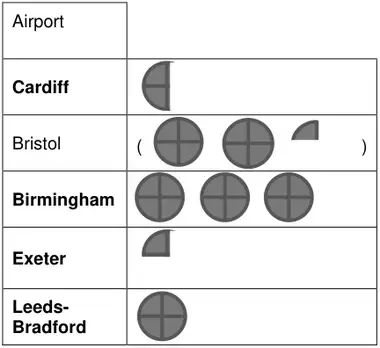 | B3 | Award B3 for all 4 correct entries Award B2 for 3 correct entries Award B1 for 2 correct entries FT ‘their values stated in the table’ FT implied use of million (i.e. with incorrect place value given in the 1st table but then used as million in the pictogram) If a different symbol that is split into 4 is consistently used, then penalise -1 only. If a different scale used then B0. |
| Scheme | Marks | Comments |
|---|---|---|
| (i) Yes and suitable reason given e.g. ‘half of 80 million is 40 million (and 46 086089 is more than 40 million)’ ‘46 million is more than 40 million (which is half of 80 million)’ ‘Double 46 million is 92 million (which is more than 80 million)’ ‘because half is 40000000 so Gatwick had more than half’ ‘because half of 80000000 is forty million (but Chris was correct because it was 46086089 which is more than half)’ ‘46086089 million is more than half of eighty million (as 40000000 is half of it)’ ‘because 46086089 doubled is greater than 80000000’ | E1 | Allow yes and ‘half of 80 is 40’ Do not allow no with a suitable reason e.g. ‘No, because half of 80 is 40 and Chris had 46 so he had extra people’ ‘No, because half of 80 million is 40 million and there was 46 million used in Gatwick’ |
| (ii) 261 909 | B1 |
| Scheme | Marks | Comments |
|---|---|---|
| 2508 × 3 or 2508 + 2508 + 2508 or equivalent | M1 | For 2508 + 2508 + 2508, allow if no addition sign seen but addition is implied award M1. |
| 7524 (litres) | A1 |