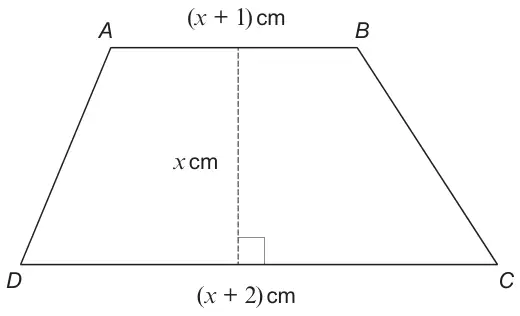
(ii) Solve the equation \(2x^2 + 3x - 50 = 0\) to calculate the lengths \(AB\) and \(DC\). Give your answers correct to 1 decimal place. [4]
Length of \(AB\) = …………………… cm Length of \(DC\) = …………………… cm
(b) A rhombus has an area of 36·8 cm2. The rhombus is enlarged by a scale factor of 7. Calculate the area of the enlarged rhombus. [2]
From the formula list: Area of trapezium \(= \dfrac{1}{2}(a+b)h\); The solutions of \(ax^2 + bx + c = 0\) where \(a \neq 0\) are given by \(x = \dfrac{-b \pm \sqrt{b^2 - 4ac}}{2a}\)
Mark scheme (a)
Scheme
Marks
Comments
(i) \(\dfrac{x+1+x+2}{2} \times x\) \((= 25)\)
M1
Missing brackets in the expression \(\dfrac{x(x+1+x+2)}{2}\) may be implied later from correct working.
\(x^2 + x + x^2 + 2x = 50\) OR \(x(2x + 3) = 50\) OR \(\dfrac{2x^2+3x}{2} = 25\) OR \(x^2 + 1.5x = 25\)
m1
\(2x^2 + 3x - 50 = 0\)
A1
Must be convincing. If m1 awarded for \(\dfrac{2x^2+3x}{2} = 25\), a further rearrangement, e.g. 2x2 + 3x = 50, must be seen before A1 is awarded.
We'd like to use Google Analytics cookies to count visits and see which pages help most. They're optional, and the site works exactly the same either way. Privacy policy