
Foundation November 2018 Unit 2 Q15
15. Two fair spinners are divided into quarters as shown below.
One spinner shows the values 10, 20, 30 and 40.
The other spinner shows the values 1, 2, 3 and 4.
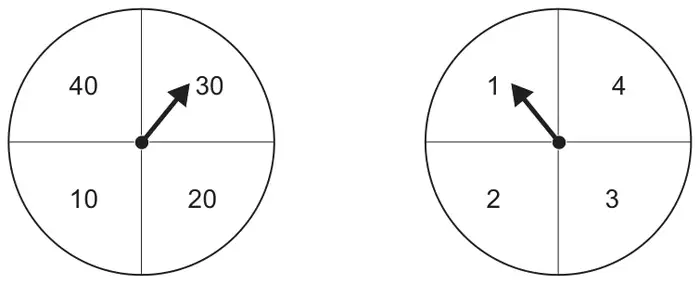
The two spinners are spun and the values shown are added together to form a number.
For example, the diagram above would form the number 31.
Consider all the possible numbers that can be formed.
Calculate the probability that the spinners will form a number that is a multiple of 7.
You must show all your working in order to justify your answer. [4]
| Scheme | Marks | Comments |
|---|---|---|
| All possible numbers shown with no extras. (11, OR Clearly justifies that there are 16 possible numbers from 4 × 4 = 16 | B2 | B1 for at least 10 correct and no more than 4 ‘extras’. 10 + 1, 10 + 2, etc and not added gain no credit. |
| (Probability multiple of 7 =) \(\dfrac{3}{16}\) or equivalent. ISW | B2 | F.T. ‘their list’ only if at least 6 numbers given which includes at least one multiple of seven. OR B1 for x/16 with x<16. B1 for 3/y with y >3. Penalise, −1, any incorrect notation e.g. ‘3 out of 16’. Unsupported 3/16 gains B0B2. |