
A2 June 2023 Further Unit 6 Q1
1. The diagram shows a uniform rod AB, of length 8 m and mass 23 kg, in limiting equilibrium with its end A on rough horizontal ground and point C resting against a smooth fixed cylinder. The rod is inclined at an angle of 30° to the ground.
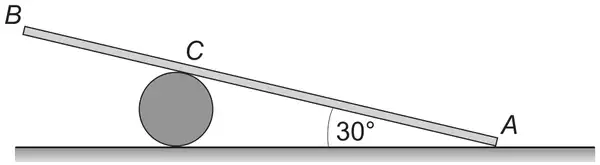
The coefficient of friction between the ground and the rod is \(\dfrac{2}{3}\).
(a) Calculate the magnitude of the normal reaction at C and the magnitude of the normal reaction to the ground at A. [8]
(b) Find the length AC. [4]
(c) Suppose instead that the rod is non-uniform with its centre of mass closer to A than to B. Without carrying out any further calculations, state whether or not this will affect your answers in part (a). Give a reason for your answer. [1]
| Scheme | Marks | Comments |
|---|---|---|
| Resolve vertically | M1 | Dim. correct equation with 3 terms |
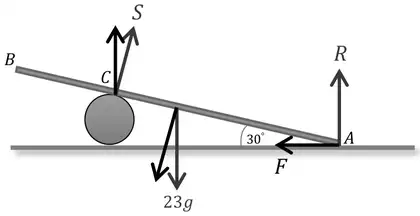
| \(S\cos30^\circ+R=23g\) \(\dfrac{\sqrt{3}}{2}S+R=23g\) | A1 | \(23g=225{\cdot}4=\dfrac{1127}{5}\) |
| Resolve horizontally | M1 | Dim. correct equation |
| \(F=S\sin30^\circ\) \(F=\dfrac{1}{2}S\) | A1 | |
| \(F=\frac{2}{3}R\) \(\frac{2}{3}R=S\sin30^\circ\) \(\dfrac{2}{3}R=\dfrac{1}{2}S\) \(R=\frac{3}{4}S\) | B1 | Used |
| \(\frac{\sqrt{3}}{2}S+\frac{3}{4}S=23g\) | m1 | Elimination of one variable Both M’s needed above |
| \(S=139{\cdot}47(80054)\quad(\text{N})\) \(R=104{\cdot}60(85041)\quad(\text{N})\) | A1 A1 | cao cao |
| Note exact forms \(S=\dfrac{92g}{3}\left(2\sqrt{3}-3\right)=\dfrac{92g}{2\sqrt{3}+3}\) \(R=23g\left(2\sqrt{3}-3\right)=\dfrac{69g}{2\sqrt{3}+3}\) | ||
| [8] |
Alternative Solution (a)
| Scheme | Marks | Comments |
|---|---|---|
| ||
| Resolve parallel to \(AB\) | M1 | Dim. correct equation with 3 terms |
| \(23g\sin30^\circ=R\sin30^\circ+F\cos30^\circ\) \(\dfrac{23}{2}g=\dfrac{1}{2}R+\dfrac{\sqrt{3}}{2}F\ \Leftrightarrow\ 23g=R+\sqrt{3}F\) | A1 | \(23g\sin30^\circ=\dfrac{23}{2}g=\dfrac{1127}{10}=112{\cdot}7\) |
| Resolve perpendicular to \(AB\) | M1 | Dim. correct equation with 4 terms |
| \(S+R\cos30^\circ=23g\cos30^\circ+F\sin30^\circ\) \(S+\dfrac{\sqrt{3}}{2}R=\dfrac{23\sqrt{3}}{2}g+\dfrac{1}{2}F\Leftrightarrow2S+\sqrt{3}R=23\sqrt{3}g+F\) | A1 | |
| \(F=\frac{2}{3}R\) | B1 | Used |
| Elimination of one variable (in either equation) \(23g=R+\sqrt{3}\left(\frac{2}{3}R\right)\) | m1 | |
| \(S=139{\cdot}47(80054)\quad(\text{N})\) \(R=104{\cdot}60(85041)\quad(\text{N})\) | A1 A1 | cao cao |
| Note exact forms \(S=\dfrac{92g}{3}\left(2\sqrt{3}-3\right)=\dfrac{92g}{2\sqrt{3}+3}\) \(R=23g\left(2\sqrt{3}-3\right)=\dfrac{69g}{2\sqrt{3}+3}\) | ||
| [8] |
| Scheme | Marks | Comments |
|---|---|---|
| Moments about \(A\) \(AC\times S=23g\times4\cos30^\circ\) | M1 A1 A1 | Dim. correct equation, no extra terms LHS RHS |
| \(AC\times139{\cdot}478\ldots=225{\cdot}4\times2\sqrt{3}\) \(AC=\dfrac{23g\times4\cos30^\circ}{139{\cdot}4780054}\) \(\dfrac{225{\cdot}4\times2\sqrt{3}}{139{\cdot}4780054}\) | FT \(S\) from (a) | |
| \(AC=5{\cdot}598076211\ (\text{m})\) or \(=\dfrac{6+3\sqrt{3}}{2}\ (\text{m})\) | A1 | cao |
| [4] |
| Scheme | Marks | Comments |
|---|---|---|
| No, both reactions remain the same and (one of the following)
| E1 | |
| [1] | ||
| Total for Question 1 | 13 |