
June 2019 Paper 3 Q11
11
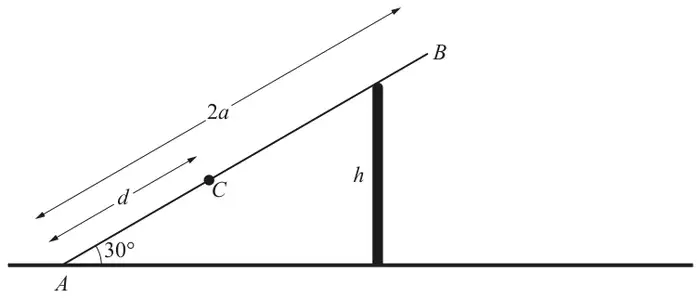
The diagram shows a ladder \(AB\), of length \(2a\) and mass \(m\), resting in equilibrium on a vertical wall of height \(h\). The ladder is inclined at an angle of \(30^\circ\) to the horizontal. The end \(A\) is in contact with horizontal ground. An object of mass \(2m\) is placed on the ladder at a point \(C\) where \(AC = d\).
The ladder is modelled as uniform, the ground is modelled as being rough, and the vertical wall is modelled as being smooth.
It is given that the equilibrium is limiting and the coefficient of friction between the ladder and the ground is \(\frac{1}{8}\sqrt{3}.\)
| Scheme | Marks | AO |
|---|---|---|
| Dist. from \(A\) to the wall along the ladder: \((l =)\, \dfrac{h}{\sin 30}\) | B1 | 3.1a |
| M1 | 3.3 | |
| \(2mgd\cos 30 + mga\cos 30 = R_w l\) | A1 | 1.1 |
| \(R_w = \frac{1}{2h}\left(2mgd\frac{\sqrt{3}}{2} + mga\frac{\sqrt{3}}{2}\right) = \frac{1}{4h}\left(2mgd + mga\right)\sqrt{3}\) \(R_w = \dfrac{mg(a + 2d)\sqrt{3}}{4h}\) | A1 | 2.2a |
| [4] |
Notes
B1: \((l =)\, 2h\)
M1: Moments about \(A\) (each term must therefore by a force \(\times\) distance) – three terms, both weights resolved (but allow sin/cos confusion), allow sign errors (M0 if only using masses)
M0 if the contact force at the wall appears as a component in their equation
A1: Correct LHS and RHS with their \(l = \alpha h\) - A0 if \(l = 2a\)
\(\alpha \ne 0, 1\)
A1: AG www – note that using \(l = 2a\) but then stating \(a = h\) is M1 only
Enough working must be shown as AG
| Scheme | Marks | AO |
|---|---|---|
| M1* | 3.3 | |
| \(R_w\cos 30 + R_A = 2mg + mg\) | A1 | 1.1 |
| M1* | 3.3 | |
| \(F_A = R_w\sin 30\) | A1 | 1.1 |
| \(R_w\sin 30 = \dfrac{\sqrt{3}}{8}\left(3mg - R_w\cos 30\right)\) | M1dep* | 3.4 |
| \(\dfrac{mg(a + 2d)\sqrt{3}}{8h} = \dfrac{\sqrt{3}}{8}\left[3mg - \dfrac{3mg(a + 2d)}{8h}\right]\) | A1 | 3.4 |
| \(h = \frac{11}{24}(a + 2d)\) | A1 | 2.2a |
| [7] |
Notes
M1*: Resolve vertically (three or four terms (if both weights not combined)) – reaction at the wall resolved – allow sign errors and sin/cos confusion (must be using \(mg\) not \(m\))
\(R_A\) is the normal contact force at \(A\)
A1: oe
M1*: Resolve horizontally (allow sin/cos confusion) – two terms only
\(F_A\) is the frictional contact force at \(A\)
A1: oe
M1dep*: Use of \(F = \frac{\sqrt{3}}{8}R\) with their expressions for \(F_A\) and \(R_A\) – dependent on previous M marks
Either in terms of \(R_w\), \(m\) and \(g\) or \(a\), \(d\) and \(h\) (and \(m\), \(g\))
A1: Correct equation in terms of (\(m\), \(g\)) \(a\), \(d\) and \(h\)
Condone non-exact values for this A mark
A1: \(k = \frac{11}{24}\) oe www (must be exact value of \(k\))
From exact working
For reference: \(k = 0.45833\ldots\)
| Scheme | Marks | AO |
|---|---|---|
| \(\frac{11}{24}(a + 2d) \le a\) | M1 | 3.1b |
| \(d \le \frac{13}{22}a\) so greatest possible value of \(d\) is \(\frac{13}{22}a\) | A1 | 2.2a |
| [2] |
Notes
M1: Uses the condition that \(h\) cannot exceed \(2a\sin 30\ (= a)\) – allow if in terms of \(k\) or their incorrect \(k\) (e.g. \(k(a + 2d) = a\) is M1)
Allow any inequality sign or equals
A1: Allow \(d \le \frac{13}{22}a\) or \(d = \frac{13}{22}a\)
A0 if exact answer not seen
| Scheme | Marks | AO |
|---|---|---|
| e.g. model the ladder as non-uniform e.g. include a frictional component for the contact of the ladder with the wall e.g. consider the size of the object at \(C\) e.g. consider the thickness of the ladder e.g. consider the fact that the ladder could bend | B1 | 3.5c |
| [1] |
Notes
B1: B0 if suggestion is to model the ground as smooth
B0 for using a more accurate value for \(g\)