
S1 January 2011 Q7
7. The bag \(P\) contains 6 balls of which 3 are red and 3 are yellow.
The bag \(Q\) contains 7 balls of which 4 are red and 3 are yellow.
A ball is drawn at random from bag \(P\) and placed in bag \(Q\). A second ball is drawn at random from bag \(P\) and placed in bag \(Q\).
A third ball is then drawn at random from the 9 balls in bag \(Q\).
The event \(A\) occurs when the 2 balls drawn from bag \(P\) are of the same colour.
The event \(B\) occurs when the ball drawn from bag \(Q\) is red.
| Scheme | Marks |
|---|---|
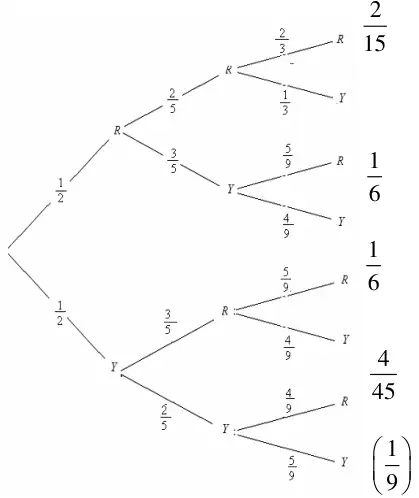 | |
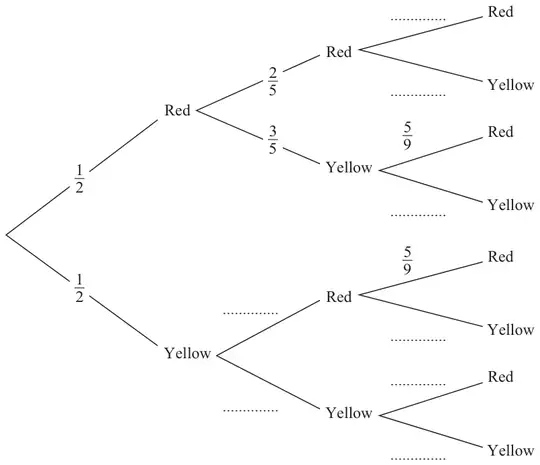
| both \(\dfrac{2}{3}, \dfrac{1}{3}\) | B1 |
| \(\dfrac{4}{9}\) | B1 |
| both \(\dfrac{3}{5}, \dfrac{2}{5}\) | B1 |
| all three of \(\dfrac{4}{9}, \dfrac{4}{9}, \dfrac{5}{9}\) | B1 |
| (4) |
| Scheme | Marks |
|---|---|
| \(\mathrm{P}(A) = \mathrm{P}(RR) + \mathrm{P}(YY) = \dfrac{1}{2} \times \dfrac{2}{5} + \dfrac{1}{2} \times \text{"}\dfrac{2}{5}\text{"} = \dfrac{2}{5}\) B1 for \(\dfrac{1}{2} \times \dfrac{2}{5}\) (oe) seen at least once | B1 M1 A1 |
| (3) |
Notes
M1 for both cases, and +, attempted, ft their values from tree diagram. May be 4 cases of 3 balls.
| Scheme | Marks |
|---|---|
| \(\mathrm{P}(B) = \mathrm{P}(RRR) + \mathrm{P}(RYR) + \mathrm{P}(YRR) + \mathrm{P}(YYR)\) M1 for at least 1 case of 3 balls identified. (Implied by 2nd M1) | M1 |
| \(\left(\dfrac{1}{2} \times \dfrac{2}{5} \times \text{"}\dfrac{2}{3}\text{"}\right) + \left(\dfrac{1}{2} \times \dfrac{3}{5} \times \dfrac{5}{9}\right) + \left(\dfrac{1}{2} \times \text{"}\dfrac{3}{5}\text{"} \times \dfrac{5}{9}\right) + \left(\dfrac{1}{2} \times \text{"}\dfrac{2}{5}\text{"} \times \text{"}\dfrac{4}{9}\text{"}\right) = \dfrac{5}{9}\) (*) | M1,A1cso |
| (3) |
Notes
2nd M1 for all 4 correct expressions, ft their values from tree diagram. A1 is cso
| Scheme | Marks |
|---|---|
| \(\mathrm{P}(A \cap B) = \mathrm{P}(RRR) + \mathrm{P}(YYR)\) M1 for identifying both cases and + probs. may be implied by correct expressions | M1 |
| \(= \left(\dfrac{1}{2} \times \dfrac{2}{5} \times \dfrac{2}{3}\right) + \left(\dfrac{1}{2} \times \dfrac{2}{5} \times \dfrac{4}{9}\right) = \dfrac{2}{9}\) (*) | A1cso |
| (2) |
| Scheme | Marks |
|---|---|
| \(\mathrm{P}(A \cup B) = \mathrm{P}(A) + \mathrm{P}(B) - \mathrm{P}(A \cap B)\) Must have some attempt to use | M1 |
| \(= \text{"}\dfrac{2}{5}\text{"} + \dfrac{5}{9} - \dfrac{2}{9} = \dfrac{11}{15}\) | A1cao |
| (2) |
Notes
M1 for clear attempt to use the correct formula, must have some correct substitution. ft their (b)
| Scheme | Marks |
|---|---|
| \(\dfrac{\mathrm{P}(RRR)}{\mathrm{P}(RRR) + \mathrm{P}(YYY)} = \dfrac{\frac{1}{2} \times \frac{2}{5} \times \frac{2}{3}}{\left(\frac{1}{2} \times \frac{2}{5} \times \frac{2}{3}\right) + \left(\frac{1}{2} \times \frac{2}{5} \times \frac{5}{9}\right)} = \dfrac{6}{11}\) Probabilities must come from the product of 3 probs. from their tree diagram. | M1 A1ft A1 cao |
| (3) | |
| (17 marks) |
Notes
M1 for identifying the correct probabilities and forming appropriate fraction of probs.
1st A1ft for a correct expression using probabilities from their tree
Accept exact decimal equivalents. Correct answer only is full marks except in (c) and (d)