
S1 June 2010 Q4
4. The Venn diagram in Figure 1 shows the number of students in a class who read any of 3 popular magazines \(A\), \(B\) and \(C\).
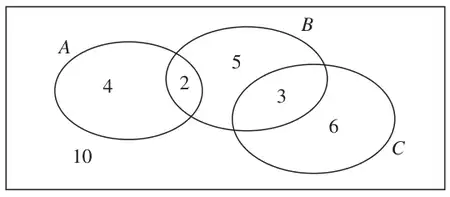
One of these students is selected at random.
Given that the student reads at least one of the magazines,
| Scheme | Marks |
|---|---|
| \(\dfrac{2 + 3}{\text{their total}} = \dfrac{5}{\text{their total}} = \dfrac{1}{6}\) (** given answer**) | M1 A1cso |
| (2) |
Notes
M1 for \(\dfrac{2 + 3}{\text{their total}}\) or \(\dfrac{5}{30}\)
| Scheme | Marks |
|---|---|
| \(\dfrac{4 + 2 + 5 + 3}{\text{total}},\ = \dfrac{14}{30}\) or \(\dfrac{7}{15}\) or \(0.4\dot{6}\) | M1 A1 |
| (2) |
Notes
M1 for adding at least 3 of “4, 2, 5, 3” and dividing by their total to give a probability
Can be written as separate fractions substituted into the completely correct Addition Rule
| Scheme | Marks |
|---|---|
| \(\mathrm{P}(A \cap C) = 0\) | B1 |
| (1) |
Notes
B1 for 0 or 0/30
| Scheme | Marks |
|---|---|
| \(\mathrm{P}(C \mid \text{reads at least one magazine}) = \dfrac{6 + 3}{20} = \dfrac{9}{20}\) | M1 A1 |
| (2) |
Notes
M1 for a denominator of 20 or \(\dfrac{20}{30}\) leading to an answer with denominator of 20
\(\dfrac{9}{20}\) only, 2/2
| Scheme | Marks |
|---|---|
| \(\mathrm{P}(B) = \dfrac{10}{30} = \dfrac{1}{3},\ \mathrm{P}(C) = \dfrac{9}{30} = \dfrac{3}{10},\ \mathrm{P}(B \cap C) = \dfrac{3}{30} = \dfrac{1}{10}\) or \(\mathrm{P}(B|C) = \dfrac{3}{9}\) | M1 |
| \(\mathrm{P}(B) \times \mathrm{P}(C) = \dfrac{1}{3} \times \dfrac{3}{10} = \dfrac{1}{10} = \mathrm{P}(B \cap C)\) or \(\mathrm{P}(B|C) = \dfrac{3}{9} = \dfrac{1}{3} = \mathrm{P}(B)\) | M1 |
| So yes they are statistically independent | A1cso |
| (3) | |
| (10 marks) |
Notes
1st M1 for attempting all the required probabilities for a suitable test
2nd M1 for use of a correct test - must have attempted all the correct probabilities. Equality can be implied in line 2.
A1 for fully correct test carried out with a comment