
M2 June 2006 Q6
6.
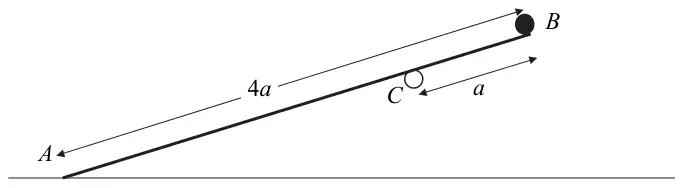
A wooden plank \(AB\) has mass \(4m\) and length \(4a\). The end \(A\) of the plank lies on rough horizontal ground. A small stone of mass \(m\) is attached to the plank at \(B\). The plank is resting on a small smooth horizontal peg \(C\), where \(BC = a\), as shown in Figure 2. The plank is in equilibrium making an angle \(\alpha\) with the horizontal, where \(\tan\alpha = \tfrac{3}{4}\). The coefficient of friction between the plank and the ground is \(\mu\). The plank is modelled as a uniform rod lying in a vertical plane perpendicular to the peg, and the stone as a particle.
Show that
(a) the reaction of the peg on the plank has magnitude \(\tfrac{16}{5}mg\), (3)
(b) \(\mu \geqslant \tfrac{48}{61}\). (6)
(c) State how you have used the information that the peg is smooth. (1)
| Scheme | Marks |
|---|---|
| M(\(A\)): | |
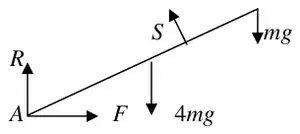
| \(S.3a = 4mg.2a\cos\alpha + mg.4a\cos\alpha\) | M1 A1 |
| \(= \dfrac{48}{5}mga\ \ \Rightarrow\ \ S = \dfrac{16}{5}mg\ \ *\) | A1 |
| (3) |
| Scheme | Marks |
|---|---|
| R(\(\uparrow\)): \(R + S\cos\alpha = 5mg\) | M1 A1 |
| R(\(\rightarrow\)): \(F = S\sin\alpha\) | M1 A1 |
| \(F \leqslant \mu R\ \ \Rightarrow\ \ \mu \geqslant \dfrac{48}{61}\ \ *\) dep on both previous M’s | M1 A1 |
| (6) |
| Scheme | Marks |
|---|---|
| Direction of \(S\) is perpendicular to plank or No friction at the peg | B1 |
| (1) | |
| (10 marks) |