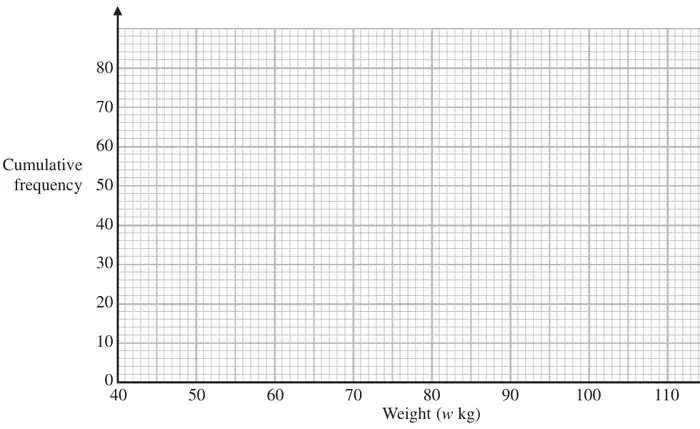
11 The frequency table shows information about the weights of 80 adults.
Weight (\(w\) kg)
Frequency
\(40 \lt w \leqslant 50\)
4
\(50 \lt w \leqslant 60\)
7
\(60 \lt w \leqslant 70\)
21
\(70 \lt w \leqslant 80\)
21
\(80 \lt w \leqslant 90\)
18
\(90 \lt w \leqslant 100\)
7
\(100 \lt w \leqslant 110\)
2
(a) Complete the cumulative frequency table.
Weight (\(w\) kg)
Cumulative frequency
\(40 \lt w \leqslant 50\)
4
\(40 \lt w \leqslant 60\)
\(40 \lt w \leqslant 70\)
\(40 \lt w \leqslant 80\)
\(40 \lt w \leqslant 90\)
\(40 \lt w \leqslant 100\)
\(40 \lt w \leqslant 110\)
(1)
(b) On the grid, draw a cumulative frequency graph for your table.(2)
(c) Use your graph to find an estimate for the number of adults with weight more than 85 kg. (2)
(d) Use your graph to find an estimate for the interquartile range of the weights of the adults. (2)
Mark scheme (a)
Scheme
Marks
4 ,11 ,32 ,53 ,71 ,78 ,80
B1
(1)
Mark scheme (b)
Scheme
Marks
M1
correct cf graph
A1
(2)
Notes
M1: ft from table for at least 5 points plotted correctly at end of interval or ft from sensible table for all 7 points plotted consistently within each interval in the freq table at the correct height
A1: accept curve or line segments accept curve that is not joined to (40,0)
Mark scheme (c)
Scheme
Marks
Reading from graph at \(w\) = 85 eg. reading of 60 – 64
M1
16 − 20
A1
(2)
Notes
M1: ft from a cumulative frequency graph provided method is shown
A1: ft from a cumulative frequency graph provided method is shown
Mark scheme (d)
Scheme
Marks
Use of 20 and 60 (or 20.25 and 60.75) eg. readings of 61− 65 and 83−87 eg. 85 − 63
M1
18 − 22
A1
(2)
Notes
M1: ft from a cumulative frequency graph provided method is shown
A1: ft from a cumulative frequency graph provided method is shown