
FP2 June 2013 (R) Q8
8.
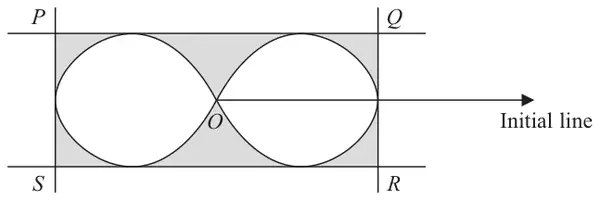
Figure 1 shows a closed curve \(C\) with equation \[r = 3(\cos 2\theta)^{\frac{1}{2}}, \qquad \text{where } -\frac{\pi}{4} < \theta \leqslant \frac{\pi}{4},\ \ \frac{3\pi}{4} < \theta \leqslant \frac{5\pi}{4}\]
The lines \(PQ\), \(SR\), \(PS\) and \(QR\) are tangents to \(C\), where \(PQ\) and \(SR\) are parallel to the initial line and \(PS\) and \(QR\) are perpendicular to the initial line. The point \(O\) is the pole.
| Scheme | Marks |
|---|---|
| \(A = (4\times)\displaystyle\int_0^{\frac{\pi}{4}}\dfrac{9}{2}\cos 2\theta\,\mathrm{d}\theta\) | M1A1 (limits for A mark only) |
| \(= 18\left[\dfrac{\sin 2\theta}{2}\right]_0^{\frac{\pi}{4}}\) | M1 |
| \(9\left[\sin\dfrac{\pi}{2} - 0\right] = 9\) | A1 |
| (4) |
Notes
M1 for \(A = \dfrac{1}{2}\displaystyle\int r^2\,\mathrm{d}\theta = \dfrac{1}{2}\int\alpha\cos 2\theta\,\mathrm{d}\theta\) with \(\alpha = 3\) or 9 4 or 2 and limits not needed for this mark – ignore any shown.
A1 for \(A = (4\times)\displaystyle\int_0^{\frac{\pi}{4}}\dfrac{9}{2}\cos 2\theta\,\mathrm{d}\theta\) Correct limits \(\left(0, \dfrac{\pi}{4}\right)\) with multiple 4 or \(\left(-\dfrac{\pi}{4}, \dfrac{\pi}{4}\right)\) with multiple 2 needed. 4 or 2 may be omitted here, provided it is used later.
M1 for the integration \(\cos 2\theta\) to become \(\pm\left(\dfrac{1}{2}\right)\sin 2\theta\). Give M0 for \(\pm 2\sin 2\theta\). Limits and 4 or 2 not needed
A1cso for using the limits and 4 or 2 as appropriate to obtain 9
| Scheme | Marks |
|---|---|
| \(r = 3(\cos 2\theta)^{\frac{1}{2}}\) | |
| \(r\sin\theta = 3(\cos 2\theta)^{\frac{1}{2}}\sin\theta\) | M1 |
| \(\dfrac{\mathrm{d}}{\mathrm{d}\theta}(r\sin\theta) = \left\{-3 \times \dfrac{1}{2}(\cos 2\theta)^{-\frac{1}{2}} \times 2\sin 2\theta\sin\theta + 3(\cos 2\theta)^{\frac{1}{2}}\cos\theta\right\}\) | M1depA1 |
| At max/min: \(\dfrac{-3\sin 2\theta\sin\theta}{(\cos 2\theta)^{\frac{1}{2}}} + 3(\cos 2\theta)^{\frac{1}{2}}\cos\theta = 0\) | M1 |
| \(\sin 2\theta\sin\theta = \cos 2\theta\cos\theta\) \(2\sin^2\theta\cos\theta = \left(1 - 2\sin^2\theta\right)\cos\theta\) \(\cos\theta\left(1 - 4\sin^2\theta\right) = 0\) \((\cos\theta = 0)\quad \sin^2\theta = \dfrac{1}{4}\) | |
| \(\sin\theta = \pm\dfrac{1}{2}\qquad \theta = \pm\dfrac{\pi}{6}\) | M1A1 |
| \(r\sin\dfrac{\pi}{6} = 3\left(\cos\dfrac{\pi}{3}\right)^{\frac{1}{2}} \times \dfrac{1}{2} = \dfrac{3\sqrt{2}}{4}\) | B1 |
| \(\therefore\) length \(PS = \dfrac{3\sqrt{2}}{2}\), (length \(PQ = 6\)) | |
| Shaded area \(= 6 \times \dfrac{3\sqrt{2}}{2} - 9,\ = 9\sqrt{2} - 9\) oe | M1,A1 |
| (9) | |
| (13 marks) |
Notes
M1 for \(r\sin\theta = 3(\cos 2\theta)^{\frac{1}{2}}\sin\theta\) or \(r^2\sin^2\theta = 9\cos 2\theta\sin^2\theta\) 3 or 9 allowed
M1dep for differentiating the rhs of the above wrt \(\theta\). Product and chain rule must be used.
A1 for \(\dfrac{\mathrm{d}}{\mathrm{d}\theta}(r\sin\theta) = \left\{-3 \times \dfrac{1}{2}(\cos 2\theta)^{-\frac{1}{2}} \times 2\sin 2\theta\sin\theta + 3(\cos 2\theta)^{\frac{1}{2}}\cos\theta\right\}\) or correct differentiation of \(r^2\sin^2\theta = 9\cos 2\theta\sin^2\theta\)
M1 for equating their expression for \(\dfrac{\mathrm{d}}{\mathrm{d}\theta}(r\sin\theta)\) to 0
M1dep for solving the resulting equation to \(\sin k\theta = \ldots\) or \(\cos k\theta = \ldots\) incuding the use of the appropriate trig formulae (must be correct formulae)
A1 for \(\sin\theta = \dfrac{1}{2}\) or \(\cos\theta = \dfrac{\sqrt{3}}{2}\) or \(\theta = (\pm)\dfrac{\pi}{6}\) oe ignore extra answers
B1 for the length of \(\dfrac{1}{2}PS = \dfrac{3\sqrt{2}}{4}\) (1.0606...) or of \(PS\). May not be shown explicitly. Give this mark if the correct area of the rectangle is shown. Length of \(PQ\) is not needed for this mark.
M1 for attempting the shaded area by their \(PS \times 6 -\) their answer to (a). There must be evidence of \(PS\) being obtained using their \(\theta\)
A1 for \(9\sqrt{2} - 9\) oe 3.7279.... or awrt 3.73
Alternatives
Option 1 – using \(r\sin\theta\) with/without manipulation of \(\cos 2\theta\) before differentiation
| Use of \(3(\cos 2\theta)^{\frac{1}{2}}\sin\theta\) | First M mark |
| \(3(\cos 2\theta)^{\frac{1}{2}}\cos\theta - 3\left(\dfrac{1}{2}\right)(\cos 2\theta)^{-\frac{1}{2}}(2)\sin 2\theta\sin\theta = 0\) \(3(\cos 2\theta)^{\frac{1}{2}}\cos\theta - 3(\cos 2\theta)^{-\frac{1}{2}}\sin 2\theta\sin\theta = 0\) | Second (dependent) M mark for differentiating using the product rule A1 awarded here for correct derivative and M1 for setting their derivative equal to 0 |
| \(3(\cos 2\theta)^{\frac{1}{2}} - 6(\cos 2\theta)^{-\frac{1}{2}}\sin^2\theta = 0\) \(\cos 2\theta - 2\sin^2\theta = 0\) | Use of \(\sin 2\theta = 2\sin\theta\cos\theta\), division by \(3\cos\theta\) and multiplication by \((\cos 2\theta)^{\frac{1}{2}}\) simplify the equation but do not provide specific M marks |
| \(\left(1 - 2\sin^2\theta\right) - 2\sin^2\theta = 0\) \(4\sin^2\theta = 1\) | Use of \(\cos 2\theta = 1 - 2\sin^2\theta\) gives next M mark provided a value of \(\sin\theta\) or alt is reached with no errors seen |
| \(\sin\theta = \pm\dfrac{1}{2}\) \(\left(\theta = \dfrac{\pi}{6}\right)\) | Value of \(\sin\theta\) reached with use of \(\cos 2\theta = \ldots\) and no method errors seen (arithmetic slips would be condoned) gives final M mark Second accuracy mark given here. |
| Use of \(3\left(\cos^2\theta - \sin^2\theta\right)^{\frac{1}{2}}\sin\theta\) | First M mark Use of \(\cos 2\theta = \cos^2\theta - \sin^2\theta\) gives 4th M mark provided a value of \(\sin\theta\) or alt is reached with no errors seen after the differentiation |
| \(3\left(\dfrac{1}{2}\right)\left(\cos^2\theta - \sin^2\theta\right)^{-\frac{1}{2}}(-2\cos\theta\sin\theta - 2\sin\theta\cos\theta)\sin\theta + 3\left(\cos^2\theta - \sin^2\theta\right)^{\frac{1}{2}}\cos\theta = 0\) \(-6\left(\cos^2\theta - \sin^2\theta\right)^{-\frac{1}{2}}\cos\theta\sin^2\theta + 3\left(\cos^2\theta - \sin^2\theta\right)^{\frac{1}{2}}\cos\theta = 0\) | Second (dependent) M mark for differentiating using the product rule A1 awarded here for correct derivative and M1 for setting their derivative equal to 0 |
| \(-6\sin^2\theta + 3\left(\cos^2\theta - \sin^2\theta\right) = 0\) \(4\sin^2\theta = 1\) | Multiplication by \((\cos^2\theta - \sin^2\theta)^{\frac{1}{2}}\), division by \(3\cos\theta\) and use of \(\cos^2\theta = 1 - \sin^2\theta\) simplify the equation but do not provide specific M marks |
| \(\sin\theta = \pm\dfrac{1}{2}\) \(\left(\theta = \dfrac{\pi}{6}\right)\) | Value of \(\sin\theta\) reached with use of \(\cos 2\theta = \ldots\) and no method errors seen (arithmetic slips would be condoned) gives final M mark Second accuracy mark given here. |
| Use of \(3\left(2\cos^2\theta - 1\right)^{\frac{1}{2}}\sin\theta\) | First M mark Use of \(\cos 2\theta = 2\cos^2\theta - 1\) gives 4th M mark provided a value of \(\sin\theta\) or alt is reached with no errors seen after the differentiation |
| \(3\left(\dfrac{1}{2}\right)\left(2\cos^2\theta - 1\right)^{-\frac{1}{2}}(-4\cos\theta\sin\theta)\sin\theta + 3\left(2\cos^2\theta - 1\right)^{\frac{1}{2}}\cos\theta = 0\) \(-6\left(2\cos^2\theta - 1\right)^{-\frac{1}{2}}\cos\theta\sin^2\theta + 3\left(2\cos^2\theta - 1\right)^{\frac{1}{2}}\cos\theta = 0\) | Second (dep) M mark for differentiating using the product rule A1 awarded here for correct derivative and M1 for setting their derivative equal to 0 |
| \(-6\sin^2\theta + 3\left(2\cos^2\theta - 1\right) = 0\) \(4\sin^2\theta = 1\) or \(4\cos^2\theta = 3\) | Multiplication by \((\cos^2\theta - \sin^2\theta)^{\frac{1}{2}}\), division by \(3\cos\theta\) and use of \(\sin^2\theta = 1 - \cos^2\theta\) or vice versa simplify the equation but do not provide specific M marks |
| \(\sin\theta = \pm\dfrac{1}{2}\) or \(\cos\theta = \pm\dfrac{\sqrt{3}}{2}\) \(\left(\theta = \dfrac{\pi}{6}\right)\) | Value of \(\sin\theta\) or \(\cos\theta\) reached with use of \(\cos 2\theta = \ldots\) and no method errors seen (arithmetic slips would be condoned) gives final M mark. Second accuracy mark given here. |
| Use of \(3\left(1 - 2\sin^2\theta\right)^{\frac{1}{2}}\sin\theta\) | First M mark Use of \(\cos 2\theta = 2\cos^2\theta - 1\) gives 4th M mark provided a value of \(\sin\theta\) or alt is reached with no errors seen after the differentiation |
| \(3\left(\dfrac{1}{2}\right)\left(1 - 2\sin^2\theta\right)^{-\frac{1}{2}}(-4\cos\theta\sin\theta)\sin\theta + 3\left(1 - 2\sin^2\theta\right)^{\frac{1}{2}}\cos\theta = 0\) \(-6\left(1 - 2\sin^2\theta\right)^{-\frac{1}{2}}\cos\theta\sin^2\theta + 3\left(1 - 2\sin^2\theta\right)^{\frac{1}{2}}\cos\theta = 0\) | Second (dependent) M mark for differentiating using the product rule A1 awarded here for correct derivative and M1 for setting their derivative equal to 0 |
| \(-6\sin^2\theta + 3\left(1 - 2\sin^2\theta\right) = 0\) (corrected from the printed mark scheme: \(3\left(1 - 2\cos^2\theta\right)\) is printed) \(4\sin^2\theta = 1\) or \(4\cos^2\theta = 3\) | Multiplication by \((\cos^2\theta - \sin^2\theta)^{\frac{1}{2}}\), division by \(3\cos\theta\) and use of \(\sin^2\theta = 1 - \cos^2\theta\) or vice versa simplify the equation but do not provide specific M marks |
| \(\sin\theta = \pm\dfrac{1}{2}\) or \(\cos\theta = \pm\dfrac{\sqrt{3}}{2}\) \(\left(\theta = \dfrac{\pi}{6}\right)\) | Value of \(\sin\theta\) or \(\cos\theta\) reached with use of \(\cos 2\theta = \ldots\) and no method errors seen (arithmetic slips would be condoned) gives final M mark. Second A mark given here. |
Option 2 – using \(r^2\sin^2\theta\) with/without manipulation of \(\cos 2\theta\) before differentiation
| Use of \(9\cos 2\theta\sin^2\theta\) | First M mark even if they have a slip on the 9 and use 3 but must be \(\sin^2\theta\) |
| \(-9(2)\sin 2\theta\sin^2\theta + 9(2)\cos 2\theta\sin\theta\cos\theta = 0\) | Second (dependent) M mark for differentiating using the product rule A1 awarded here for correct derivative and M1 for setting their derivative equal to 0 |
| \(-2\sin^2\theta + \cos 2\theta = 0\) or \(-\sin 2\theta\sin\theta + \cos 2\theta\cos\theta = 0\) leading to \(-2\sin^2\theta + \cos 2\theta = 0\) or \(\cos 3\theta = 0\) (compound angle formula) | Division by \(9\sin 2\theta\) or \(18\sin\theta\) and use of \(\sin 2\theta = 2\sin\theta\cos\theta\) followed by division by \(\cos\theta\) will simplify the equation but not provide specific M marks |
| \(-2\sin^2\theta + 1 - 2\sin^2\theta = 0\) \(4\sin^2\theta = 1\) | Use of \(\cos 2\theta = 1 - 2\sin^2\theta\) gives next M mark provided a value of \(\sin\theta\) or alt is reached with no errors seen |
| \(\sin\theta = \pm\dfrac{1}{2}\) or \(3\theta = \dfrac{\pi}{2}\) (from \(\cos 3\theta = 0\)) \(\left(\theta = \dfrac{\pi}{6}\right)\) (corrected from the printed mark scheme, which prints \(\cos 3\theta = 1\) and \(3\theta = 2\pi\)) | Value of \(\sin\theta\) or alt reached with use of \(\cos 2\theta = \ldots\) and no method errors seen (arithmetic slips would be condoned) gives final M mark Second accuracy mark given here. |
| Use of \(9\left(\cos^2\theta - \sin^2\theta\right)\sin^2\theta\) Could be expanded out to \(9\cos^2\theta\sin^2\theta - 9\sin^4\theta\) before differentiation in which case the derivative is immediately given by \(-18\cos\theta\sin^3\theta + 18\cos^3\theta\sin\theta - 36\sin^3\theta\cos\theta\) | First M mark even if they have a slip on the 9 and use 3 but must be \(\sin^2\theta\) Use of \(\cos 2\theta = 2\cos^2\theta - 1\) gives 4th M mark provided a value of \(\sin\theta\) or alt is reached with no errors seen after the differentiation |
| \(9(-2\cos\theta\sin\theta - 2\sin\theta\cos\theta)\sin^2\theta + 9\left(\cos^2\theta - \sin^2\theta\right)2\sin\theta\cos\theta = 0\) \(-36\sin^3\theta\cos\theta + 18\left(\cos^2\theta - \sin^2\theta\right)\sin\theta\cos\theta = 0\) \(-36\cos\theta\sin^3\theta + 18\cos^3\theta\sin\theta - 18\sin^3\theta\cos\theta = 0\) | Second (dependent) M mark for differentiating using the product rule A1 awarded here for correct derivative and M1 for setting their derivative equal to 0 |
| \(18\cos^3\theta\sin\theta - 54\sin^3\theta\cos\theta = 0\) \(\cos^2\theta - 3\sin^2\theta = 0\) \(1 - 4\sin^2\theta = 0\) or \(4\cos^2\theta - 3 = 0\) | Division by \(18\cos\theta\sin\theta\) and use of \(\sin^2\theta = 1 - \cos^2\theta\) or vice versa will simplify the equation but not provide specific M marks |
| \(\sin\theta = \pm\dfrac{1}{2}\) or \(\cos\theta = \pm\dfrac{\sqrt{3}}{2}\) \(\left(\theta = \dfrac{\pi}{6}\right)\) | Value of \(\sin\theta\) or \(\cos\theta\) reached with use of \(\cos 2\theta = \ldots\) and no method errors seen (arithmetic slips would be condoned) gives final M mark Second accuracy mark given here. |
| Use of \(9\left(2\cos^2\theta - 1\right)\sin^2\theta\) Could be expanded out to \(18\cos^2\theta\sin^2\theta - 9\sin^2\theta\) before differentiation in which case the derivative is immediately given by \(-36\cos\theta\sin^3\theta + 36\cos^3\theta\sin\theta - 18\sin\theta\cos\theta\) | First M mark even if they have a slip on the 9 and use 3 but must be \(\sin^2\theta\) Use of \(\cos 2\theta = 2\cos^2\theta - 1\) gives 4th M mark provided a value of \(\sin\theta\) or alt is reached with no errors seen after the differentiation |
| \(9(-4\cos\theta\sin\theta)\sin^2\theta + 9\left(2\cos^2\theta - 1\right)2\sin\theta\cos\theta = 0\) \(-36\sin^3\theta\cos\theta + 36\cos^3\theta\sin\theta - 18\sin\theta\cos\theta = 0\) | Second (dependent) M mark for differentiating using the product rule A1 awarded here for correct derivative and M1 for setting their derivative equal to 0 |
| \(-2\sin^2\theta + 2\cos^2\theta - 1 = 0\) \(2\cos 2\theta = 1\) or \(1 - 4\sin^2\theta = 0\) or \(4\cos^2\theta - 3 = 0\) | Division by \(18\cos\theta\sin\theta\) and use of \(\sin^2\theta = 1 - \cos^2\theta\) or vice versa will simplify the equation but not provide specific M marks It is also possible to use \(\cos^2\theta - \sin^2\theta = \cos 2\theta\) here |
| \(\sin\theta = \pm\dfrac{1}{2}\) or \(\cos\theta = \pm\dfrac{\sqrt{3}}{2}\) or \(\cos 2\theta = \dfrac{1}{2}\) \(\left(\theta = \dfrac{\pi}{6}\right)\) | Value of \(\sin\theta\) or alt reached with use of \(\cos 2\theta = \ldots\) and no method errors seen (arithmetic slips would be condoned) gives final M mark Second accuracy mark given here. |
| Use of \(9\left(1 - 2\sin^2\theta\right)\sin^2\theta\) Could be expanded out to \(9\sin^2\theta - 18\sin^4\theta\) before differentiation in which case the derivative is immediately given by \(18\sin\theta\cos\theta - 72\cos\theta\sin^3\theta\) | First M mark even if they have a slip on the 9 and use 3 but must be \(\sin^2\theta\) Use of \(\cos 2\theta = 2\cos^2\theta - 1\) gives 4th M mark provided a value of \(\sin\theta\) or alt is reached with no errors seen after the differentiation |
| \(9(-4\cos\theta\sin\theta)\sin^2\theta + 9\left(1 - 2\sin^2\theta\right)2\sin\theta\cos\theta = 0\) \(-36\sin^3\theta\cos\theta - 36\sin^3\theta\cos\theta + 18\sin\theta\cos\theta = 0\) | Second (dependent) M mark for differentiating using the product rule A1 awarded here for correct derivative and M1 for setting their derivative equal to 0 |
| \(1 - 4\sin^2\theta = 0\) | Division by \(18\cos\theta\sin\theta\) will simplify the equation but not provide specific M marks |
| \(\sin\theta = \pm\dfrac{1}{2}\) or \(\cos\theta = \pm\dfrac{\sqrt{3}}{2}\) or \(\cos 2\theta = \dfrac{1}{2}\) \(\left(\theta = \dfrac{\pi}{6}\right)\) | Value of \(\sin\theta\) or alt reached with use of \(\cos 2\theta = \ldots\) and no method errors seen (arithmetic slips would be condoned) gives final M mark Second accuracy mark given here. |
Using the factor formulae after differentiating \(3(\cos 2\theta)^{\frac{1}{2}}\sin\theta\):
M1 awarded for using \(3(\cos 2\theta)^{\frac{1}{2}}\sin\theta\)
\(3\left(\dfrac{1}{2}\right)(\cos 2\theta)^{-\frac{1}{2}}(-2\sin 2\theta)\sin\theta + 3(\cos 2\theta)^{\frac{1}{2}}\cos\theta = 0\)
M1A1 awarded for correct differentiation using product and chain rule
M1 for setting derivative equal to zero
Multiplication by \((\cos 2\theta)^{\frac{1}{2}}\) and division by 3 gives
\(\cos 2\theta\cos\theta - \sin 2\theta\sin\theta = 0\)
\(\cos 3\theta = 0\)
dM1 mark can now be awarded for using correct trigonometric formulae to reduce the equation to \(\cos k\theta = \ldots\) but the A mark requires \(\cos\theta = \ldots\) or \(\theta = \dfrac{\pi}{6}\)
\(3\theta = \dfrac{\pi}{2}\)
\(\theta = \dfrac{\pi}{6}\)
The A1 mark can now be awarded