
FP2 June 2013 Q8
8.
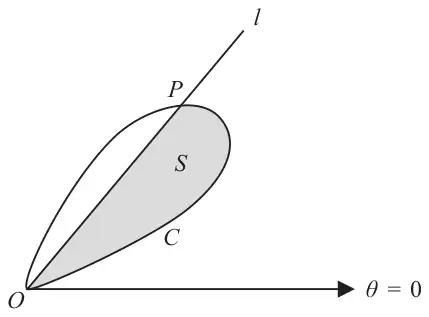
Figure 1 shows a curve \(C\) with polar equation \(r = a\sin 2\theta\), \(0 \leqslant \theta \leqslant \dfrac{\pi}{2}\), and a half-line \(l\).
The half-line \(l\) meets \(C\) at the pole \(O\) and at the point \(P\). The tangent to \(C\) at \(P\) is parallel to the initial line. The polar coordinates of \(P\) are \((R, \phi)\).
The region \(S\), shown shaded in Figure 1, is bounded by \(C\) and \(l\).
| Scheme | Marks |
|---|---|
| \((y =)\ r\sin\theta = a\sin 2\theta\sin\theta\) | M1 |
| \(\left(\dfrac{\mathrm{d}y}{\mathrm{d}\theta} =\right) a\left(2\cos 2\theta\sin\theta + \sin 2\theta\cos\theta\right)\) | M1depA1 |
| \(\left(\dfrac{\mathrm{d}y}{\mathrm{d}\theta} =\right) 2a\sin\theta\left(\cos 2\theta + \cos^2\theta\right)\) | M1 |
| At \(P\) \(\dfrac{\mathrm{d}y}{\mathrm{d}\theta} = 0 \Rightarrow \sin\theta = 0\) (n/a) or \(2\cos^2\theta - 1 + \cos^2\theta = 0\) \(3\cos^2\theta = 1\) | M1 \(\sin\theta = 0\) not needed |
| \(\cos\theta = \dfrac{1}{\sqrt{3}}\) * | A1cso |
| (6) |
Notes
M1 for obtaining the \(y\) coordinate \(y = r\sin\theta = a\sin 2\theta\sin\theta\)
M1dep for attempting the differentiation to obtain \(\dfrac{\mathrm{d}y}{\mathrm{d}\theta}\). Product rule and/or chain rule must be used; sin to become \(\pm\)cos (cos to become \(\pm\)sin). The 2 may be omitted. Dependent on the first M mark.
A1 for correct differentiation eg \(\dfrac{\mathrm{d}y}{\mathrm{d}\theta} = a\left(2\cos 2\theta\sin\theta + \sin 2\theta\cos\theta\right)\) oe
M1 for using \(\sin 2\theta = 2\sin\theta\cos\theta\) anywhere in their solution to (a)
M1 for setting \(\dfrac{\mathrm{d}y}{\mathrm{d}\theta} = 0\) and getting a quadratic factor with no \(\sin^2\theta\) included.
Alternative: Obtain a quadratic in \(\sin\theta\) or \(\tan\theta\) and complete to \(\cos\theta =\) later.
A1cso for \(\cos\theta = \dfrac{1}{\sqrt{3}}\) or \(\cos\phi = \dfrac{1}{\sqrt{3}}\) *
Question 8 (a) Variations you may see:
\(y = r\sin\theta = a\sin 2\theta\sin\theta\)
| \(y = a\sin 2\theta\sin\theta\) | \(y = 2a\sin^2\theta\cos\theta\) | \(y = 2a(\cos\theta - \cos^3\theta)\) |
| \(\mathrm{d}y/\mathrm{d}\theta = a(2\cos 2\theta\sin\theta + \sin 2\theta\cos\theta)\) \(= a(2\cos 2\theta\sin\theta + 2\sin\theta\cos^2\theta)\) \(= 2a\sin\theta(\cos 2\theta + \cos^2\theta)\) \(= 2a\sin\theta(3\cos^2\theta - 1)\) or \(= 2a\sin\theta(2\cos^2\theta - \sin^2\theta)\) or \(= 2a\sin\theta(2 - 3\sin^2\theta)\) | \(\mathrm{d}y/\mathrm{d}\theta = 2a(2\sin\theta\cos^2\theta - \sin^3\theta)\) \(= 2a\sin\theta(2\cos^2\theta - \sin^2\theta)\) | \(\mathrm{d}y/\mathrm{d}\theta = 2a(-\sin\theta + 3\sin\theta\cos^2\theta)\) \(= 2a\sin\theta(3\cos^2\theta - 1)\) |
At \(P\): \(\mathrm{d}y/\mathrm{d}\theta = 0 \Rightarrow \sin\theta = 0\) or:
| \(2\cos^2\theta - \sin^2\theta = 0\) | \(3\cos^2\theta - 1 = 0\) | \(2 - 3\sin^2\theta = 0\) |
| \(\tan^2\theta = 2\) | \(\cos^2\theta = 1/3\) | \(\sin^2\theta = 2/3\) |
| \(\tan\theta = \pm\sqrt{2} \Rightarrow \cos\theta = \pm\dfrac{1}{\sqrt{3}}\) | \(\cos\theta = \pm\dfrac{1}{\sqrt{3}}\) | \(\sin\theta = \pm\dfrac{\sqrt{2}}{\sqrt{3}} = \pm\dfrac{\sqrt{6}}{3} \Rightarrow \cos\theta = \pm\dfrac{1}{\sqrt{3}}\) |
| Scheme | Marks |
|---|---|
| \(r = a\sin 2\theta = 2a\sin\theta\cos\theta\) | |
| \(r = 2a\sqrt{\left(1 - \dfrac{1}{3}\right)}\sqrt{\dfrac{1}{3}} = 2a\dfrac{\sqrt{2}}{3}\) | M1A1 |
| (2) |
Notes
M1 for using \(\sin 2\theta = 2\sin\theta\cos\theta\), \(\cos^2\theta + \sin^2\theta = 1\) and \(\cos\phi = \dfrac{1}{\sqrt{3}}\) in \(r = a\sin 2\theta\) to obtain a numerical multiple of \(a\) for \(R\). Need not be simplified.
A1cao for \(R = 2a\dfrac{\sqrt{2}}{3}\)
Can be done on a calculator. Completely correct answer with no working scores 2/2; incorrect answer with no working scores 0/2
| Scheme | Marks |
|---|---|
| Area \(= \displaystyle\int_0^{\phi}\dfrac{1}{2}r^2\,\mathrm{d}\theta = \dfrac{1}{2}a^2\int_0^{\phi}\sin^2 2\theta\,\mathrm{d}\theta\) | M1 |
| \(= \dfrac{1}{2}a^2\displaystyle\int_0^{\phi}\dfrac{1}{2}(1 - \cos 4\theta)\,\mathrm{d}\theta\) | M1 |
| \(= \dfrac{1}{4}a^2\left[\theta - \dfrac{1}{4}\sin 4\theta\right]_0^{\phi}\) | M1A1 |
| \(= \dfrac{1}{4}a^2\left[\phi - \dfrac{1}{4}\left(4\sin\phi\cos\phi\left(2\cos^2\phi - 1\right)\right)\right]\) | M1dep on 2nd M mark |
| \(= \dfrac{1}{4}a^2\left[\arccos\left(\dfrac{1}{\sqrt{3}}\right) - \left(\sqrt{\dfrac{2}{3}} \times \sqrt{\dfrac{1}{3}} \times \left(\dfrac{2}{3} - 1\right)\right)\right]\) | M1 dep (all Ms) |
| \(\dfrac{1}{36}a^2\left[9\arccos\left(\dfrac{1}{\sqrt{3}}\right) + \sqrt{2}\right]\) * | A1 |
| (7) | |
| (15 marks) |
Notes
M1 for using the area formula \(\displaystyle\int_0^{\phi}\dfrac{1}{2}r^2\,\mathrm{d}\theta = \dfrac{1}{2}a^2\int_0^{\phi}\sin^2 2\theta\,\mathrm{d}\theta\). Limits not needed
M1 for preparing \(\displaystyle\int\sin^2 2\theta\,\mathrm{d}\theta\) for integration by using \(\cos 2x = 1 - 2\sin^2 x\)
M1 for attempting the integration: \(\cos 4\theta\) to become \(\pm\sin 4\theta\) – the \(\dfrac{1}{4}\) may be missing but inclusion of 4 implies differentiation – and the constant to become \(k\theta\). Limits not needed.
A1 for \(= \dfrac{1}{4}a^2\left[\theta - \dfrac{1}{4}\sin 4\theta\right]\) Limits not needed
M1dep for changing their integrated function to an expression in \(\sin\theta\) and \(\cos\theta\) and substituting limits 0 and \(\phi\). Dependent on the second M mark of (c)
M1dep for a numerical multiple of \(a^2\) for the area. Dependent on all previous M marks of (c)
A1cso for \(\dfrac{1}{36}a^2\left[9\arccos\left(\dfrac{1}{\sqrt{3}}\right) + \sqrt{2}\right]\) *
This is a given answer, so check carefully that it can be obtained from the previous step in their working.
Also: The final 3 marks can only be awarded if the working is shown ie \(\sin 4\theta\) cannot be obtained by calculator.